:sales@zsjhsteelgroup.com WhatsApp:+86-15122582058





| Quantity: | |
|---|---|


ZSJH
Large-Diameter Spiral Welded Pipe for Water Transmission, Piling and Infrastructure
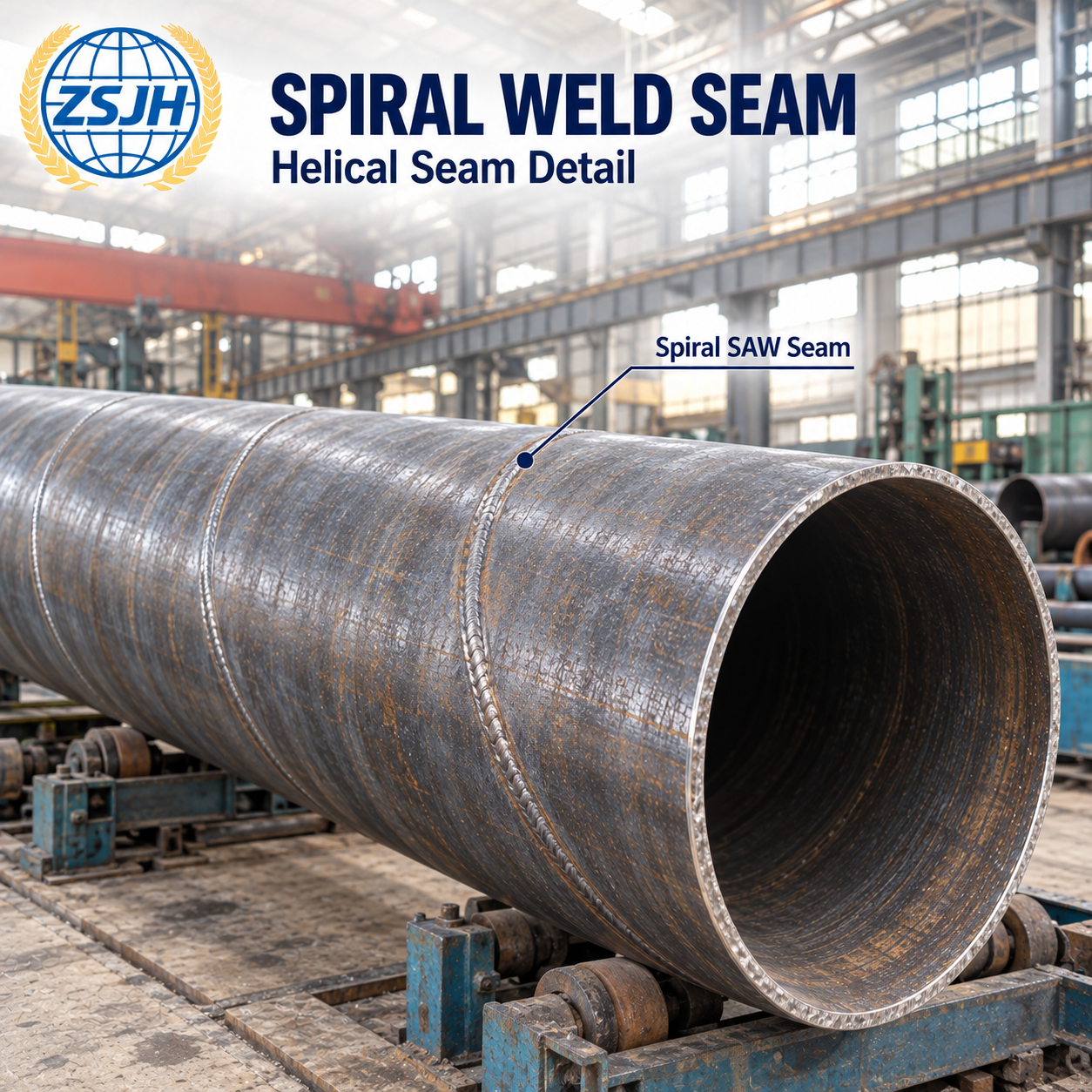
SSAW Steel Pipe, also known as Spiral Welded Steel Pipe or SAWH pipe, is manufactured by forming steel strip into a cylindrical section at a controlled angle and joining the edges through submerged arc welding. The resulting weld follows a continuous helical path around the pipe body.
This manufacturing route provides flexibility in producing large-diameter pipes for water transmission, steel pipe piles and engineering structures. Oil and gas pipeline applications require compliance with the specified line-pipe standard, manufacturing qualification and project requirements.
A typical production sequence includes coil preparation, strip leveling, edge preparation, spiral forming, internal and external submerged arc welding, cutting, inspection and pipe-end finishing. The exact sequence and inspection stages depend on the production line and applicable specification.
Key features include:
Spiral weld configuration: A continuous helical seam joins the formed strip edges.
Flexible diameter production: Adjusting the forming angle allows different pipe diameters to be produced from a given strip width, within manufacturing limits.
Large-diameter options: Suitable for projects requiring large bores or substantial tubular sections.
Project-specific finishing: Pipe length, end preparation, protective coatings and inspection can be specified for the intended application.
Traceable supply: Material identification and inspection records can be defined in the purchase specification.
The spiral manufacturing process alone does not determine pressure rating, load capacity or service life. These depend on material properties, dimensions, weld integrity, corrosion protection and engineering design.
The helical weld is a defining feature of SSAW pipe. Strip-edge alignment, welding parameters, consumables and weld profile must be controlled to meet the selected specification.
Relevant quality requirements may include:
Internal and external weld appearance
Weld reinforcement and edge alignment
Examination of the spiral seam
Inspection of strip-end welds and their intersections with the spiral seam, where present
Pipe-end weld condition and any required local dressing
Ultrasonic testing, radiographic testing and other examinations are performed as required by the governing standard and agreed inspection plan. Test coverage, acceptance criteria and documentation should be confirmed before production.
A visible, consistent weld profile does not replace weld integrity testing.
SSAW manufacturing is commonly selected for large-diameter projects. Available dimensions must be assessed as a combination of diameter, wall thickness, steel grade and length.
| Parameter | Details to Confirm |
|---|---|
| Outside diameter | Required diameter and permitted variation |
| Wall thickness | Nominal thickness, tolerance and any minimum-wall requirement |
| Length | Fixed or random length and cutting tolerance |
| Pipe geometry | Ovality, straightness and end squareness |
| Steel grade | Material specification, strength and toughness requirements |
| Weld profile | Permitted reinforcement and any end-area dressing |
| Pipe ends | Plain or beveled ends and connection requirements |
Maximum diameter and maximum wall thickness should not be assumed to be available together. Submit the complete specification for a production feasibility review.
Corrosion protection should be selected according to the conveyed medium, soil conditions, exposure, installation method and required service life.
Subject to project requirements and confirmed availability, options may include:
External epoxy coating
Three-layer polyethylene coating (3LPE)
Three-layer polypropylene coating (3LPP)
Internal liquid epoxy lining
Cement mortar lining for suitable water applications
Temporary protection for transport and storage
The coating specification should define surface preparation, material system, thickness, adhesion and other required tests. Uncoated end lengths and field-joint protection should also be coordinated with the installation method.
For drinking-water projects, all water-contact materials must meet the applicable approval requirements. Temporary protective oil is not a substitute for a permanent corrosion protection system.
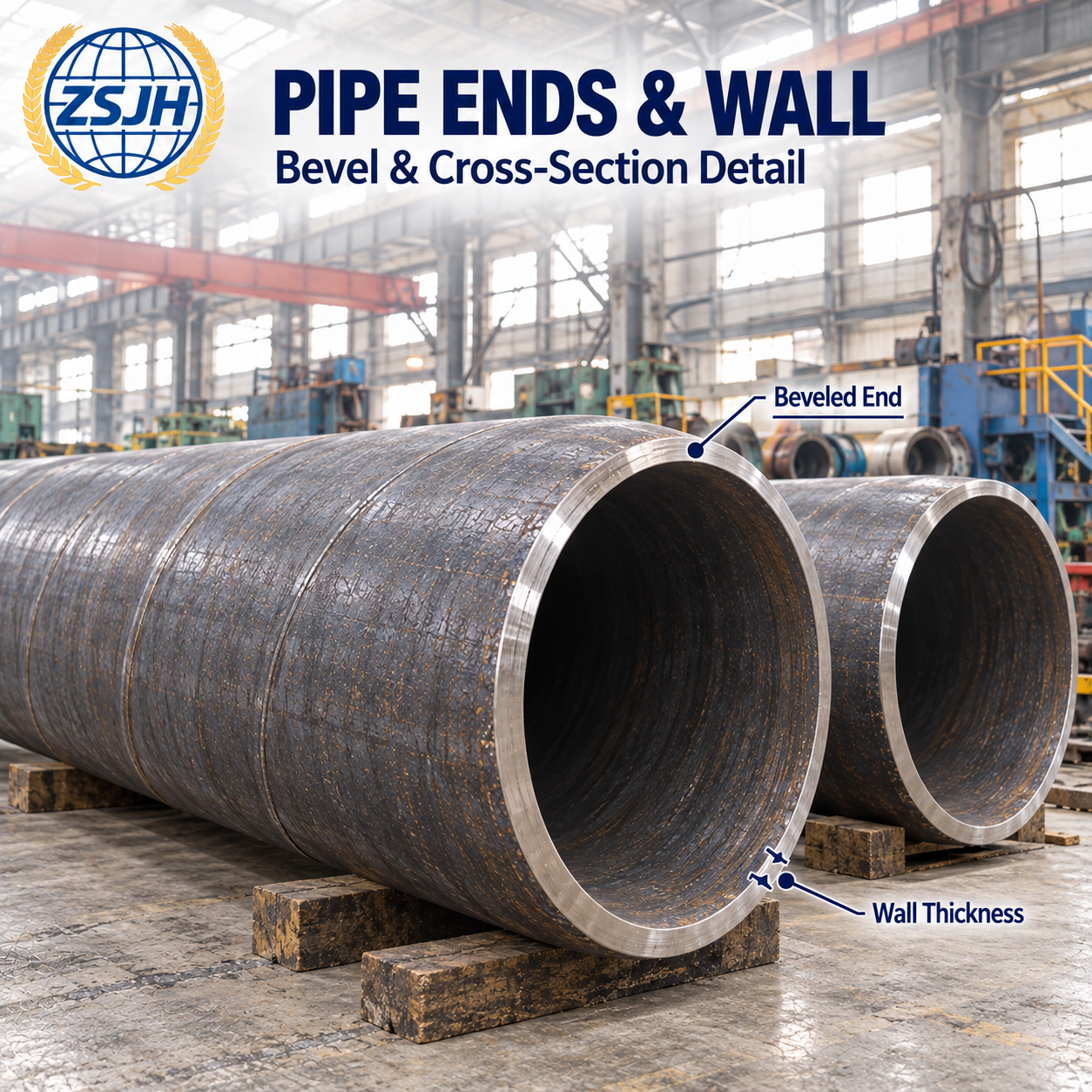
Pipe ends can be prepared to suit the project’s fabrication and installation requirements.
Plain Ends
Square-cut ends for specified fabrication or compatible connection systems.
Beveled Ends
Prepared for butt welding, with bevel angle, root face and dimensional tolerances defined in the order.
Project-Specific Connections
Flanges, collars or other connection arrangements may be reviewed against approved drawings and manufacturing capability.
End roundness, squareness and bevel consistency affect field fit-up. For coated pipe, end protection and coating cutback should be agreed before shipment.
Water Transmission Pipelines
For bulk water supply, irrigation networks, pumping systems and other water infrastructure. Pressure design, lining, coating and connections must suit the operating conditions.
Steel Pipe Piles
For foundations, marine works and civil engineering projects where the pipe is specified and designed for piling service. Selection depends on axial and lateral loads, driving conditions, connections and corrosion allowance.
Engineering Structures
For tubular supports, structural members and other engineered assemblies, subject to the appropriate material specification and structural design.
Oil & Gas Pipelines
For projects that permit spiral submerged arc welded pipe and require the relevant manufacturing qualifications, material properties, weld examination and testing. Suitability must be established against the project specification.
Common specification references may include API 5L for qualified line-pipe applications, ASTM A252/A252M for steel pipe piles, and AWWA C200 for applicable steel water pipe projects. These standards address different applications and are not interchangeable.
The inspection plan may include:
Chemical composition and mechanical property verification
Visual and dimensional inspection
Weld-seam nondestructive testing
Hydrostatic testing for applicable fluid-service orders
Coating and lining inspection
Marking and traceability verification
Final packing and document review
Hydrostatic testing is not automatically a requirement for every structural or piling order. Where required, test pressure, holding time and acceptance criteria follow the applicable specification. Test pressure should not be treated as the allowable operating pressure.
Large-diameter pipe delivery requires coordination between production, finishing, inspection and transport.
Important planning items include:
Production batches aligned with the installation schedule
Pipe identification linked to inspection records
Coating and lining completion before dispatch
Pipe-end and finished-surface protection
Suitable supports, chocks and transport restraints
Loading plans based on pipe dimensions, weight and route limitations
Shipment documents consistent with the purchase order
Transport arrangements should be reviewed early, particularly for oversized diameters or long pipe lengths.
ZSJHSTEEL helps overseas buyers coordinate SSAW pipe sourcing around the complete project specification.
We work with your diameter, wall thickness, steel grade, application, weld inspection, corrosion protection and delivery requirements to develop a suitable supply proposal. Early confirmation of these details supports comparable quotations, clearer documentation and more efficient site receiving.
What is the difference between SSAW and LSAW pipe?
SSAW pipe is typically formed from steel strip with a helical weld. LSAW pipe is typically formed from steel plate with a longitudinal weld. Selection depends on the project specification and qualified manufacturing capability.
Can SSAW pipe be used for pressure pipelines?
Yes, when the selected pipe is manufactured, tested and designed for the specified pressure service. Diameter and wall thickness alone do not establish suitability.
Can one pipe specification cover both water transmission and piling?
The requirements differ. Water pipelines emphasize pressure integrity, connections and lining, while piling orders focus on structural properties, geometry and installation loads. Any combined requirements must be explicitly specified.
Can the pipe be supplied coated and lined?
Coating and lining options can be reviewed during quotation. Provide the required system, thickness, inspection criteria and any approval requirements.
What information is needed to confirm the available diameter range?
Provide the diameter together with wall thickness, steel grade, length, quantity and applicable standard. These parameters determine production feasibility.
Please send:
Intended application and destination country
Product standard, edition and steel grade
Outside diameter, wall thickness, length and quantity
Required dimensional tolerances
Weld inspection and hydrostatic testing requirements
Pipe-end preparation and connection details
External coating and internal lining specifications
Required certificates and third-party inspection scope
Destination port and delivery schedule
Contact ZSJHSTEEL to discuss Spiral Welded Steel Pipe specifications, corrosion protection and project delivery requirements.


