:sales@zsjhsteelgroup.com WhatsApp:+86-15122582058






| Quantity: | |
|---|---|


ZSJH
High-temperature seamless alloy steel pipe is used in power plants, refineries and process installations where material selection must account for elevated-temperature strength, long-term service and fabrication requirements.
ZSJHSTEEL supports procurement to agreed specifications, with alloy grade, dimensions, heat-treatment condition, inspection and traceable material documents confirmed before supply.
| Parameter | Ordering Requirement |
|---|---|
| Product | Seamless ferritic alloy steel pipe |
| Standard | ASTM A335/A335M or another specified standard |
| Alloy Grade | P11, P22, P91 or another agreed grade, subject to confirmation |
| Dimensions | Outside diameter × wall thickness × length |
| Wall Designation | Thickness in mm or applicable Schedule |
| Heat Treatment | Grade-specific condition required by the standard and order |
| Ends | Plain or beveled, with agreed preparation details |
| Impact Testing | Test temperature, specimen requirements and acceptance criteria where required |
| Inspection | Dimensions, material properties and specified examinations |
| Documents | Material certificate and agreed test reports |
P11, P22 and P91 are examples of high-temperature alloy pipe grades. They have different composition, heat-treatment and fabrication requirements and should not be treated as interchangeable.
Select the material according to:
Design pressure and temperature.
Applicable allowable stresses and creep considerations.
Conveyed medium and corrosion conditions.
Welding, heat treatment and inspection requirements.
Required toughness at the minimum design temperature.
ASTM A335/A335M covers seamless ferritic alloy steel pipe for high-temperature service. Grade selection depends on the design, service conditions and required material properties.
Impact toughness describes resistance to fracture under specified test conditions. It is different from tensile strength, hardness and high-temperature creep performance.
Where Charpy V-notch impact testing is required, the order should define:
| Requirement | Details to Specify |
|---|---|
| Test Temperature | Required temperature in °C |
| Specimen | Full-size or permitted subsize specimen |
| Orientation | Required specimen direction |
| Sampling | Heat, heat-treatment lot or other specified test unit |
| Acceptance | Required average and individual absorbed-energy values |
| Reporting | Individual results, specimen dimensions and test temperature |
An impact-test temperature is not automatically the pipe’s minimum allowable operating temperature. Suitability must be assessed under the applicable design code, including material, thickness and service conditions.
Do not assume one fixed impact temperature or energy requirement applies to every P11, P22 or P91 order. Confirm whether testing is required and identify the governing acceptance criteria.
Correct heat treatment is essential to obtaining the specified material properties. The treatment must match the grade, manufacturing route and applicable standard.
Confirm the required delivery condition and any additional records, including:
Heat-treatment method.
Heat or lot identification.
Required mechanical and hardness results.
Furnace records where contractually required.
Requirements following further processing or repair.
For Grade P91, fabrication and welding controls deserve particular attention. Welding procedures and post-weld heat-treatment requirements must be established for the actual application.
Mill heat treatment and post-weld heat treatment serve different purposes. One does not automatically replace the other.
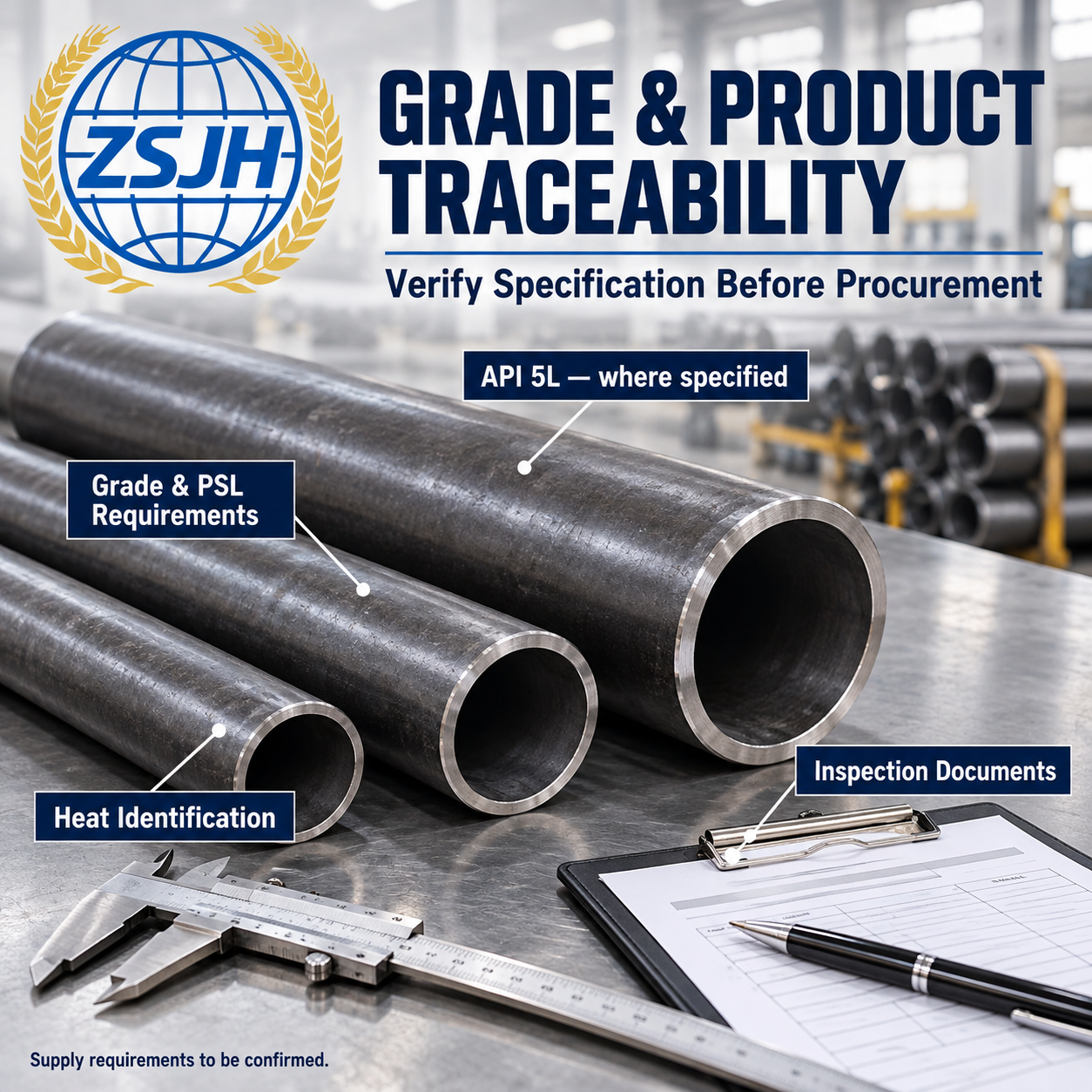
Alloy grades cannot be reliably identified by appearance alone. Verification should combine product identification, material documents and the specified examination methods.
| Check / Test | Purpose |
|---|---|
| Chemical Analysis | Verify composition against the specified grade |
| Positive Material Identification — PMI | Support alloy identification using a suitable method |
| Tensile Testing | Verify required strength and elongation |
| Hardness Testing | Check specified hardness requirements |
| Impact Testing | Verify notch toughness where required |
| Dimensional Inspection | Check OD, wall thickness, length and end condition |
| Hydrostatic / Nondestructive Testing | Meet the applicable standard and inspection plan |
PMI does not replace heat-treatment records or mechanical testing. A chemistry match alone does not establish the complete delivery condition.
Inspection methods, coverage and acceptance criteria should be agreed before production.
Material documentation should correspond to the delivered pipes and show the results required by the order.
Typical information includes:
Manufacturer, standard and alloy grade.
Pipe dimensions and heat identification.
Chemical composition.
Required tensile and hardness results.
Heat-treatment condition.
Impact-test temperature, specimen details and results, where required.
Required hydrostatic or nondestructive examination records.
Specify the certificate type, supplementary reports and any third-party inspection at inquiry stage. Identification should remain traceable through cutting, packing and delivery.
Illustrative ordering description:
Seamless Alloy Steel Pipe — ASTM A335/A335M P22 — OD × Wall Thickness × Length as Specified — Heat Treatment to Standard — Beveled Ends — Impact Testing at Project-Specified Temperature and Acceptance Criteria — Material Certificate Required
This example describes procurement requirements, not confirmed stock or operating limits.
Typical applications include power-plant steam piping, refinery installations and high-temperature process pipework.
Selection must consider the complete piping design, including allowable stress, creep, thermal expansion, supports, connections and welding requirements. There is no universal pressure or temperature rating for this product category.
Can P11, P22 and P91 be substituted?
Only after technical review and approval. Their material and fabrication requirements differ.
Does passing an impact test prove high-temperature suitability?
No. Impact testing addresses toughness under defined conditions. High-temperature strength and creep must be assessed separately.
Is impact testing included with every order?
The applicable standard and project specification determine the requirement. State the temperature, sampling and acceptance criteria explicitly.
Can PMI confirm correct heat treatment?
No. PMI supports composition verification. Heat-treatment and property verification require appropriate records and tests.
Can these pipes be welded?
Yes, using qualified procedures appropriate to the grade and project, including required preheat, post-weld heat treatment and examination.
ZSJHSTEEL helps overseas buyers define alloy-pipe requirements before ordering, covering grade, dimensions, heat treatment, material verification and documentation.
We support coordinated sourcing, with inspection scope, traceability, packing and delivery arrangements agreed during quotation to meet the project’s procurement needs.
Send ZSJHSTEEL your:
Required standard, edition and alloy grade.
Outside diameter, wall thickness or Schedule, length and quantity.
Design pressure, maximum and minimum design temperatures.
Heat-treatment and end-preparation requirements.
Impact-test temperature and acceptance criteria, where required.
PMI, examination and material-certificate requirements.
Delivery destination and target schedule.
Contact ZSJHSTEEL for high-temperature seamless alloy steel pipe matched to your project specification.


