:sales@zsjhsteelgroup.com WhatsApp:+86-15122582058





| Quantity: | |
|---|---|


ZSJH
Longitudinal Welded Carbon Steel Pipe for Structural, Mechanical and Fluid Service
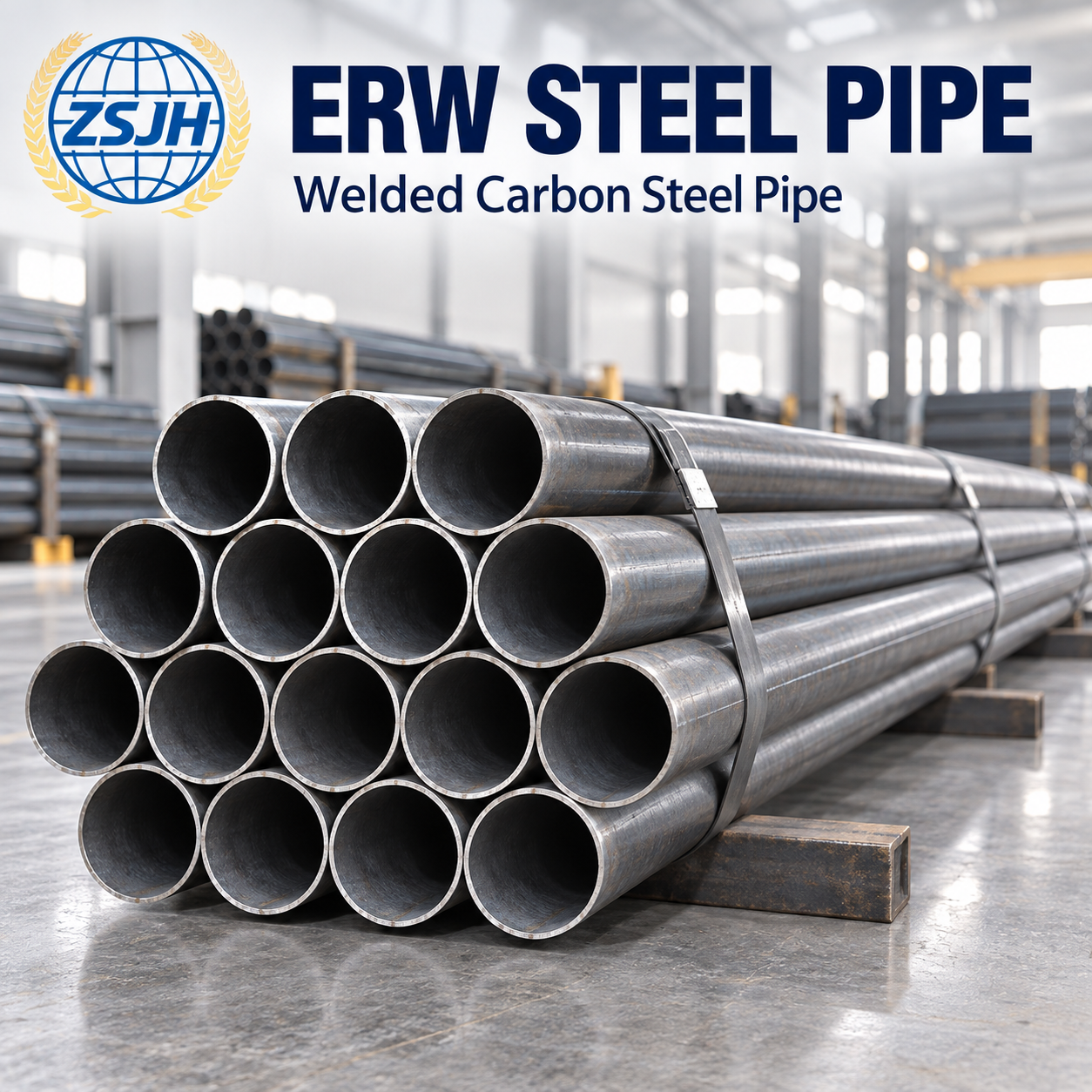
ERW Steel Pipe is produced by continuously forming steel strip from coils into a circular section and welding the longitudinal edges together. Modern production commonly uses high-frequency electric resistance welding, with heat concentrated at the strip edges before they are pressed together to form the weld.
The continuous forming process supports efficient production and consistent dimensions. Available applications depend on the specified material grade, manufacturing standard, inspection requirements and delivery condition.
A typical production sequence includes coil preparation, strip forming, high-frequency welding, weld bead removal, sizing, straightening and cutting. Weld-zone heat treatment and additional finishing are performed where required by the applicable specification.
Key product features include:
Longitudinal straight seam: A continuous weld running along the pipe length.
Controlled external weld profile: External weld flash is typically removed by scarfing to provide a smoother profile.
Consistent dimensional control: Forming and sizing operations control outside diameter, ovality and other specified dimensions.
Flexible finishing options: Pipe length, end preparation and surface protection can be selected for the intended application.
Efficient volume production: Continuous manufacturing suits repeat orders and projects requiring consistent specifications.
Internal weld bead condition should be confirmed before ordering, particularly for applications involving internal components, machining or specific flow requirements.
Weld quality is a key consideration when selecting ERW carbon steel pipe. Strip edge preparation, welding heat input, squeeze pressure and weld-zone treatment must be controlled to meet the specified requirements.
Depending on the standard and purchase order, verification may include weld inspection, nondestructive examination and mechanical testing. External seam appearance alone does not establish weld integrity; inspection scope and acceptance criteria should be agreed before production.
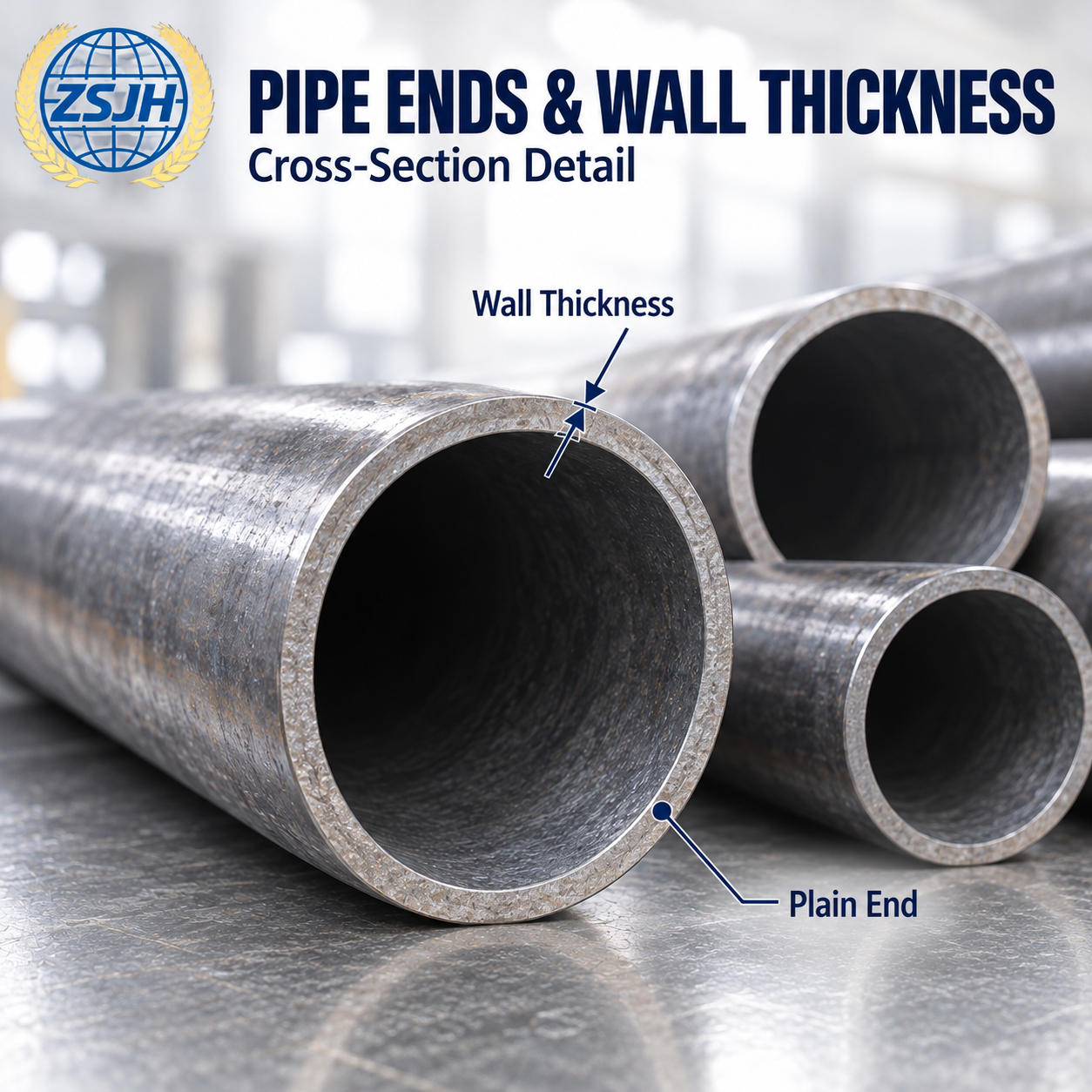
Outside diameter and wall thickness affect fit-up, connection compatibility, structural performance and pressure design. Relevant dimensional requirements may include:
Outside diameter and permitted variation
Nominal wall thickness and allowable deviation
Ovality and straightness
Overall length and cutting tolerance
Pipe-end squareness and weld bead condition
Tolerance limits follow the selected product standard and order requirements. Nominal wall thickness should not be treated as a guaranteed minimum wall thickness unless this is explicitly specified. Where tighter tolerances are needed, feasibility should be confirmed during quotation.
End preparation should match the intended connection and installation method.
| End Option | Typical Requirement |
|---|---|
| Plain ends | Square-cut ends for fabrication or compatible mechanical connections |
| Beveled ends | Prepared for butt welding, with bevel geometry specified in the order |
| Threaded ends | Thread form, dimensions and coupling requirements confirmed before production |
| Grooved ends | Groove profile and dimensional compatibility confirmed for the selected coupling system |
Deburring, end protection and any special machining requirements should also be included in the purchase specification.
Inspection requirements vary with the intended service and governing standard. The agreed inspection plan may include:
Visual and dimensional inspection
Chemical composition verification
Tensile and other required mechanical tests
Flattening, bending or other fabrication-related tests
Weld-seam nondestructive testing
Hydrostatic testing where required
Verification of marking, traceability and packaging
Test methods, inspection frequency and acceptance criteria should be specified in advance. Material certificates and additional inspection documents can be requested for confirmation during quotation.
Fluid Transportation
For water, air and other compatible fluids where the pipe grade, pressure design, corrosion protection and connection system meet the service requirements. Oil and gas service requires the appropriate line-pipe specification and project qualification.
Building & Structural Applications
For columns, bracing, supports and fabricated steel assemblies when supplied to an appropriate structural specification and selected through engineering design.
Mechanical Applications
For equipment frames, tubular components and general fabrication. Applications requiring close dimensional control, forming or machining may need a dedicated mechanical tubing specification.
General Industrial Use
For plant fabrication, support systems and other industrial installations, subject to operating conditions and the applicable design requirements.
ERW describes the manufacturing process; it does not define a single performance level or application.
Common specification references include ASTM A53/A53M Type E for relevant pipe applications, ASTM A500/A500M for structural tubing, ASTM A513/A513M for mechanical tubing, and API 5L for qualified line-pipe applications.
These specifications are not interchangeable. The required standard, edition, grade and supplementary requirements must be confirmed, together with availability for the requested dimensions.
The order should identify both the metallurgical delivery condition and the surface finish. As-welded or heat-treated supply must follow the selected specification; surface options may include bare steel, temporary protective oil or an agreed coating system.
Temporary oil protection is intended for handling and storage and should not be treated as a permanent corrosion protection system. Export packing requirements may include strapped bundles, timber supports, end protectors and identification tags, as agreed for shipment.
ZSJHSTEEL helps buyers define ERW steel pipe requirements around their actual project needs. We work with your specified dimensions, material grade, application and delivery requirements to coordinate suitable sourcing, inspection documentation and export packing.
For repeat procurement and project orders, confirming these details early helps reduce specification mismatches and simplifies receiving inspection.
Is ERW steel pipe suitable for pressure service?
It can be, when manufactured, tested and selected to the appropriate specification. Suitability depends on the fluid, design pressure, temperature, grade and applicable piping code.
Is the internal weld bead removed?
This varies by product and manufacturing capability. Specify internal bead removal or a maximum permitted bead height if it affects your application.
Can tighter dimensional tolerances be requested?
Yes. Provide the required tolerances for review. Availability depends on dimensions, material, processing route and inspection requirements.
Can ERW pipe be supplied with corrosion protection?
Surface protection can be discussed according to the application. The coating system, surface preparation and inspection requirements should be agreed before ordering.
Send ZSJHSTEEL the following details for a project-specific quotation:
Product standard, edition and material grade
Outside diameter, wall thickness and required tolerances
Length and quantity
Intended application and operating conditions
Pipe-end preparation and internal weld bead requirements
Delivery condition and surface protection
Testing, certification and packing requirements
Destination port and delivery schedule
Contact us to discuss ERW Steel Pipe specifications, finishing options and export supply requirements.


