:sales@zsjhsteelgroup.com WhatsApp:+86-15122582058





| Quantity: | |
|---|---|


ZSJH
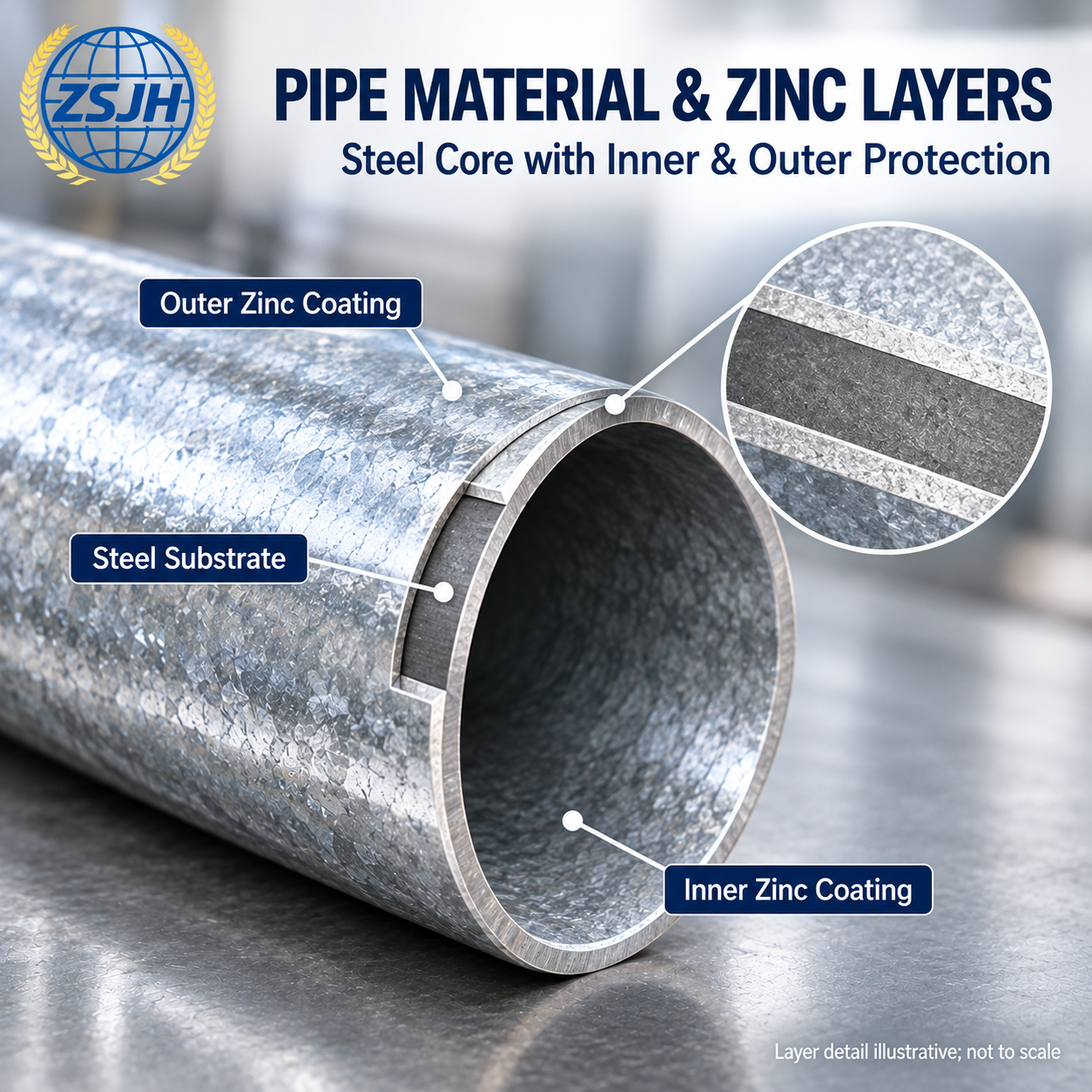
Hot-dip galvanized steel pipe combines the strength of carbon steel with a protective zinc coating on both inner and outer surfaces. Galvanizing the pipe after manufacture helps protect the exterior, internal bore and weld area against corrosion, making it a practical choice for outdoor construction, agricultural frameworks and industrial installations.
For reliable performance, buyers should specify more than pipe dimensions: coating requirements, connection details and the actual service environment are equally important.
| Parameter | Specification / Ordering Requirement |
|---|---|
| Product | Round hot-dip galvanized carbon steel pipe |
| Manufacturing Method | Welded or seamless, as specified and confirmed |
| Outside Diameter | Specify actual OD in mm or the applicable DN/NPS designation |
| Wall Thickness | Specify thickness in mm, schedule or the relevant thickness series |
| Length | Fixed or cut lengths, subject to order confirmation |
| Steel Grade | Selected according to the pipe standard and intended application |
| Zinc Coating | Internal and external hot-dip galvanized coating |
| Coating Requirement | Specify the applicable coating standard/class and acceptance criteria |
| Pipe Ends | Plain, threaded or grooved, subject to dimensional and processing suitability |
| Inspection | Dimensions, surface condition and coating verification; additional tests as required |
| Documentation | Material and inspection documents to be agreed before ordering |
Ordering format: Outside Diameter × Wall Thickness × Length, followed by steel grade, pipe standard and coating requirements.
The outer zinc coating protects surfaces exposed to weather and handling. The inner coating protects the pipe bore, where inspection and maintenance can be more difficult.
Hot-dip galvanizing forms a metallurgically bonded coating with zinc–iron alloy layers. Zinc provides a barrier against exposure and sacrificial protection to nearby steel at small damaged areas. Cut ends, machined threads, grooves and weld repairs still require attention because processing after galvanizing can expose the steel.
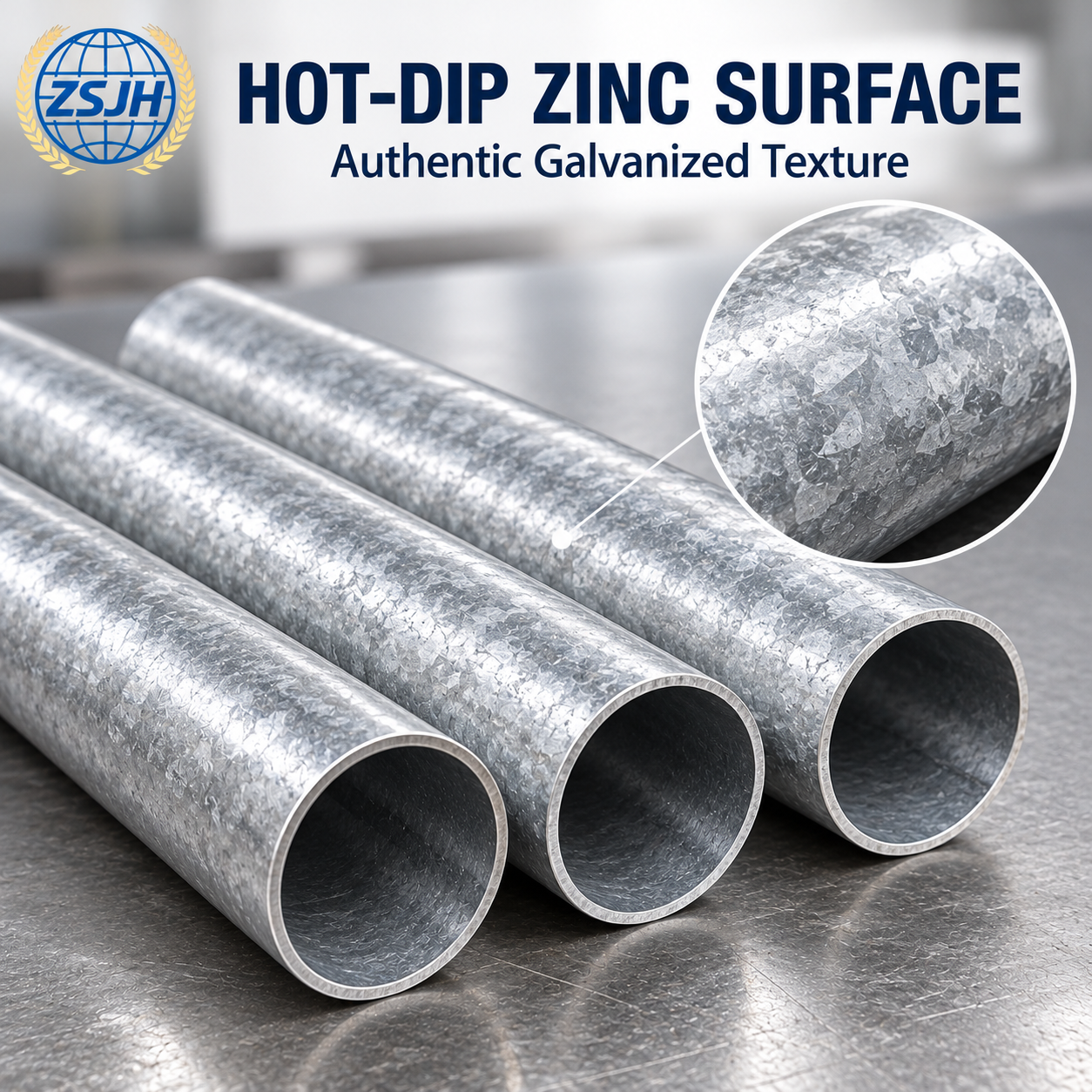
A bright, mottled or matte-grey appearance can occur. Surface appearance alone does not establish coating thickness or corrosion performance.
Coating thickness should be specified according to the applicable standard, galvanizing process and service conditions. There is no single universal thickness requirement for every galvanized pipe.
For a clear purchase specification, define:
Whether the requirement applies to the inner surface, outer surface or both.
Whether acceptance is based on coating thickness in µm or coating mass in g/m².
The required local minimum and average values, where applicable.
The sampling locations, test method and inspection documentation.
Coating mass and thickness are related, but they should not be treated as interchangeable acceptance criteria without checking the standard’s measurement basis.
For comparable coatings in the same environment, a greater zinc thickness generally provides a longer protective period. Actual service life also depends on humidity, salt exposure, industrial pollutants, water chemistry, abrasion and installation details. A fixed service-life claim should therefore be supported by project-specific conditions.
The pipe standard defines requirements such as material, dimensions and testing. The coating standard defines galvanizing requirements. Both should be identified in the order.
| Standard | Relevance |
|---|---|
| ASTM A53/A53M | Covers black and hot-dip zinc-coated welded and seamless steel pipe. Specify the required type, grade, dimensions and galvanized finish. |
| EN 10255 | Covers non-alloy steel tubes suitable for welding and threading. Specify the required dimensional series and delivery condition. |
| EN 10240 | Specifies internal and/or external hot-dip galvanized coatings applied to steel tubes in automatic plants. State the required coating quality. |
| ISO 1461 | Applies to hot-dip galvanized fabricated iron and steel articles within its scope. It excludes tubes and pipes galvanized in automatic plants, so its applicability must be checked. |
Compliance is order-specific. These standards should not be presented as interchangeable or assumed to apply simultaneously.
Pipe markings or bundle tags may identify the manufacturer, applicable standard, steel grade, size and heat or batch number, as required by the order and standard.
Illustrative purchase specification:
Hot-Dip Galvanized Steel Pipe — ASTM A53/A53M, Type E, Grade B — OD 60.3 mm × WT 3.91 mm × Length 6,000 mm — Plain Ends — Internal & External Galvanizing
This example illustrates how to describe a product; it does not confirm stock availability or certification. DN and NPS are nominal designations and should not be read as the actual outside diameter.
Construction: Fencing, handrails, posts and general support frameworks.
Agriculture: Greenhouse frames, crop-support systems and farm installations.
Industrial Facilities: Protective barriers, equipment-support frameworks and suitable utility installations.
Fluid Conveyance: Only where the pipe, joints, pressure rating and applicable approvals meet the system requirements.
For coastal, chemically aggressive, buried or continuously immersed service, assess the exposure before selecting the coating. Additional protection may be required. Internal galvanizing alone does not establish suitability for drinking water, corrosive fluids or every operating temperature.
Is this the same as pre-galvanized pipe?
No. Pre-galvanized pipe is typically formed from previously coated strip. Hot-dip galvanizing after pipe manufacture coats the completed pipe, including its internal surface and weld area. Specify the required manufacturing route when ordering.
Can I request a particular zinc coating thickness?
Yes—include the required standard or coating class, thickness or mass criteria, and inspection method in your inquiry. Feasibility and acceptance requirements must be confirmed before production.
Does a shinier surface mean better corrosion resistance?
No. Gloss and zinc-pattern appearance are not reliable measures of coating thickness or service life. Use inspection results and the agreed specification.
Can galvanized pipe be used outdoors or near the sea?
It is widely used outdoors. Coastal salt exposure is more demanding, so coating selection and any additional protection should be assessed for the location.
What causes white deposits during storage?
White or grey deposits can develop when moisture is trapped between tightly bundled galvanized products with poor ventilation. Keep bundles dry, raised off the ground and arranged for drainage and airflow. Significant deposits should be assessed for coating loss.
Can the pipe be cut, threaded or welded?
Yes, where suitable for the product and application. Processing can damage or remove the coating, so exposed areas need an appropriate repair procedure. Welding requires proper fume controls and qualified working practices.
ZSJHSTEEL helps overseas buyers define a complete procurement specification—from pipe dimensions and steel grade to galvanizing requirements, end connections and delivery needs.
Our focus is on clear technical communication and coordinated sourcing, helping customers resolve specification questions before placing an order. Required inspection documents, packing arrangements and shipment details can be agreed during quotation.
Send us your:
Outside diameter, wall thickness and length.
Steel grade, pipe standard and zinc coating requirements.
End finish and connection details.
Quantity and intended application.
Service environment, including coastal or chemical exposure.
Required documents, destination port and delivery schedule.
Contact ZSJHSTEEL for a quotation matched to your project’s dimensions, corrosion-protection requirements and delivery needs.


