:sales@zsjhsteelgroup.com WhatsApp:+86-15122582058







| Quantity: | |
|---|---|


ZSJH
Structural steel pipes can be manufactured or supplied according to ASTM, EN, GB/T and other specified standards. The applicable standard, steel grade and inspection requirements are confirmed before production.
High-strength steel grades and suitable wall thicknesses provide reliable resistance to compression, bending and torsional loads in demanding structural applications.
Controlled forming, sizing and straightening processes help maintain the required outside diameter, roundness, wall thickness and straightness.
Available material options may include ASTM A500 grades, S355J2H, S355J0H, S355JR, Q355B and other equivalent structural steel grades.
Depending on pipe diameter, wall thickness, order quantity and technical requirements, products can be supplied as ERW, longitudinal submerged-arc-welded, spiral submerged-arc-welded or hot-finished hollow sections.
Thick-wall and large-diameter structural pipes can be supplied for columns, bridge components, offshore-supporting structures, long-span trusses and heavy industrial frameworks.
Pipes can be delivered with fixed-length cutting, beveling, drilling, profiling, bending, flange installation, base plates, stiffeners and welded connection components.
Available surface treatments include shot blasting, shop primer, finish painting, hot-dip galvanizing and customized anticorrosion coating systems.
Engineering-grade structural steel pipes are widely used in:
Industrial plants and manufacturing facilities
Steel structure warehouses
Multi-storey commercial buildings
Airport terminals and railway stations
Exhibition centers and sports facilities
Long-span roofing systems
Pipe trusses and space-frame structures
Structural columns and load-bearing supports
Bridges and pedestrian overpasses
Equipment platforms and access systems
Transmission and communication towers
Solar mounting structures
Marine and coastal engineering
Piling and foundation systems when the appropriate pipe standard is specified
Custom architectural steel structures
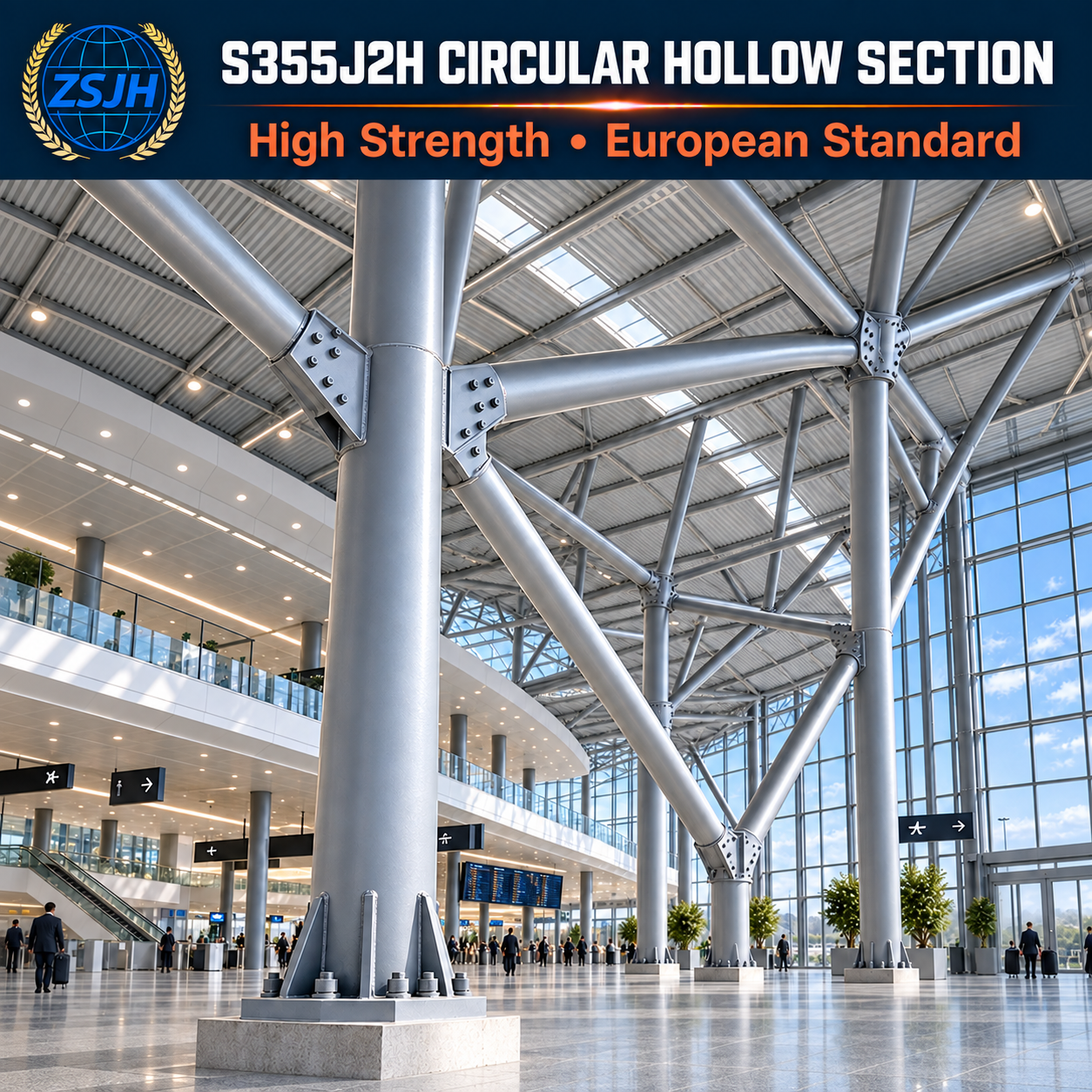
Circular hollow sections can be used for structural columns, roof supports, canopies, entrance structures, exposed architectural members and secondary supporting frames.
Thick-wall structural steel tubes are suitable for equipment platforms, pipe racks, heavy machinery supports and industrial production facilities.
Large-diameter and high-strength structural pipes can be used in transport terminals, bridge components, public facilities and heavy-load support systems.
Circular hollow sections provide efficient structural performance in pipe trusses, spatial frames, stadium roofs and exhibition halls.
The clean circular profile makes structural steel pipe suitable for visible columns and roof structures where both strength and appearance are important.
Pipes can be processed into project-specific components according to engineering drawings, connection details and erection requirements.
The following specifications are general references. Final dimensions and technical requirements should be determined by the selected manufacturing standard and approved project documents.
| Specification | Available Options |
|---|---|
| Product form | Round structural steel pipe and circular hollow section |
| Manufacturing method | ERW, LSAW, SSAW or hot-finished |
| Outside diameter | Customized according to project requirements |
| Wall thickness | Standard, medium-wall or heavy-wall |
| Length | Standard mill length or customized fixed length |
| Steel grades | ASTM A500 grades, S235, S275, S355, S355J2H, Q235B, Q355B or equivalent |
| End preparation | Plain, square-cut, beveled, flanged or fabricated |
| Section tolerance | According to the selected product standard |
| Surface condition | Black steel, shot-blasted, primed, painted or galvanized |
| Fabrication | Cutting, beveling, drilling, bending, profiling and welding |
| Connection details | Flanges, base plates, stiffeners, gusset plates and branch connections |
| Inspection | Dimensional, visual, weld, coating and specified nondestructive testing |
| Documentation | Material certificates and inspection records as contractually required |
| Packaging | Bundled, supported, framed or customized export packaging |
| Standard | General Product Category |
|---|---|
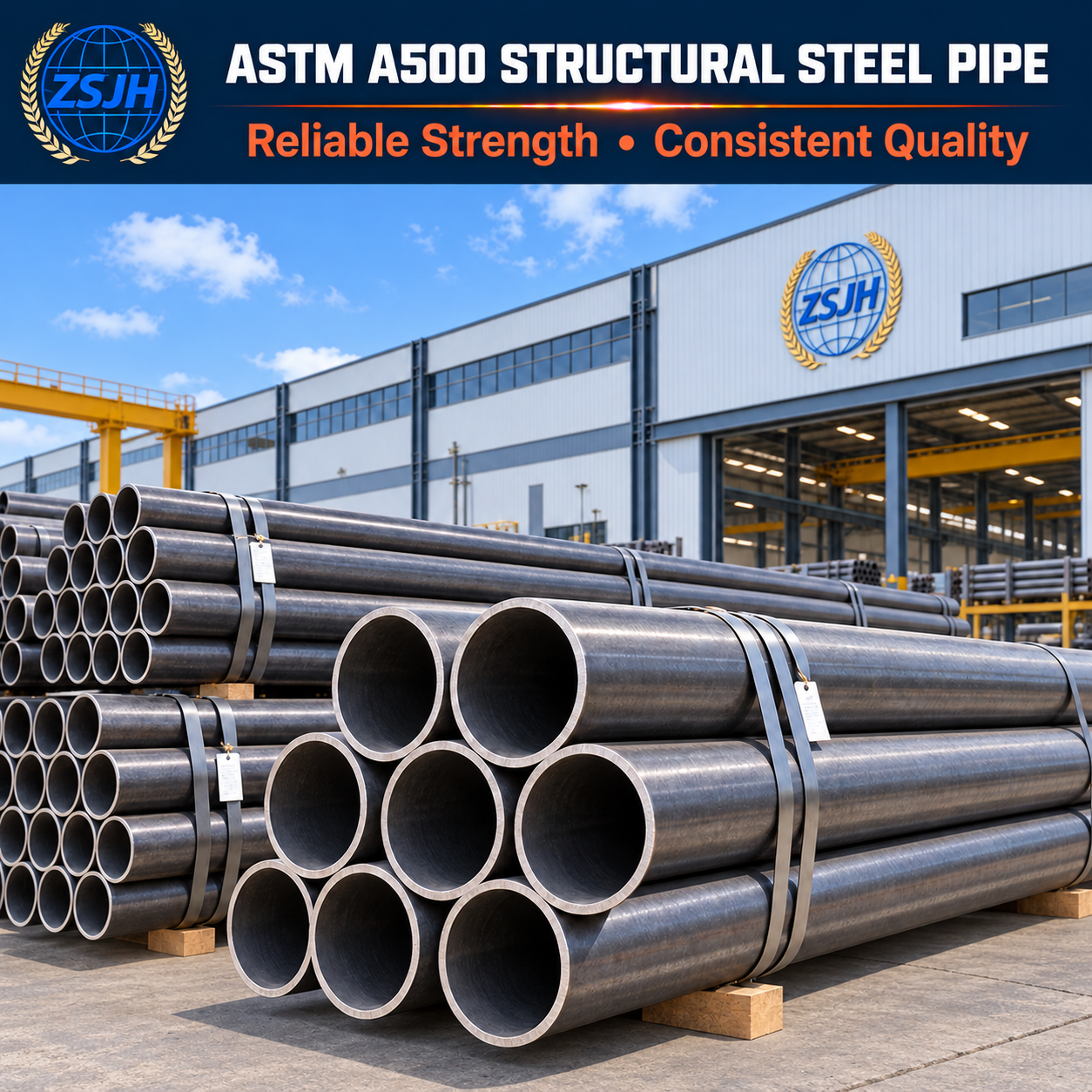
| ASTM A500 | Cold-formed welded and seamless carbon steel structural tubing |
| EN 10219 | Cold-formed welded structural hollow sections |
| EN 10210 | Hot-finished structural hollow sections |
| ASTM A252 | Welded and seamless steel pipe piles |
| ASTM A53 | Steel pipe for specified mechanical and pressure-related applications |
| GB/T standards | Structural and welded steel pipes manufactured to applicable Chinese standards |
| Project-specific standards | Requirements stated in customer specifications and engineering drawings |
The appropriate standard must be confirmed for each project. Structural tubing, pressure pipe and piling pipe have different intended uses and acceptance requirements and should not be treated as interchangeable products.
ASTM A500 structural tubing is commonly specified for building columns, frames, trusses and other load-bearing structural applications. The required grade and mechanical properties should be stated in the purchase documents.
EN 10219 covers cold-formed welded structural hollow sections. These products are suitable for structural frameworks, industrial buildings and general construction.
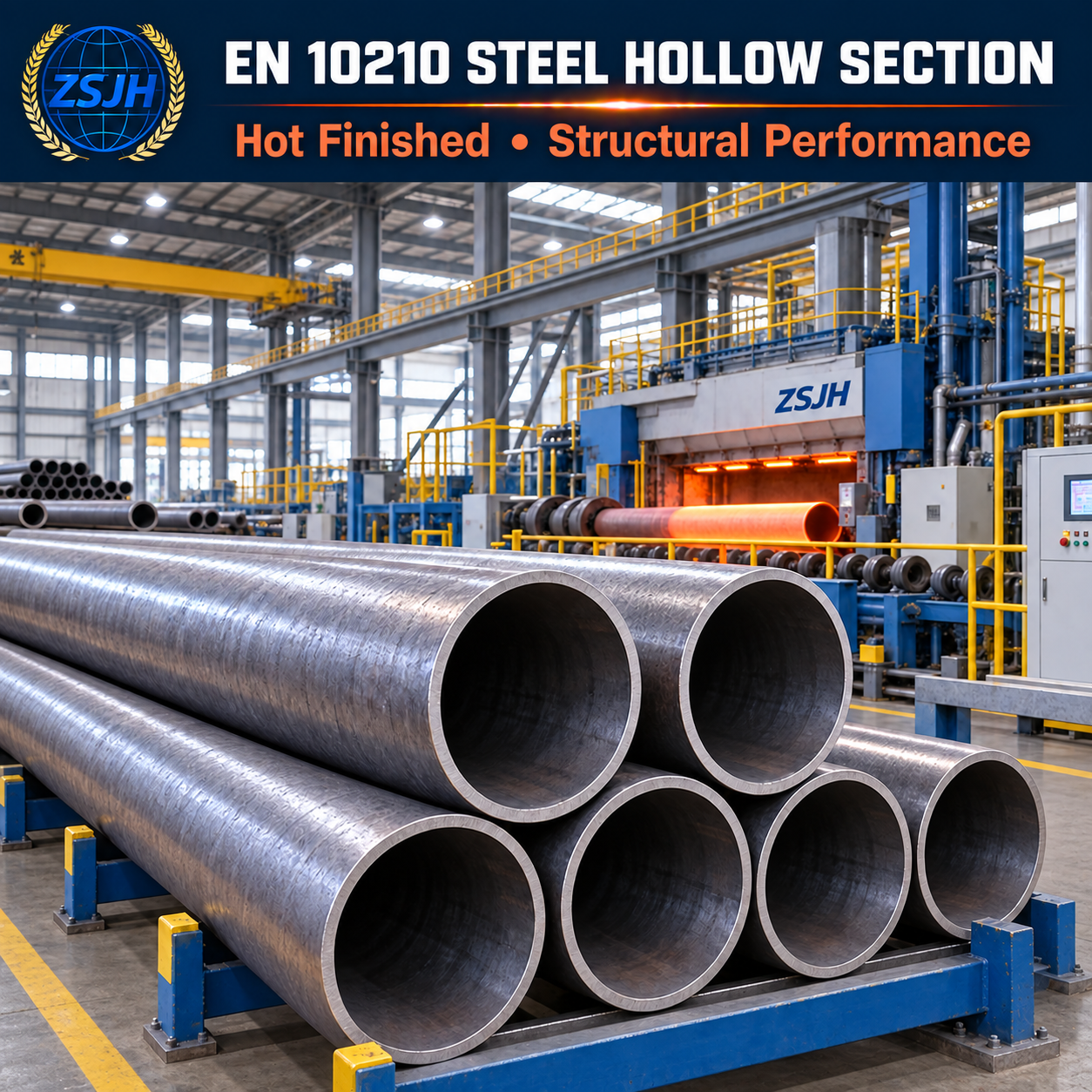
EN 10210 applies to hot-finished structural hollow sections. Hot-finished products are frequently selected for demanding structural applications requiring specified dimensional and mechanical properties.
S355J2H provides high yield strength and specified impact toughness. It is commonly considered for bridges, terminals, large-span structures and projects operating under lower-temperature conditions.
Q355B round structural tubes are widely used in industrial facilities, steel buildings, pipe trusses and general engineering projects manufactured according to applicable Chinese standards.
Equivalent or alternative grades may be considered only after reviewing their chemical composition, mechanical properties, impact requirements, dimensional tolerances and applicable design standards.
The production team reviews the applicable standard, steel grade, outside diameter, wall thickness, length, tolerances, fabrication drawings and inspection requirements.
Steel coils or plates are selected according to the specified grade and thickness. Material identification and supporting documentation are checked before processing.
Raw materials are leveled, trimmed or cut to the required width. Plate edges may be prepared before submerged-arc welding.
Steel is progressively formed into a circular section. The forming method depends on the required pipe diameter, wall thickness and production process.
Depending on the product specification, welding may be performed using:
Electric-resistance welding
Longitudinal submerged-arc welding
Spiral submerged-arc welding
Other approved welding processes
Welding procedures and parameters are controlled according to the applicable production requirements.
For hot-finished hollow sections, the product undergoes an appropriate thermal process to achieve the specified final condition and material properties.
The pipe is sized and straightened to achieve the required diameter, ovality and alignment.
Finished pipes are cut to the required length. Ends can be supplied square-cut, beveled or prepared for project-specific connections.
According to approved drawings, additional processing may include:
CNC cutting and profiling
Hole drilling
Slot cutting
Pipe bending
Branch opening preparation
Flange welding
Base-plate installation
Stiffener and gusset welding
Trial assembly
Shot blasting or another specified cleaning method removes mill scale and prepares the steel surface for coating.
Primer, finish paint, hot-dip galvanizing or a customized coating system is applied according to the service environment.
Finished products are checked for dimensions, straightness, roundness, weld appearance, fabrication accuracy, coating quality and identification.
Pipes are bundled or supported to reduce movement during transportation. Fabricated parts, machined surfaces and coated components receive additional protection when necessary.
The closed circular section provides consistent performance around its axis and is suitable for members subjected to combined loading conditions.
Circular hollow sections offer good torsional performance and are widely used in spatial structures, roof trusses and architectural frameworks.
High-strength steel grades and heavy wall thicknesses can provide the capacity required for demanding industrial and infrastructure projects.
Accurate diameter, wall thickness, length, ovality and straightness help improve fabrication efficiency and connection alignment.
Structural pipes can be cut, welded, drilled, bent and combined with plates, flanges and other structural components.
The smooth circular profile provides a modern appearance for exposed columns, terminals, commercial buildings and public structures.
Project-ready fabrication can reduce field cutting and welding, shorten erection time and improve installation accuracy.
Appropriate steel grade selection, surface preparation, coating and maintenance can provide reliable service in indoor and outdoor environments.
Quality-control requirements are determined by the product standard, project specification and contract. Inspection may include:
Raw-material certificate verification
Steel grade and heat-number identification
Chemical composition verification
Mechanical property review
Outside-diameter inspection
Wall-thickness measurement
Length and straightness checking
Roundness and ovality inspection
Weld appearance inspection
Ultrasonic testing when specified
Radiographic testing when specified
Magnetic-particle or penetrant testing for fabricated connections
Connection position and hole-spacing inspection
Coating-thickness measurement
Galvanized-surface inspection
Final marking and packaging inspection
Third-party inspection can be coordinated when required. The inspection agency, scope, acceptance criteria and documentation requirements should be agreed upon before production.
ASTM A500 is an American specification for cold-formed welded and seamless carbon steel structural tubing. EN 10219 is a European standard for cold-formed welded structural hollow sections. They have different grade designations, tolerances, testing rules and certification requirements.
EN 10210 covers hot-finished structural hollow sections, while EN 10219 covers cold-formed welded structural hollow sections. Their manufacturing conditions, dimensional tolerances and material requirements differ.
Yes. S355J2H circular hollow sections can be supplied subject to the required dimensions, quantity, manufacturing route and applicable technical requirements.
Yes. Q355B structural tubes can be supplied according to the applicable standard and project requirements.
Yes. Heavy-wall tubes can be supplied for high-load structural applications. Please provide the outside diameter, wall thickness, length, grade and quantity for availability confirmation.
ERW pipe is produced using electric-resistance welding and is commonly selected for small- and medium-diameter structural tubes. Submerged-arc welding is frequently used for larger diameters and heavier wall thicknesses.
Yes. ZSJH can provide fixed-length cutting, beveling, drilling, profiling, bending, welding and connection-component fabrication according to approved drawings.
Yes. Hot-dip galvanizing is available for outdoor and corrosion-sensitive applications. Pipe dimensions, vent and drain-hole requirements, coating standards and final assembly details should be reviewed before galvanizing.
Material certificates and inspection documents can be supplied according to the contract and applicable standard. Required certificate types should be confirmed before ordering.
Yes. Ultrasonic, radiographic, magnetic-particle or penetrant testing may be arranged where technically applicable and contractually required.
Material substitution should not be based only on similar yield strength. Chemical composition, toughness, weldability, dimensional standards and design-code requirements must also be reviewed and approved by the responsible engineer.
The selection should be based on structural calculations, applicable design codes, loading conditions, temperature, corrosion exposure, connection design and fabrication requirements. Final selection should be approved by the project’s qualified structural engineer.
ZSJH reviews standards, material grades, dimensions, tolerances, connection details and inspection requirements before production begins.
We can support projects requiring ASTM A500, EN 10219, EN 10210, S355J2H, Q355B and other specified structural steel pipe requirements.
In addition to supplying structural pipes, we provide cutting, drilling, profiling, bending, welding, surface treatment and fabricated-component assembly.
Products can be manufactured according to structural drawings, bills of materials and project-specific technical specifications.
Material identification, dimensional accuracy, weld appearance, fabrication details and surface quality are checked throughout production.
We understand the requirements of international transportation, export packaging, document preparation and overseas project coordination.
ZSJH can supply raw structural pipes, processed members, fabricated steel pipe components or combined steel structure packages.
Material certificates, inspection records, packing lists and other required documents can be prepared according to the agreed contractual scope.
Our team works with customers to confirm technical details, production schedules, inspection arrangements and shipment plans.
Looking for ASTM A500 structural steel pipe, EN 10219 circular hollow sections, EN 10210 steel hollow sections, S355J2H tubes or customized heavy-wall structural pipes?
Send your project requirements to ZSJH for technical review and quotation. For an accurate proposal, please provide:
Project name and destination country
Applicable product standard
Required steel grade
Outside diameter
Wall thickness
Pipe length
Required quantity or total weight
Dimensional tolerances
Structural or fabrication drawings
End-preparation requirements
Welding and connection details
Surface-treatment system
Testing and inspection requirements
Material certification requirements
Packing requirements
Expected delivery schedule
Contact ZSJH Steel today for engineering-grade structural steel pipes, circular hollow sections and customized fabrication solutions.
ZSJH Steel — Connecting the World, Building the Future Together.


