:sales@zsjhsteelgroup.com WhatsApp:+86-15122582058







| Quantity: | |
|---|---|


ZSJH
During hot-dip galvanizing, fabricated steel components are immersed in molten zinc. The process forms metallurgically bonded zinc-iron alloy layers and an outer zinc layer over properly prepared steel surfaces.
When components are correctly designed with suitable vent and drain holes, galvanizing can protect external surfaces, edges, corners and many otherwise difficult-to-coat areas.
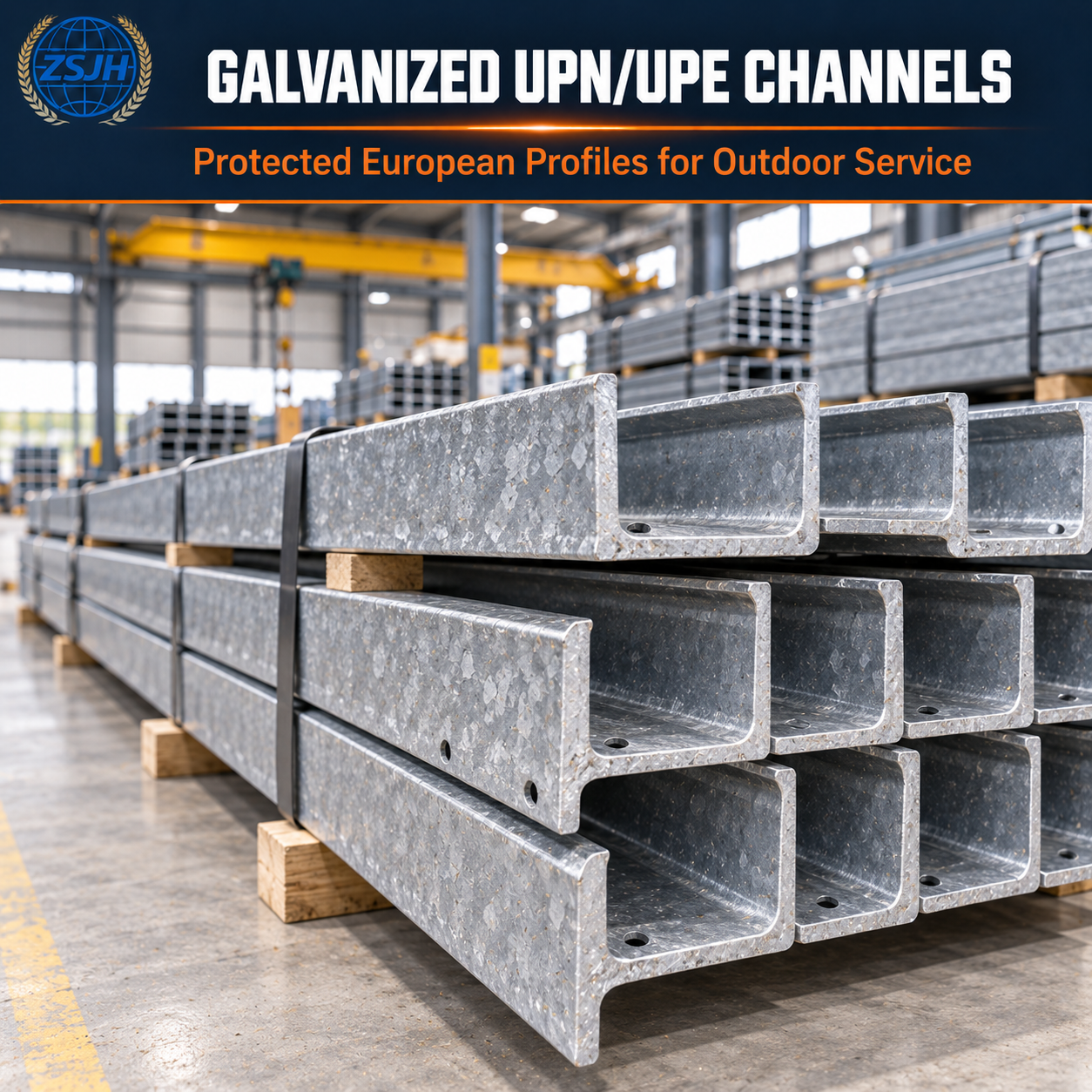
Galvanized UPN/UPE channels are commonly used in utility, industrial, infrastructure and renewable-energy projects exposed to rain, humidity and changing weather conditions.
Unlike a loosely applied surface layer, the galvanized coating is metallurgically bonded to the steel substrate and provides practical resistance to normal transportation and installation handling.
Hot-dip galvanized steel generally requires less immediate coating maintenance than unprotected carbon steel in suitable environments.
Channels can be cut, drilled, coped and welded before galvanizing, allowing processed surfaces and fabricated connections to receive zinc protection during the immersion process.
| Feature | UPN Channel | UPE Channel |
|---|---|---|
| Profile type | European standard channel | European parallel-flange channel |
| Inner flange surface | Tapered | Parallel |
| Connection detailing | May require tapered washers or specially detailed plates | Parallel flange surfaces simplify many plate connections |
| Typical applications | Conventional structural and utility framing | Connection-intensive frames and fabricated assemblies |
| Surface treatment | Hot-dip galvanizing after suitable preparation | Hot-dip galvanizing after suitable preparation |
| Selection basis | Structural calculation and connection requirements | Structural calculation and connection requirements |
UPN and UPE sections are not directly interchangeable. Similar nominal depths may have different flange widths, masses, section properties and connection dimensions.
| Parameter | Available Specification |
|---|---|
| Product name | Hot-Dip Galvanized UPN/UPE Steel Channels |
| Product type | Hot-rolled European structural channel |
| Available profiles | UPN tapered-flange and UPE parallel-flange channels |
| Common steel grades | S235JR, S275JR, S355JR or equivalent |
| Material standard | EN 10025 series or agreed equivalent |
| Dimensions and section properties | EN 10365 or agreed project specification |
| Dimensional tolerances | EN 10279 or agreed requirements |
| Galvanizing reference | ISO 1461 or specified project standard |
| Section size | According to the selected UPN/UPE designation |
| Length | Standard mill length or customized fixed length |
| Surface finish | Hot-dip galvanized |
| Processing | Cutting, drilling, coping, notching and welding |
| Connection method | Bolted, welded or combined connection |
| Inspection | Dimensions, straightness, surface condition and coating inspection |
| Marking | Bundle identification or customized marking |
| Packaging | Bundled with straps, supports and export protection |
Final section sizes, steel grades, coating requirements and fabrication tolerances must be confirmed according to the project specification and applicable standards.
The required minimum coating thickness is influenced by the steel section thickness and the applicable galvanizing standard. For this reason, one fixed zinc-coating value should not be stated for every UPN/UPE channel size.
Coating acceptance may include:
Visual inspection
Coating-thickness measurement
Surface continuity inspection
Inspection of drainage and vent areas
Removal of excessive zinc runs or sharp points
Verification of uncoated or damaged areas
Repair of permitted local coating defects
Natural variation in zinc color, brightness and spangle does not necessarily indicate poor coating performance. Newly galvanized steel may appear bright silver, matte gray or locally varied depending on steel chemistry, cooling and storage conditions.
The zinc coating separates the steel substrate from moisture and atmospheric contaminants.
Zinc can provide sacrificial protection to small exposed areas, helping protect the underlying steel where minor coating damage occurs.
Galvanized channels are suitable for many atmospheric environments when the coating system is selected according to the actual exposure conditions.
In suitable environments, hot-dip galvanizing can reduce the frequency of initial repainting and routine coating maintenance.
UPN/UPE channels can be processed into complete frames, brackets and assemblies before galvanizing.
The coating can be visually inspected, while coating thickness can be measured using suitable instruments.
Both structural steel and zinc are recyclable materials and can be recovered through established metal recycling systems.
Hot-dip galvanized UPN/UPE channels can be used for:
Outdoor utility-support structures
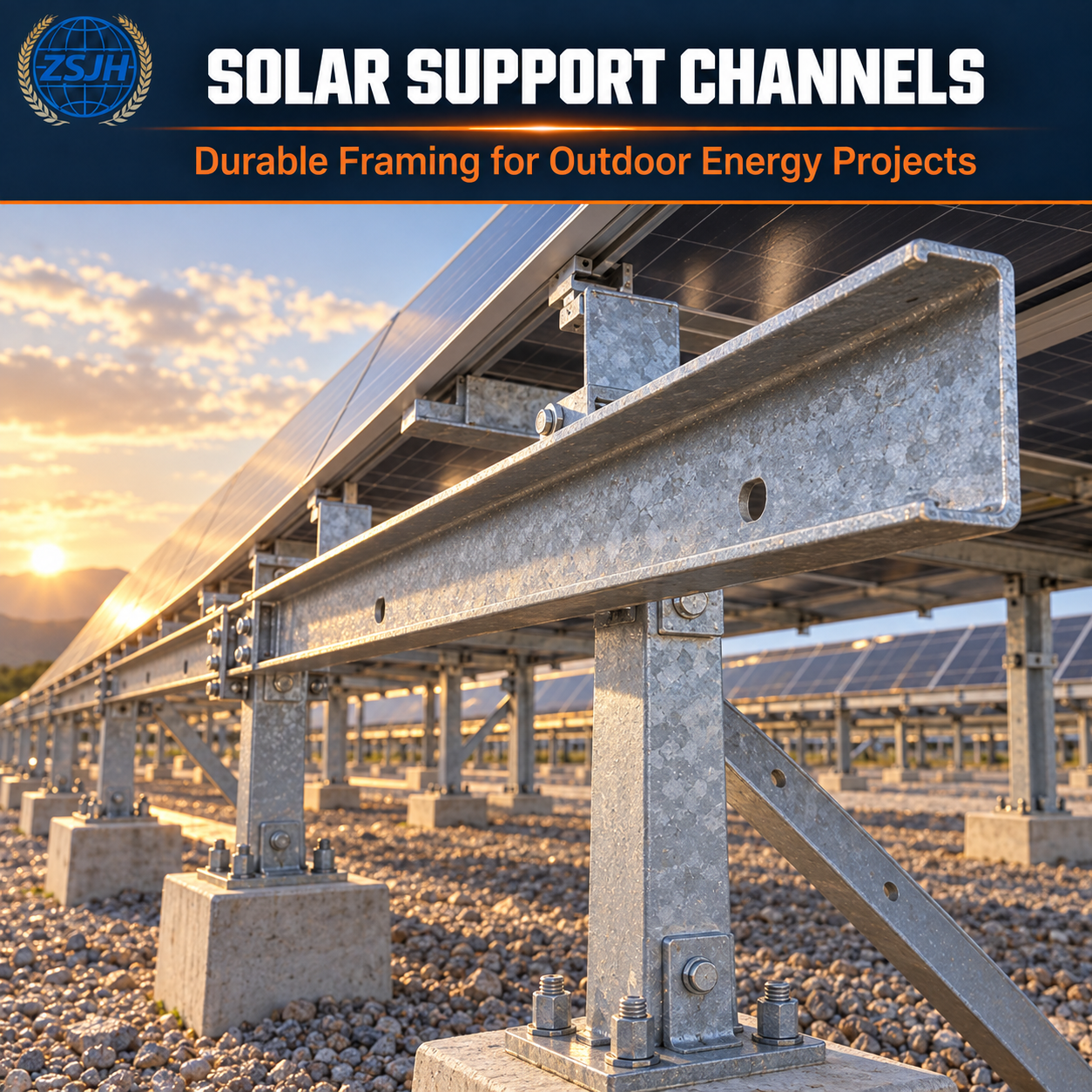
Solar-panel support frames
Electrical substation structures
Cable-tray support frames
Pipe-support systems
Equipment enclosures
Outdoor machinery shelters
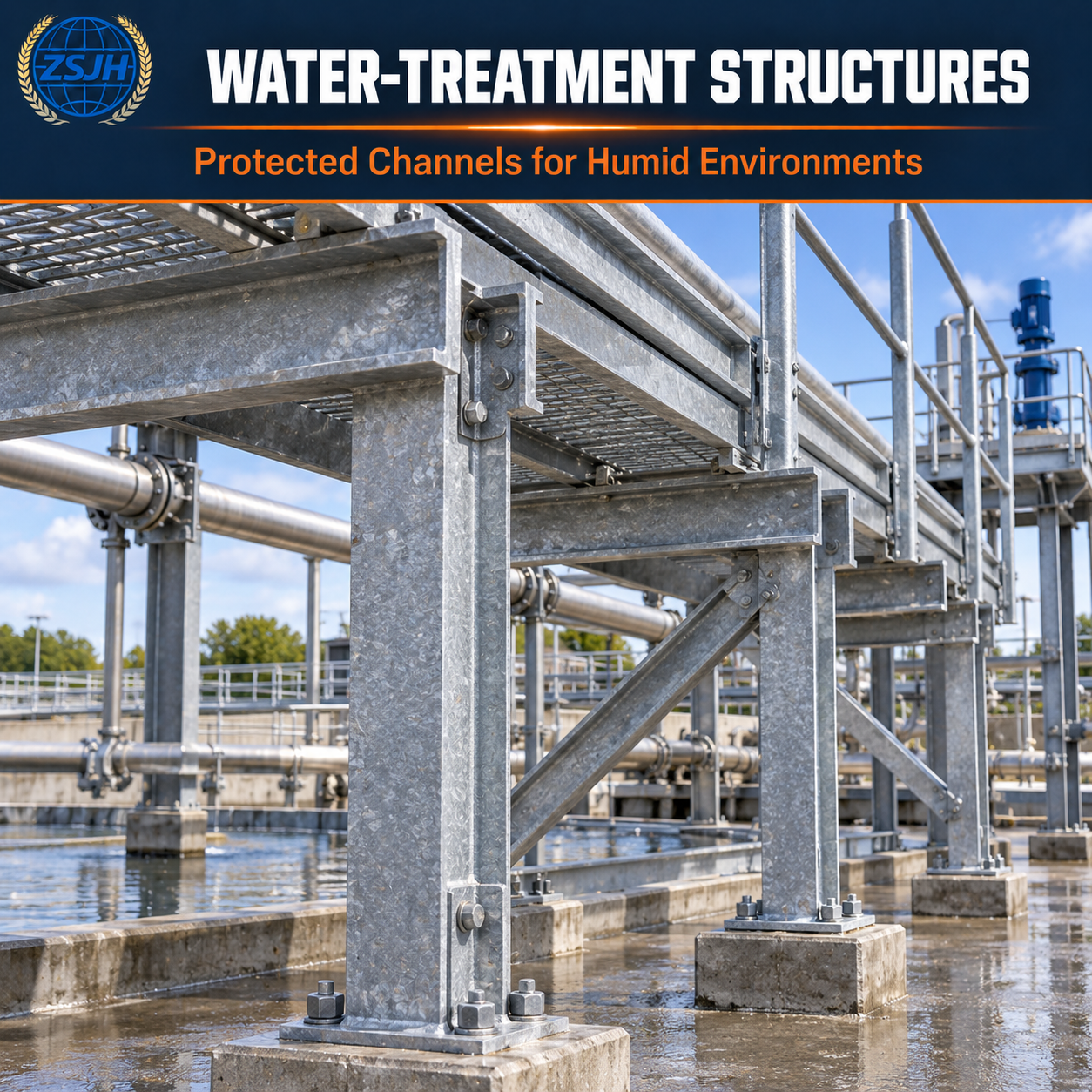
Water-treatment facilities
Wastewater-treatment structures
Pump-station framing
Industrial access platforms
Service walkways
Agricultural facilities
Communication-equipment supports
Building-service structures
Coastal and high-humidity projects, subject to environmental assessment
These channels are suitable for projects requiring standardized structural sections combined with practical corrosion protection.
They may be considered for:
Outdoor industrial construction
Public utility facilities
Renewable-energy projects
Water and wastewater infrastructure
Electrical distribution facilities
Chemical and process plants
Agricultural installations
Equipment-support frameworks
Infrastructure maintenance projects
For severe marine, acidic, alkaline or chemical environments, standard hot-dip galvanizing alone may not provide sufficient protection. A duplex system combining galvanizing with a compatible paint coating may be considered after a professional corrosion assessment.
Closed pockets and overlapping surfaces can trap air, cleaning solution or molten zinc. Suitable vent and drain holes must be incorporated before galvanizing.
Welding sequence, asymmetric fabrication, residual stress and large differences in material thickness may cause distortion during galvanizing. Fabricated components should be designed and processed with this risk in mind.
Galvanizing adds coating thickness to surfaces. Bolt-hole dimensions, mating surfaces and assembly tolerances should allow for the finished coating.
Cutting or welding after galvanizing removes or damages the zinc coating locally. A compatible repair method should be applied according to the specified standard and project requirements.
Freshly galvanized products stored in close contact under damp, poorly ventilated conditions may develop white corrosion products. Bundles should be kept dry, separated and adequately ventilated.
Contact between galvanized steel and certain dissimilar metals in the presence of moisture can promote galvanic corrosion. Isolation materials or suitable connection details may be required.
Hot-dip galvanizing provides corrosion protection but does not increase the rated structural capacity of the channel. Section selection must be based on engineering calculations.
UPN/UPE channels are selected according to the required profile designation, steel grade, mechanical properties and project standard.
Channel dimensions, length, straightness and surface condition are checked before fabrication.
The channels can be cut, drilled, notched, coped and welded according to approved fabrication drawings.
Required vent and drainage openings are added to fabricated components to support safe and effective galvanizing.
Oil, grease and other organic contaminants are removed from the steel surface.
The steel is treated in an acid solution to remove rust and mill scale.
The prepared components are rinsed to remove residual cleaning chemicals.
A flux solution is applied to reduce oxidation and promote reaction between the steel and molten zinc.
Components are dried before immersion to improve process safety and coating formation.
The prepared steel is immersed in molten zinc. Zinc reacts with the steel surface to form metallurgically bonded alloy layers.
The component is withdrawn at a controlled rate, allowing excess zinc to drain from the surface and internal details.
The galvanized component is cooled, and zinc runs, sharp points or other finishing issues are treated where necessary.
The surface appearance and coating thickness are inspected according to the agreed standard.
Finished channels are identified, separated where necessary and packaged to reduce handling and transportation damage.
ZSJH can coordinate:
UPN or UPE profile selection
S235JR, S275JR or S355JR steel grades
Customized fixed-length cutting
CNC drilling
Slotted holes
Web and flange notching
End coping
End-plate welding
Base-plate installation
Brackets and stiffeners
Vent and drainage-hole preparation
Hot-dip galvanizing
Duplex coating systems
Customized marking
Export packaging
All fabricated details should be confirmed using approved drawings before production.
To maintain the galvanized surface:
Store bundles on suitable supports above the ground
Provide spacing between layers where possible
Keep the material dry and ventilated
Avoid prolonged contact with standing water
Do not cover wet galvanized steel with airtight sheeting
Use suitable lifting equipment and non-damaging slings
Avoid dragging channels across abrasive surfaces
Repair significant coating damage according to the specified procedure
Inspect the material after transportation and before installation
UPN channels have tapered inner flange surfaces, while UPE channels have parallel flanges. Both profiles can be hot-dip galvanized, but their section dimensions and connection details differ.
No. Galvanizing provides corrosion protection but does not increase the specified structural capacity of the channel. Structural capacity is determined by section properties, steel grade, restraint and design conditions.
The required minimum coating thickness depends on the steel thickness and applicable galvanizing standard. The final requirement should be confirmed according to ISO 1461 or the specified project standard.
Yes, but cutting and welding damage the local zinc coating. The affected areas must be cleaned and repaired using an approved zinc-rich coating, zinc spray or another specified repair method.
Yes, provided the assembly dimensions suit the galvanizing facility and suitable venting, drainage and lifting points are included. Large components may require alternative fabrication or double-dipping arrangements.
They may be used in coastal environments, but coating life can be reduced by chloride exposure. A heavier protection strategy or duplex coating system may be required.
White storage stain can develop when freshly galvanized surfaces remain wet and poorly ventilated. Correct storage and separation help reduce this risk.
Yes. A compatible duplex coating system can provide additional protection and a specified color. Proper surface preparation is essential for coating adhesion.
Yes. Cutting, drilling, notching and welded plates can be completed before galvanizing according to approved fabrication drawings.
Please provide:
UPN or UPE profile designation
Steel grade
Required length and quantity
Applicable material standard
Galvanizing standard
Fabrication drawings
Hole, plate and welding requirements
Required coating inspection
Packaging requirements
Destination port or delivery location
ZSJH assists customers in confirming the channel profile, steel grade, length, processing requirements and corrosion-protection system.
Channels can be cut, drilled and fabricated before galvanizing, helping provide a coordinated finished component.
Material identification, dimensions, fabrication details, surface condition and galvanized coating are checked throughout the supply process.
Products can be processed according to drawings for utility, solar, water-treatment, industrial and infrastructure applications.
Galvanized channels are bundled and protected according to their size, length, surface condition and transportation method.
Our team supports specification confirmation, drawing review, order coordination, production updates and export documentation.
Send ZSJH your UPN/UPE profile designation, steel grade, required length, quantity, fabrication drawings, galvanizing standard and destination port.
Our team will review your requirements and provide a suitable supply, fabrication and surface-protection proposal for your outdoor structural project.


