:sales@zsjhsteelgroup.com WhatsApp:+86-15122582058







| Quantity: | |
|---|---|


ZSJH
CNC equipment can produce accurate saddle cuts, slots, branch openings and intersecting pipe profiles. Precise profiling improves component fit-up and helps maintain consistent connection geometry.
Pipe diameter, wall thickness, member length, bending radius, end preparation, hole position and connection details can be customized according to approved shop drawings.
Fabricated components can be supplied with:
Welded branch connections
Flanged ends
Bolted end plates
Base plates
Gusset plates
Stiffeners
Prefabricated tubular nodes
Customized connection assemblies
Project-ready components can reduce on-site measuring, cutting, drilling and welding, helping improve installation efficiency.
Critical dimensions such as length, angle, hole position, flange orientation, pipe curvature and connection location are inspected during fabrication.
Flanged and bolted structural pipe assemblies can be divided into transportable modules and assembled efficiently at the construction site.
Shot blasting removes mill scale, surface contamination and loose oxidation, creating a clean surface for primer or protective coating.
Available options include shop primer, zinc-rich primer, epoxy coating, polyurethane finish coating and hot-dip galvanizing where suitable.
Precision-fabricated structural steel pipes are suitable for:
Pipe truss structures
Space-frame buildings
Long-span roof systems
Airport terminal structures
Railway stations
Stadium roof supports
Bridge components
Architectural canopies
Curved steel structures
Industrial plants
Equipment platforms
Pipe racks
Transmission and communication structures
Offshore and coastal projects
Modular steel buildings
Customized tubular assemblies
CNC-profiled pipe ends provide accurate fit-up between chord and branch members. Prefabricated nodes can reduce complex positioning work at the construction site.
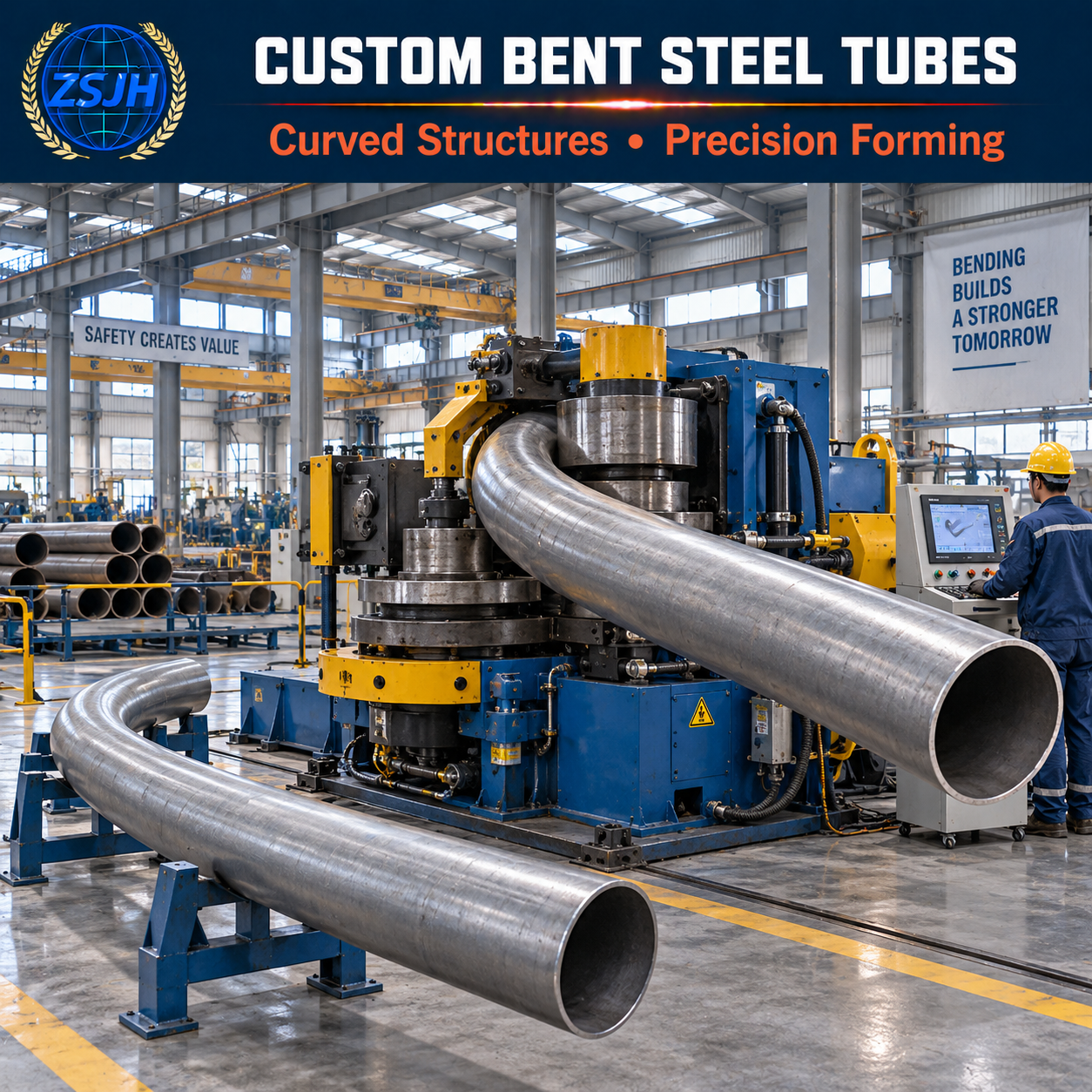
Custom-bent structural tubes can be used for entrance canopies, curved roofs, exhibition buildings, pedestrian structures and architecturally exposed steelwork.
Flanged structural pipe assemblies and bolted end-plate connections allow components to be transported separately and assembled on site.
Fabricated tubes can be supplied with base plates, stiffeners, brackets and other connection components for industrial-support systems.
Heavy-wall pipes can be processed into bridge arches, tubular trusses and customized supporting components with controlled dimensions and connection details.
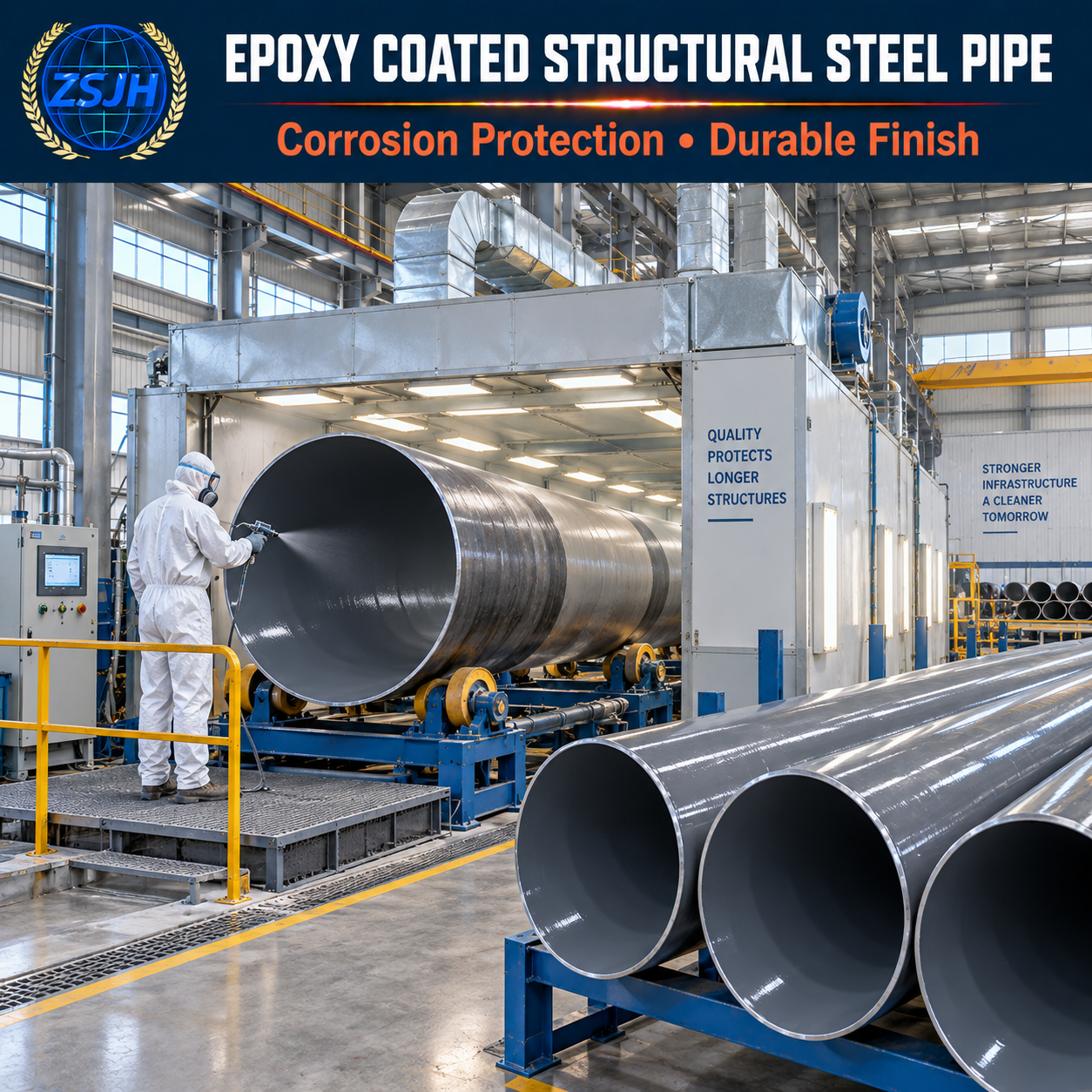
Epoxy-coated or zinc-rich-primer-coated steel pipe components are suitable for industrial, coastal, outdoor and high-humidity environments when the coating system is properly selected.
Processed tubular members and prefabricated nodes can form roof trusses, branching supports and three-dimensional structural systems.
ZSJH can supply raw pipes, processed members or complete fabricated tubular assemblies.
Fixed-length cutting
CNC profile cutting
Saddle cutting
Slot cutting
Branch-hole cutting
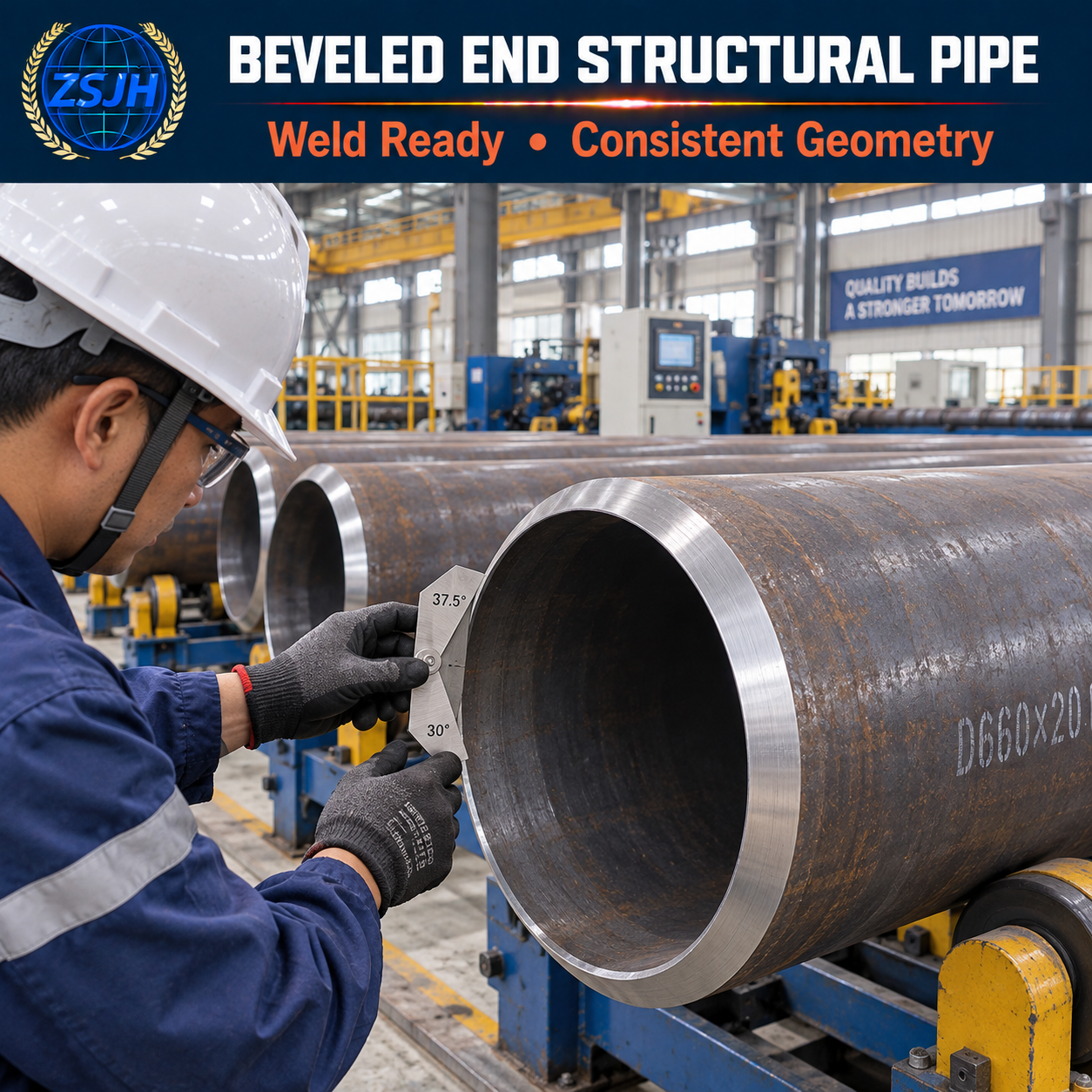
Pipe-end beveling
Hole drilling
Pipe bending
Pipe rolling
End preparation
Flange welding
End-plate installation
Base-plate fabrication
Gusset-plate installation
Stiffener welding
Branch connection welding
Tubular node fabrication
Bolted connection preparation
Project-specific connection assemblies
Mechanical cleaning
Shot blasting
Shop primer
Zinc-rich primer
Epoxy coating
Polyurethane finish coating
Hot-dip galvanizing where technically suitable
Customized multilayer coating systems
Material identification
Dimensional inspection
Weld inspection
Coating inspection
Nondestructive testing when specified
Material certificates
Inspection reports
Packing lists
Component identification records
The following information is provided for general reference. Final specifications should be determined by approved drawings, structural calculations and applicable project standards.
| Item | Available Options |
|---|---|
| Product type | Fabricated structural steel pipe and tubular components |
| Cross-section | Circular hollow section |
| Outside diameter | Customized according to project requirements |
| Wall thickness | Standard, medium-wall or heavy-wall |
| Member length | Standard length or project-specific fixed length |
| Steel grade | Q235, Q355B, S235, S275, S355, S355J2H, ASTM grades or equivalent |
| Manufacturing method | ERW, LSAW, SSAW, seamless or hot-finished where specified |
| End type | Square-cut, beveled, profiled, flanged or end-plated |
| Bending | Custom radius according to technical feasibility |
| Hole processing | CNC drilling, slotting and connection-hole preparation |
| Welding | According to approved WPS and project requirements |
| Connection type | Welded, bolted, flanged or customized |
| Surface preparation | Mechanical cleaning or shot blasting |
| Coating | Primer, zinc-rich primer, epoxy, polyurethane or specified system |
| Inspection | Dimensional, visual, welding, NDT and coating inspection |
| Packing | Bundled, supported, framed or customized export packaging |
Fabrication tolerances depend on the product standard, project specification and approved drawings. Controlled dimensions may include:
Overall member length
Pipe outside diameter
Wall thickness
Straightness
Ovality
Pipe-end angle
Bevel angle
Root face
Branch opening position
Hole diameter and spacing
Flange orientation
Connection-plate position
Bending radius
Arc height
Node geometry
Assembly alignment
Critical tolerances should be clearly identified in the drawings before production.
Our technical team reviews:
Material grade
Pipe dimensions
Applicable standards
Component drawings
Connection details
Welding requirements
Dimensional tolerances
Surface-treatment system
Inspection requirements
Packing and transportation limitations
Pipes, plates, flanges and connection materials are checked for grade, dimensions, surface condition and identification.
Components can be marked and tracked according to the agreed documentation and traceability requirements.
Steel pipes are cut to the required member length using suitable cutting equipment.
Computer-controlled pipe-cutting equipment produces:
Saddle cuts
Branch intersections
End contours
Slots
Openings
Welding-preparation profiles
Digital models and approved drawings guide the cutting process.
Pipe ends can be machined or cut to the required bevel angle, root face and preparation geometry for welding.
Connection plates, flanges, base plates, gussets and stiffeners are cut and drilled according to shop drawings.
Structural tubes can be cold bent, roll bent or induction bent depending on:
Pipe diameter
Wall thickness
Steel grade
Required radius
Section tolerances
Surface requirements
The bending method should be confirmed through technical evaluation.
Pipes and connection components are positioned using jigs, fixtures and dimensional references.
Welding is performed according to the approved procedure and connection design. Preheating and interpass-temperature controls may be applied when required.
Welds are checked for appearance, size, continuity and location. Specified nondestructive testing can be arranged.
Fabricated components are inspected for length, angle, curvature, hole position, flange orientation and connection alignment.
Complex tubular nodes, modular assemblies and large structural components may be trial-assembled before coating.
Steel surfaces are cleaned to the specified preparation grade before coating.
The selected primer and finishing system is applied under controlled production conditions. Coat thickness and curing conditions are monitored as required.
Completed products are inspected for:
Dimensions
Connection details
Weld appearance
Surface preparation
Coating finish
Marking
Packing condition
Each component can be marked according to the erection drawing or bill of materials. Protective packaging is selected according to product size, coating and shipment method.
CNC profiling is suitable for pipe trusses, branch connections and complex tubular intersections. It improves fit-up accuracy and reduces manual marking.
Controlled beveling prepares pipe ends for full-penetration or project-specific welded connections.
Bent steel tubes can be used in arches, stadium roofs, canopies and curved architectural structures.
Welded flanges allow tubular members to be assembled with bolts, helping support modular construction and future disassembly.
Complex nodes can be fabricated in the factory using pipes, plates, bolts and stiffeners according to detailed engineering drawings.
Branch pipes can be profiled and welded to main tubular members for trusses, frames and process-support structures.
Fabricated components can be supplied with connection plates, drilled holes, protective coatings and erection marks.
Shot blasting removes mill scale and oxidation while producing a suitable surface profile for coating adhesion.
A temporary protective primer can be applied for transportation and fabrication-stage protection.
Zinc-rich primer provides enhanced corrosion resistance and is often used as the first layer of a multilayer coating system.
Epoxy coatings offer good adhesion, chemical resistance and corrosion protection for industrial and infrastructure projects.
Polyurethane topcoats can provide color retention, UV resistance and an attractive finished appearance.
Hot-dip galvanizing may be suitable for outdoor tubular components. Venting, drainage, component size and distortion risks must be evaluated before galvanizing.
Multilayer coating systems can be developed according to environmental exposure, expected service life and maintenance requirements.
Precision cutting helps tubular members align correctly during fabrication and erection.
Controlled bevels and profiles support more uniform welding geometry.
Prefabricated connections reduce on-site measuring, cutting, drilling and welding.
Clear component identification and accurate connection positions help reduce erection errors.
Flanged and bolted assemblies can be transported in sections and assembled efficiently at the project site.
Cutting and bending services support straight, curved, branching and three-dimensional structures.
Professional surface preparation improves coating adhesion and long-term protective performance.
CNC nesting and controlled processing can improve material utilization.
Inspection during each fabrication stage helps maintain dimensions, weld quality and surface condition.
Components can be marked, bundled and packed according to the erection sequence and international transport requirements.
Quality inspection can include:
Material certificate verification
Steel grade and heat-number checking
Pipe-dimension inspection
CNC profile verification
Bevel-angle inspection
Branch-opening measurement
Bending-radius inspection
Flange flatness and orientation inspection
Bolt-hole diameter and spacing checks
Component fit-up inspection
Weld appearance inspection
Ultrasonic testing when specified
Magnetic-particle testing when specified
Radiographic testing when specified
Trial-assembly inspection
Surface-cleanliness inspection
Dry-film coating-thickness measurement
Coating appearance and adhesion checks
Final marking and packing inspection
The inspection scope and acceptance criteria should be confirmed before production.
Yes. CNC profiling can be completed according to approved drawings and compatible digital fabrication information. Final file formats and dimensional requirements should be confirmed before production.
Available profiles may include saddle cuts, branch intersections, slots, holes, end contours and customized welding-preparation shapes.
Yes. Pipe ends can be supplied with project-specific bevel angles, root faces and end preparations.
Yes. Bending services may be available according to pipe diameter, wall thickness, steel grade, bending radius and tolerance requirements.
Pipe bending can cause ovality, wall thinning or local deformation. These effects are controlled through proper process selection, tooling and inspection. Acceptable tolerances must be stated before production.
Yes. Pipes can be supplied with welded flanges, machined connection surfaces and specified bolt-hole arrangements.
Yes. ZSJH can fabricate multi-branch tubular nodes with gusset plates, stiffeners, end plates and other project-specific connection details.
Yes. Trial assembly can be arranged for complex nodes, modular systems and components requiring precise connection alignment.
Surface preparation can be performed according to the coating specification and agreed cleanliness grade. The required blasting standard should be stated in the project documents.
The correct coating depends on climate, chemical exposure, UV exposure, humidity, service life and maintenance conditions. A coating specification should be selected by the project engineer or corrosion-protection specialist.
Yes, subject to pipe diameter, length, accessibility, coating type and inspection requirements. Internal coating requirements should be specified clearly.
Yes, where component dimensions and design are suitable. Vent and drain holes, coating thickness and distortion control must be considered.
Yes. UT, MT, PT or RT can be arranged when specified and technically applicable.
Yes. Third-party inspection can be coordinated according to the agreed inspection plan and acceptance criteria.
Components can be marked according to the erection drawings, bill of materials or customer-specified identification system.
ZSJH combines structural pipe supply, CNC processing, welding, connection fabrication, surface treatment and export packaging.
Components are manufactured according to approved shop drawings, bills of materials and project specifications.
Our fabrication scope includes saddle cuts, branch connections, flanged assemblies, base plates and multi-member tubular nodes.
Critical dimensions, welding details, coating condition and component identification are inspected throughout production.
Pipe dimensions, end preparation, connection form, curvature and coating can be customized for each project.
Products can be manufactured or supplied according to ASTM, EN, GB/T and project-specific technical requirements.
Ready-to-install components help customers reduce field processing and improve erection efficiency.
ZSJH supports packing design, component marking, shipment planning and documentation for international projects.
Our team confirms material grades, tolerances, welding requirements, inspection criteria and coating systems before production.
Customers can order individual processed pipes, fabricated nodes, modular assemblies or combined steel structure packages.
Looking for a reliable supplier of precision-fabricated structural steel pipe, CNC-cut tubular components, curved steel tubes, flanged assemblies or protective coatings?
Send your project information to ZSJH for technical review and quotation. Please provide:
Project name and destination country
Structural drawings and shop drawings
Bill of materials
Digital models or cutting files when available
Applicable standards
Steel grade
Pipe diameter
Wall thickness
Member length
Required quantity
CNC profile details
Bevel requirements
Bending radius and tolerances
Flange and bolt-hole details
Welding requirements
Nondestructive testing requirements
Trial-assembly requirements
Surface-preparation standard
Coating specification
Component-marking requirements
Packing and transportation requirements
Expected delivery schedule
Contact ZSJH Steel today for precision-fabricated structural steel pipes and project-ready tubular steel components.
ZSJH Steel — Connecting the World, Building the Future Together.


