:sales@zsjhsteelgroup.com WhatsApp:+86-15122582058







| Quantity: | |
|---|---|


Structural steel pipes provide reliable performance under compression, bending and torsional forces. They are suitable for columns, trusses, arches and other important load-bearing members.
The circular hollow section distributes material uniformly around its central axis, providing good structural efficiency in multidirectional loading conditions.
Closed tubular sections offer strong torsional performance, making them suitable for bridges, long-span roofs, stadium structures and complex spatial frameworks.
Circular steel tubes can be incorporated into pipe trusses, space frames and roof-support systems to create large column-free spaces.
Smooth circular profiles provide a modern appearance for visible structural members in terminals, stadiums, exhibition halls and commercial buildings.
Pipe diameter, wall thickness, steel grade, connection form, surface treatment and fabrication details can be customized according to structural calculations and approved drawings.
Cutting, beveling, profiling, drilling, bending, welding and connection assembly can be completed before shipment, reducing on-site processing.
Depending on environmental exposure, products can be shot-blasted, primed, painted, galvanized or treated with project-specific protective coating systems.
ZSJH structural steel pipe systems are suitable for:
Pipe truss structures
Airport terminal buildings
Railway stations
Long-span roofing systems
Sports stadium roofs
Exhibition and convention centers
Bridge construction
Pedestrian overpasses
Space-frame buildings
Architectural tubular structures
Transmission towers
Industrial facilities
Equipment-support frameworks
Steel tubular piles
Foundation engineering
Marine and coastal structures
Energy and infrastructure projects
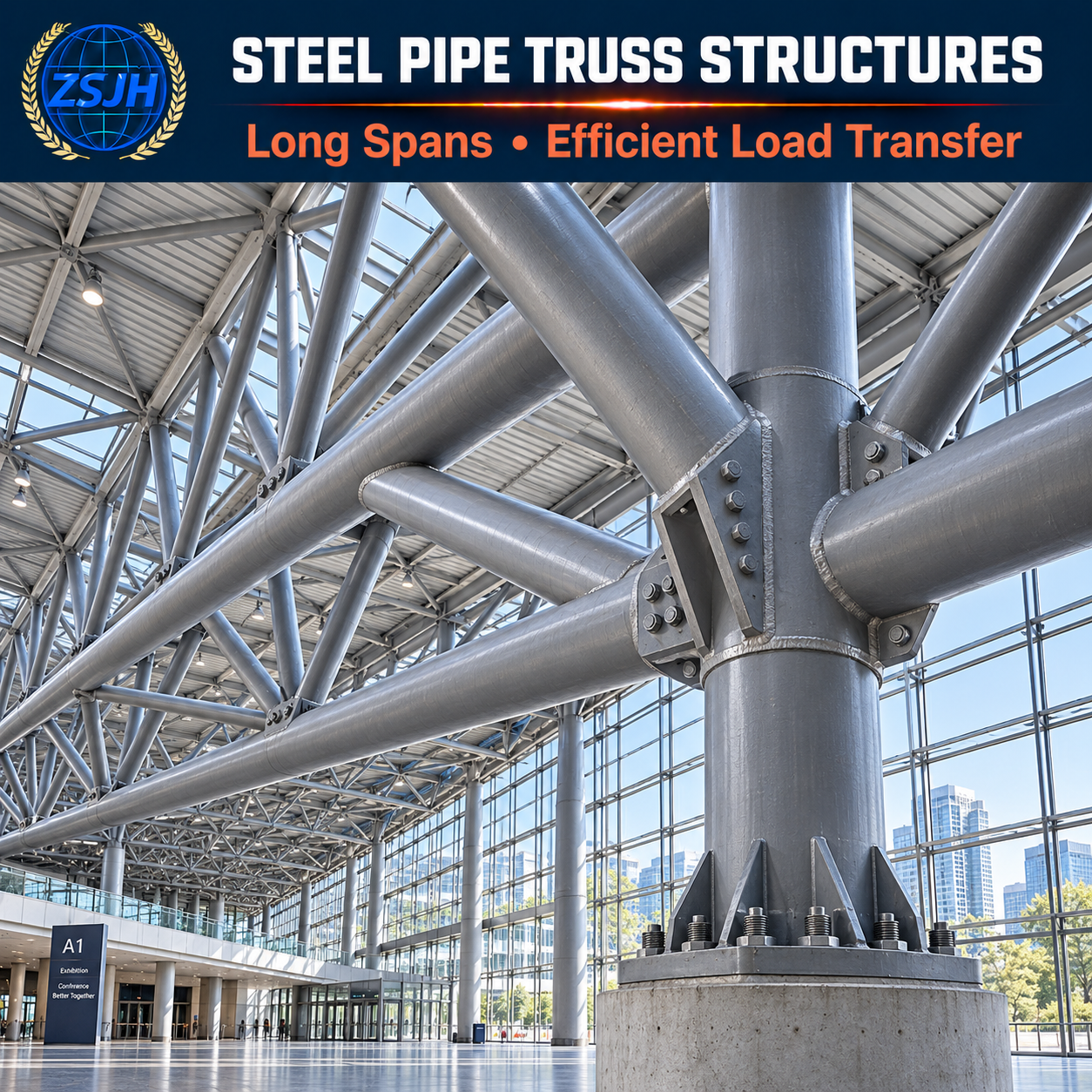
Circular steel tubes are widely used as upper chords, lower chords, diagonal members and vertical members in pipe trusses. Their closed section offers efficient structural performance and a visually clean profile.
Typical applications include:
Exhibition halls
Airport terminals
Railway stations
Industrial buildings
Entrance canopies
Public building atriums
Steel tubular columns and branching roof supports can be used to create large, open terminal interiors. The circular profile is suitable for exposed architectural structures where strength and appearance are equally important.
Circular hollow-section members can form roof trusses, arches and spatial-support systems for buildings requiring wide column-free areas.
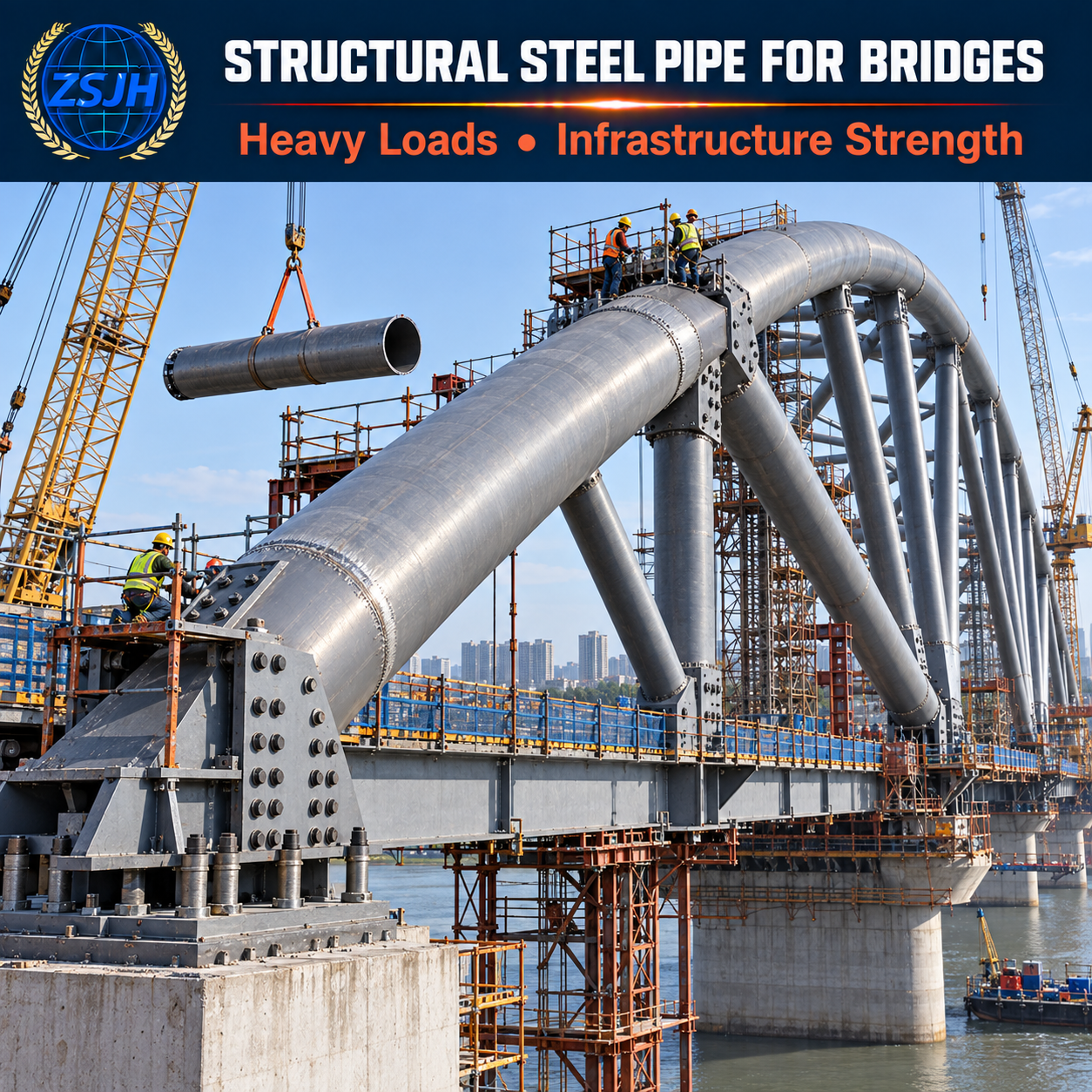
Large-diameter structural steel pipes can be used in tubular arches, bridge trusses, supporting columns, piers and other engineered bridge components.
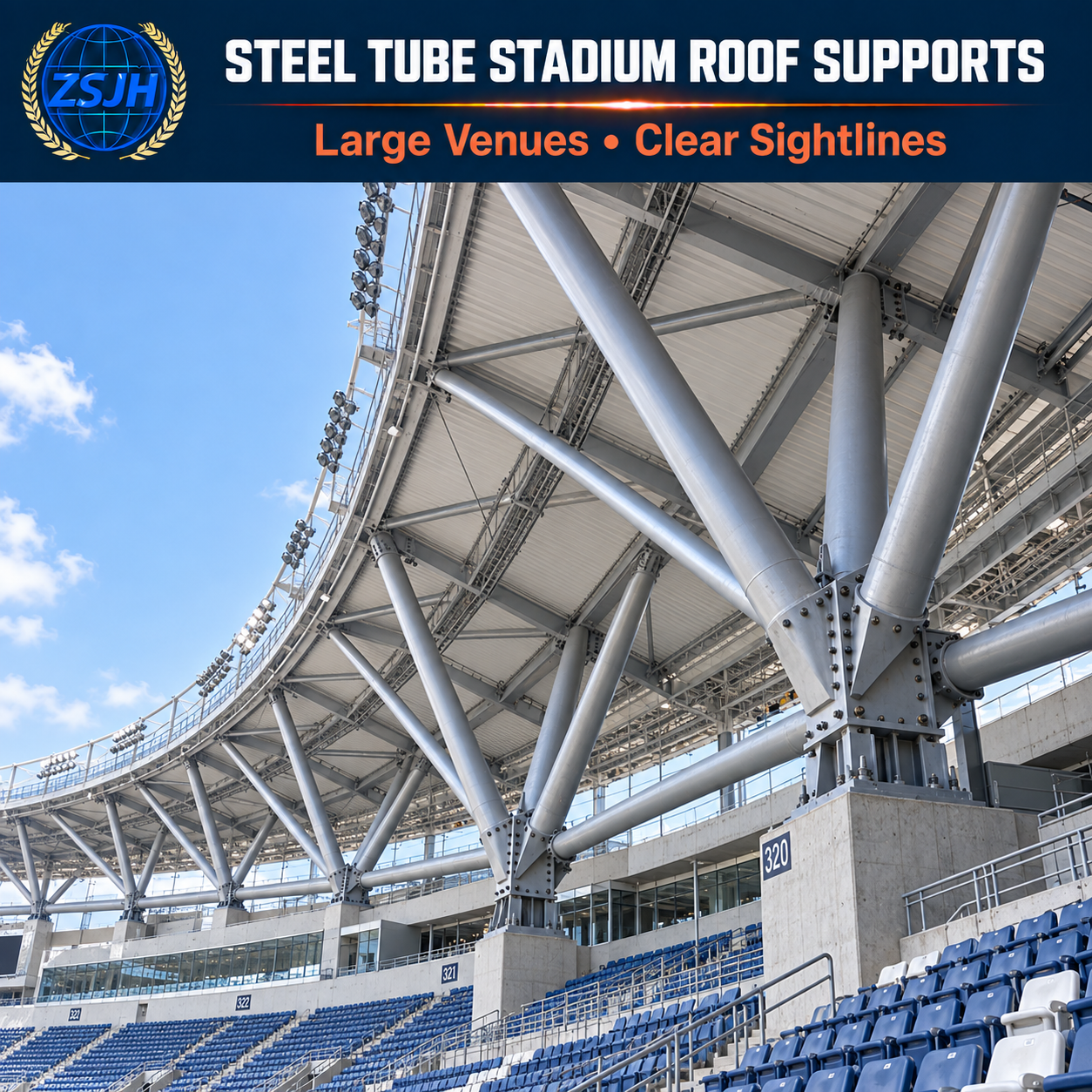
Steel tube supports are suitable for cantilevered stadium roofs and long-span perimeter structures. Their structural efficiency helps maintain clear sightlines and large unobstructed seating areas.
Tubular steel members can be connected through engineered nodes to form lightweight three-dimensional structural systems capable of spanning large areas.
Round structural pipes can be used in power-transmission and communication structures where strength, wind resistance and member efficiency are important.
Steel tubular piles may be used for deep foundations, marine structures, bridge foundations and heavy industrial facilities when manufactured according to the appropriate piling standard.
Structural pipes can serve as columns, equipment supports, pipe-rack members, platform supports and industrial framework components.
| Project Type | Typical Structural Pipe Use |
|---|---|
| Airport terminals | Tubular columns, branching supports and roof trusses |
| Railway stations | Space frames, canopies and platform-roof systems |
| Stadiums | Cantilever roof trusses and perimeter supports |
| Bridges | Tubular arches, trusses, columns and bracing |
| Exhibition halls | Long-span pipe trusses and space frames |
| Industrial plants | Columns, roof supports and equipment frameworks |
| Architectural projects | Exposed circular columns and decorative structures |
| Transmission projects | Tower legs, bracing and support members |
| Foundation engineering | Steel tubular piles and deep-foundation components |
| Marine projects | Piles, platform supports and coated tubular members |
The following information is provided as a general reference. Final dimensions and technical requirements must be confirmed according to engineering calculations, approved drawings and the applicable product standard.
| Item | Available Options |
|---|---|
| Product type | Round structural steel pipe and circular hollow section |
| Structural form | Columns, truss members, arches, braces, piles and fabricated assemblies |
| Outside diameter | Customized according to project requirements |
| Wall thickness | Standard, medium-wall or heavy-wall |
| Length | Standard mill length or customized fixed length |
| Steel grade | Q235, Q355B, S235, S275, S355, S355J2H, ASTM grades or equivalent |
| Manufacturing method | ERW, LSAW, SSAW, seamless or hot-finished where specified |
| End preparation | Square-cut, beveled, flanged or customized |
| Connection type | Welded, bolted, flanged or engineered node connection |
| Surface preparation | Manual cleaning, mechanical cleaning or shot blasting |
| Surface treatment | Primer, finish paint, hot-dip galvanizing or anticorrosion coating |
| Fabrication | Cutting, profiling, drilling, bending, welding and assembly |
| Inspection | Dimensional, visual, weld, coating and specified NDT |
| Documentation | Material certificates and inspection records as required |
| Packing | Bundled, supported, framed or customized export packaging |
Depending on the intended application, structural pipes may be supplied according to:
ASTM A500
ASTM A252
EN 10210
EN 10219
GB/T structural pipe standards
AWS welding requirements where specified
ISO coating and inspection requirements
Customer-specified engineering standards
Structural tubes, piling pipes and pressure-service pipes have different performance and inspection requirements. The correct product standard must be selected for the intended application.
Pipe members can be profiled and welded directly to other tubular members or connection plates. Weld geometry and access should be reviewed during detailing.
Gusset plates can connect tubular braces, truss members and supporting frames through welded or bolted details.
Flanged ends support modular assembly and may reduce the need for field welding.
Bolted plates can be used for transportation-friendly structural modules and efficient site erection.
Engineered spherical or bolted nodes can connect multiple tubular members in three-dimensional space-frame systems.
Tubular columns can be supplied with base plates, anchor-bolt holes, stiffeners and other connection components.
CNC profile cutting can prepare accurate branch openings and intersecting pipe ends for tubular trusses and architectural structures.
The technical team reviews:
Applicable structural standards
Material grades
Pipe dimensions
Member identification
Connection details
Welding requirements
Surface-treatment systems
Inspection and documentation requirements
Steel pipes, plates, flanges and connection materials are selected according to the approved bill of materials.
Material dimensions, surface condition, identification and supporting documentation are checked before fabrication.
Pipes are cut to the required length. Ends may be square-cut, beveled or prepared for specific welded or bolted connections.
Intersecting pipe ends, slots and branch openings can be cut using CNC equipment to improve fit-up accuracy.
Base plates, gusset plates, end plates and stiffeners are cut and drilled according to shop drawings.
Where required, pipe members can be bent or rolled for arches, curved roofs and architectural structures.
Pipes, plates and connection components are positioned and checked before welding.
Qualified welding processes are selected according to material grade, member thickness and project specifications.
Weld appearance, size and continuity are checked. Nondestructive testing can be performed when required.
Member length, connection position, hole spacing, angle, curvature and overall assembly dimensions are verified.
Complex trusses, space-frame modules and bridge components may be trial-assembled to verify connection alignment before shipment.
Steel surfaces can be shot-blasted to remove mill scale and prepare the components for coating.
Primer, finish paint, hot-dip galvanizing or project-specific anticorrosion coatings are applied as required.
Members are marked according to erection drawings and packed in an organized sequence to support efficient site installation.
Pipe trusses and space frames make it possible to create wide interiors with fewer intermediate supports.
Efficient hollow-section design can help reduce structural self-weight while maintaining the required load-bearing capacity.
The circular shape may provide favorable aerodynamic characteristics compared with wider flat structural profiles, depending on the design configuration.
Steel tubes can be arranged into straight, curved, branching and three-dimensional structural forms.
Fabricated pipe components with bolted or flanged connections can support faster and more controlled site erection.
Large structures can be divided into transportable modules and clearly marked for shipment and installation.
Appropriate coating or galvanizing systems can improve service life in outdoor, industrial, coastal and high-humidity environments.
Project-ready fabrication reduces the need for extensive cutting, drilling and welding at the construction site.
Tubular steel systems can be combined with glass curtain walls, metal roofing, concrete foundations and architectural cladding systems.
Quality control can cover the complete process from raw-material receipt to final shipment.
Inspection items may include:
Material certificate verification
Steel grade and heat-number checking
Outside diameter and wall-thickness measurement
Length and straightness inspection
Roundness and ovality inspection
Pipe-end profile verification
Plate and bolt-hole inspection
Component fit-up inspection
Weld appearance and dimension checking
Ultrasonic testing when specified
Magnetic-particle testing when specified
Radiographic testing when specified
Trial-assembly verification
Surface-preparation inspection
Dry-film coating-thickness measurement
Galvanized-surface inspection
Member-marking verification
Packing and loading inspection
Third-party inspection can be arranged according to the agreed inspection scope and acceptance criteria.
Structural steel pipe is suitable for pipe trusses, roof supports, bridges, stadiums, airport terminals, space frames, towers, industrial structures and foundation systems.
Circular steel tubes provide efficient resistance to compression and torsion. Their uniform geometry also makes them suitable for multidirectional loading and exposed architectural designs.
Yes. ZSJH can provide cutting, profiling, plate fabrication, welding, inspection, surface treatment and trial assembly according to approved shop drawings.
Yes. Tubular bridge components can be manufactured according to project drawings and specified standards. Material, welding, NDT and dimensional requirements must be confirmed before production.
Yes. Large-diameter and heavy-wall pipes can be supplied subject to the required manufacturing method, steel grade, dimensions and quantity.
Yes. Pipe bending and rolling services may be available according to the pipe diameter, wall thickness, material grade, bending radius and dimensional tolerances.
Yes. Tubular members can be supplied with bolted end plates, flanges, gusset plates or engineered connection nodes.
Trial assembly can be arranged for complex trusses, bridge members and modular structures when required by the project.
The correct system depends on climate, humidity, pollution, coastal exposure and expected service life. Options include painting, hot-dip galvanizing and multilayer anticorrosion coatings.
Steel tubular piles can be used for foundation projects when manufactured and inspected according to the appropriate piling standard. General structural tubes should not automatically be substituted for certified piling pipes.
Yes. Material certificates, dimensional reports, coating records and specified testing documents can be provided according to the agreed contract requirements.
Yes. Third-party inspection can be coordinated before shipment. The selected agency, inspection points and acceptance criteria should be confirmed before production.
Large members may be divided into transportable sections or modules. Components are marked, supported and packed according to their dimensions, weight, coating and installation sequence.
ZSJH can support detailing and fabrication coordination according to the agreed project scope. Final structural calculations and design approval should be completed by qualified engineers under the applicable local codes.
ZSJH can support material procurement, fabrication, inspection, surface treatment, packing and international shipment within one coordinated supply process.
Our fabrication scope covers pipe trusses, tubular columns, bridge components, long-span roof members and customized steel pipe assemblies.
Components are manufactured according to approved structural drawings, shop drawings and bills of materials.
We can process tubular intersections, gusset plates, base plates, flanges, stiffeners and bolted connection details.
Material identification, dimensional accuracy, welding quality, coating condition and member marking are checked throughout production.
Products can be supplied according to ASTM, EN, GB/T and project-specific technical requirements.
Components can be packed and supported for container transport, break-bulk shipment or other agreed delivery methods.
Material grades, dimensions, tolerances, welding requirements, inspection scope and delivery schedules are confirmed before manufacturing.
Customers can purchase raw structural pipes, processed members, fabricated components or complete project-based steel packages.
Looking for a professional supplier of structural steel pipe systems for infrastructure and long-span construction?
ZSJH can provide pipe truss members, tubular columns, bridge components, stadium roof supports, space-frame members and customized fabricated pipe structures.
For an accurate quotation, please provide:
Project name and destination country
Structural drawings or shop drawings
Bill of materials
Applicable design and product standards
Steel grade
Pipe outside diameter
Wall thickness
Member length
Required quantity
Connection details
Welding requirements
Nondestructive testing requirements
Trial-assembly requirements
Surface-treatment system
Packing and transportation requirements
Required documentation
Expected delivery schedule
Contact ZSJH Steel today for customized structural steel pipe systems and professional fabrication solutions for your next infrastructure or long-span construction project.
ZSJH Steel — Connecting the World, Building the Future Together.


