:sales@zsjhsteelgroup.com WhatsApp:+86-15122582058




| Quantity: | |
|---|---|


ZSJH
Matched Components. Adjustable Connections. Drawing-Based Supply.
ZSJH Steel supplies custom structural tie rod assemblies for roof bracing, column bracing, and other engineered tension applications in steel buildings. Each assembly combines a steel tension rod with specified end fittings and, where required, adjustment components to transfer tensile forces between structural connection points.
Our supply scope can include threaded steel tie rods, clevis ends, connecting pins, turnbuckles, couplers, and locknuts. Rod dimensions, material grades, connection geometry, and protective finishes are coordinated with approved project drawings for compatible assembly and installation.
A structural tie rod performs as part of an assembly. Matching the rod, threads, end fittings, pins, and adjustment devices helps customers avoid incompatible parts and procurement omissions.
Adjustable steel tie rods can incorporate turnbuckles or threaded end fittings to accommodate the specified installation adjustment. Adjustment range and minimum thread engagement must be established before production.
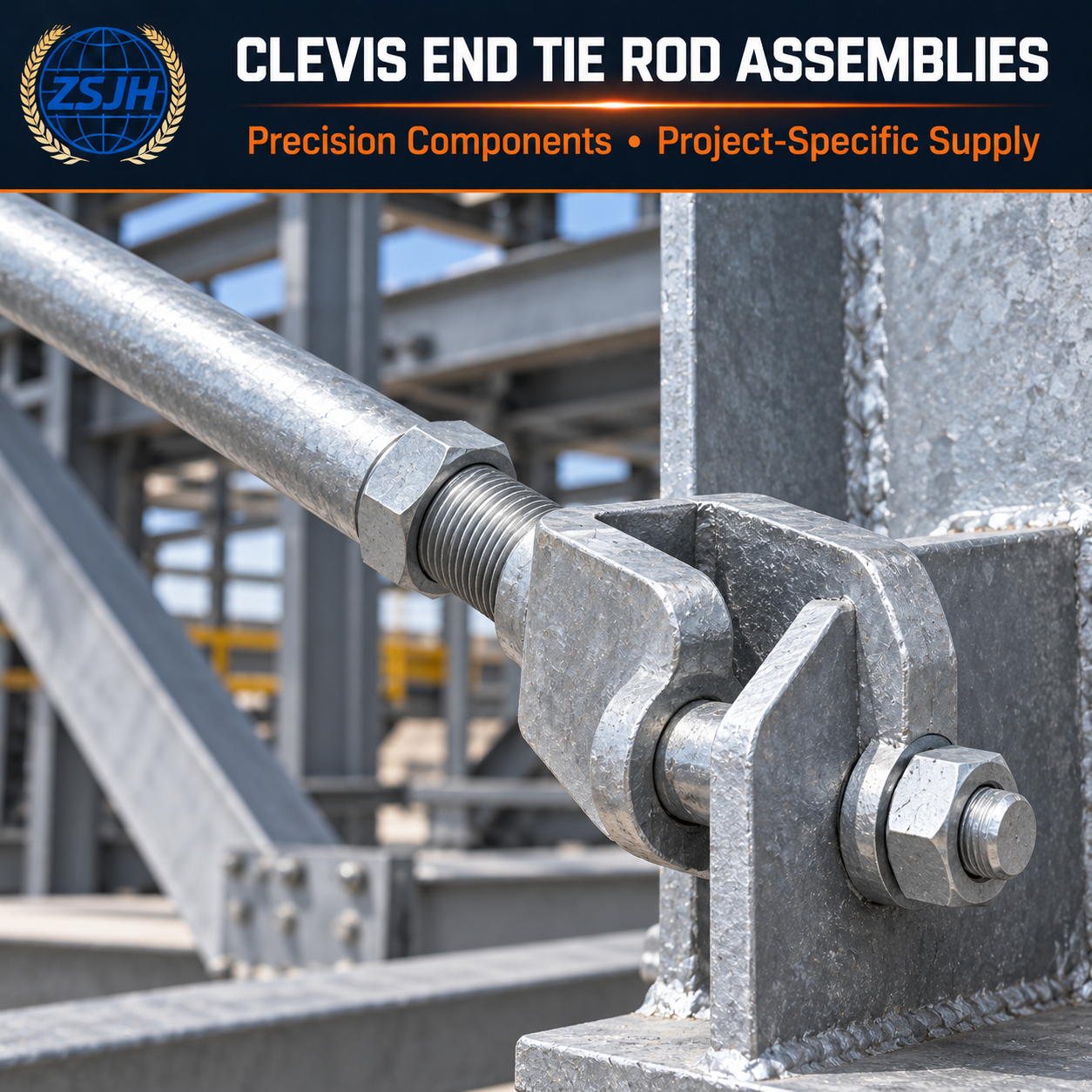
Clevis end tie rod assemblies can be configured to suit the connection plate thickness, pin diameter, and required clearance. Coordinated end geometry supports accurate fit-up at the structural node.
Rod diameter, overall length, thread size, thread direction, and end details can be manufactured to approved drawings. Defining the assembled length between connection points helps reduce ambiguity during ordering.
Protective painting or hot-dip galvanizing can be specified according to project conditions. Coating requirements must account for thread fit, mating components, and the suitability of the selected materials.
Assemblies can be identified and grouped by location or member mark, with matching hardware packed together as agreed. This helps installation teams locate the correct components for each bracing bay.
Structural tension rods can form diagonal members within roof-plane bracing systems, transferring tensile forces between the connection points defined in the building design.
Tie rod bracing for steel buildings can be used in vertical bays between columns. Crossed tension rods are commonly specified where different diagonals resist opposing loading directions.
Drawing-based assemblies can be supplied for warehouse and workshop bracing packages, with lengths and end fittings matched to the frame geometry.
Steel tie rod systems can be fabricated to the building supplier’s approved details and coordinated with primary frames, gusset plates, and erection requirements.
Custom assemblies may also be supplied for truss ties and other specified tension members, subject to the required load capacity, connection details, and service conditions.
This product category focuses on the rod assembly itself: the rod body, threaded ends, adjustment devices, and connection fittings. Roof and column bracing layouts belong to the complete building stability design.
| Item | Supply and Customization Scope |
|---|---|
| Rod body | Diameter, length, and steel grade to approved specifications |
| Threaded ends | Thread size, pitch, length, and left- or right-hand direction |
| End fittings | Clevis ends or other connection fittings shown in approved details |
| Adjustment components | Turnbuckles, threaded couplers, and locknuts where specified |
| Connecting hardware | Pins, retaining devices, bolts, nuts, and washers as detailed |
| Connection interfaces | Clevis opening, plate thickness, pin diameter, and clearance |
| Assembly dimensions | Connection-center length and permitted adjustment range |
| Surface treatment | Protective painting or hot-dip galvanizing, subject to material suitability |
| Supply format | Loose matched components or preassembled units as agreed |
The capacity of a tie rod assembly depends on its complete load path. Rod diameter alone does not establish the capacity of the finished assembly.
Before fabrication, the project specification should confirm:
Design tensile force and applicable design standard
Rod material and the effective section at threaded portions
Capacity and compatibility of end fittings and adjustment devices
Thread engagement and locking requirements
Pin dimensions and connection plate geometry
Connection-center length and adjustment range
Coating requirements and dimensional allowances
Structural tie rods are intended for tension applications unless specifically designed otherwise. They should not be assumed to resist compression.
Installation adjustment and any required pretension must follow the approved procedure. Excessive tightening can introduce unintended forces into the rods, connections, and supporting frame.
We review the available drawings to clarify assembled lengths, thread details, end connections, quantities, and finish requirements before production.
As a structural tie rod supplier, ZSJH Steel can provide the specified rods and matching hardware within one coordinated supply package.
Our focus includes the dimensions that determine fit-up: connection-center length, clevis opening, pin size, thread engagement, and adjustment allowance.
Material documentation, dimensional inspection, thread checks, finish inspection, and any specified testing can be included in the agreed inspection scope.
Member identification, protected threaded ends, grouped hardware, and export packing can be arranged to support overseas delivery and site handling.
Depending on the approved design, an assembly may include a steel rod, threaded ends, clevises, connecting pins, turnbuckles or couplers, and locknuts. The quotation should clearly identify included components.
A tie rod assembly is an individual tension member with its connection fittings. A bracing system includes the arrangement of members, structural nodes, transfer members, and connections needed to provide building stability.
Yes, when adjustable fittings are specified. The available adjustment depends on the fitting design and required thread engagement. Adjustment should remain within the approved limits.
No. Tie rod assemblies with turnbuckles are one configuration. Other designs use adjustable clevis ends or threaded couplers, while some assemblies have no installation adjustment.
Provide a drawing showing the distance between connection centers, the required installed length, and the adjustment range. State whether the dimension refers to the rod alone or the complete assembly.
Slender tension rods are generally intended to carry tensile forces. If compression resistance is required, the responsible engineer must specify a suitable member and connection design.
Yes, where suitable for the specified materials and fittings. Thread allowances and component compatibility must be coordinated with the galvanizing process.
A larger rod does not automatically increase the capacity of the complete connection. End fittings, pins, plates, and the supporting structure must also be checked by the responsible engineer.
Yes. Send the approved dimensions, material specifications, thread details, end fitting requirements, quantities, and surface treatment for review and quotation.
Rod size and length, material grade, fitting type, thread machining, finish, quantities, documentation, and testing requirements all influence the price.
Need structural tie rod assemblies that match your connection details?
Send ZSJH Steel your drawings or component schedule. We will review the supply scope and prepare a quotation for the specified rods, adjustment devices, and matching end fittings.
For an accurate quotation, please provide:
Rod diameter, material grade, and quantity
Assembly length between connection centers
Thread size, direction, and required engagement
End fitting type, clevis opening, and pin dimensions
Adjustment range and turnbuckle or coupler details
Design tensile force if component selection support is requested
Surface treatment, inspection, and testing requirements
Delivery destination and required schedule
If the details are still being developed, share the available drawings so we can identify the information needed to define the assembly.
Send Your Drawings • Specify Your Connections • Request a Quotation


