:sales@zsjhsteelgroup.com WhatsApp:+86-15122582058





| Quantity: | |
|---|---|


ZSJH
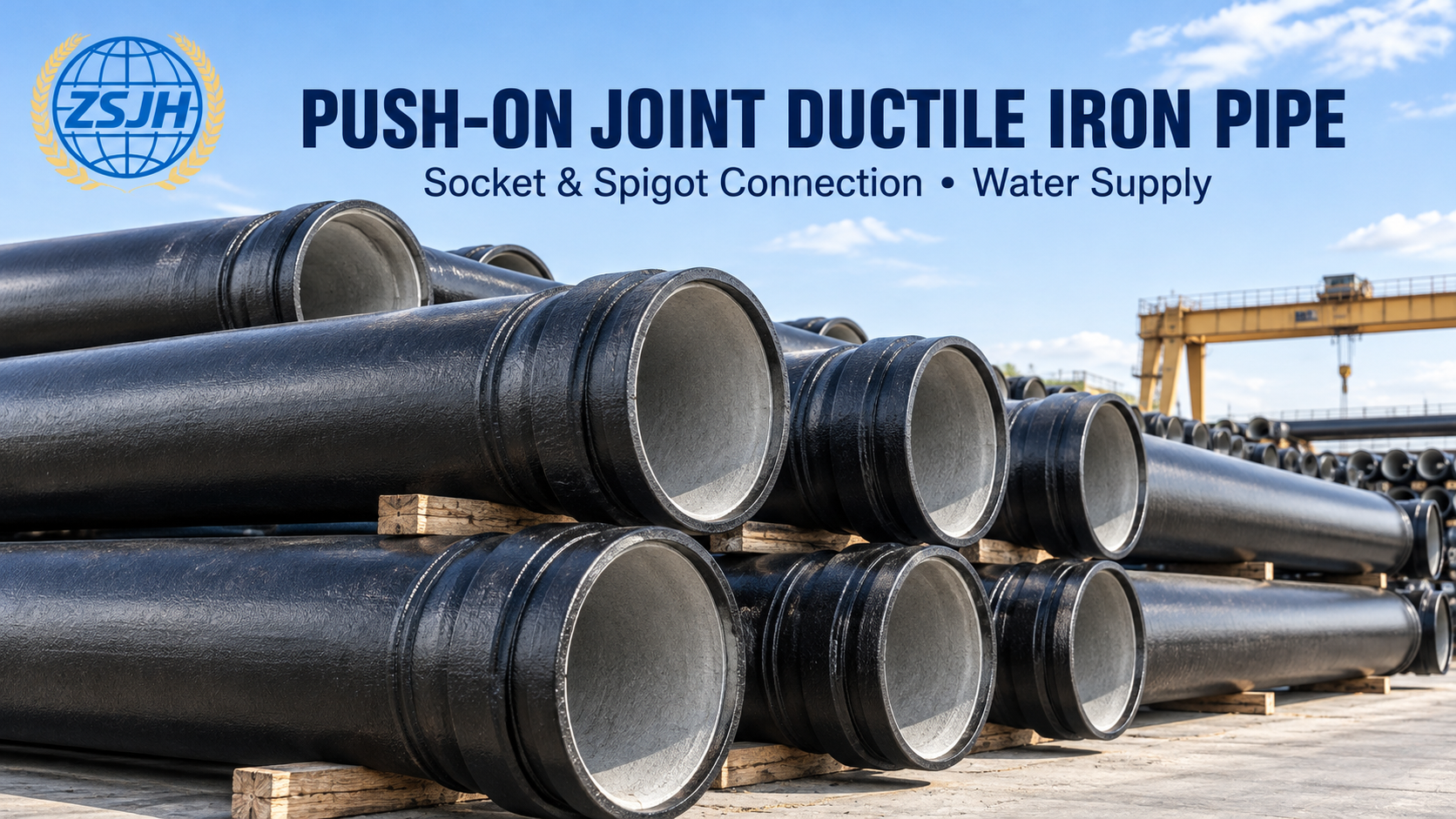
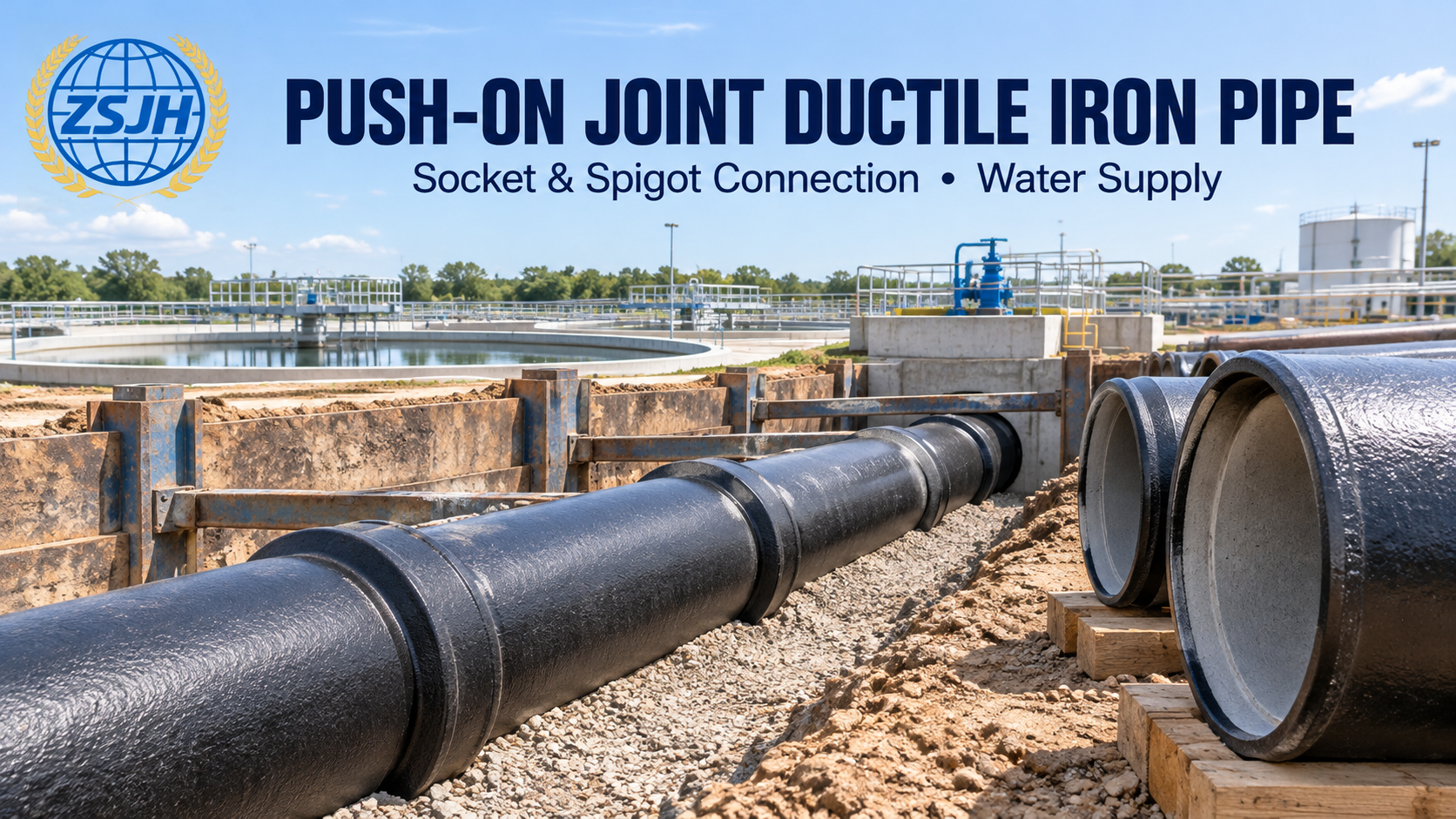
ZSJH supplies push-on joint ductile iron pipes for municipal water supply, water transmission mains, distribution networks and industrial water infrastructure. The socket-and-spigot connection uses a rubber sealing gasket to create a watertight joint without welding at the connection.
For buyers selecting a ductile iron pipe for water supply, the key considerations are more than diameter alone. Pipe class, joint performance, internal lining, external coating and gasket compatibility should all match the operating conditions and project specification.
Socket — the receiving end
The enlarged socket, also called the bell, contains a shaped recess for the sealing gasket. Its dimensions and surface condition are important for correct gasket seating and joint assembly.
Spigot — the insertion end
The plain spigot enters the socket of the adjoining pipe. A correctly prepared chamfer helps insertion, while an insertion-depth mark provides a reference during assembly.
Rubber sealing gasket — the sealing component
The gasket is compressed between the socket and spigot to form the seal. Its profile must match the joint design, and its material must be suitable for the conveyed water, service temperature and applicable drinking-water requirements.
A standard push-on joint provides sealing and limited angular deflection within the manufacturer's specified limits. It does not automatically provide axial restraint. Where hydraulic thrust requires restraint, the project design must specify suitable thrust blocks, restrained joints or another approved solution.
The following examples describe common specification fields. They are not a declaration that every combination is available.
| Parameter | Common Designation or Example | What Buyers Should Confirm |
|---|---|---|
| Product type | Push-On Joint Ductile Iron Pipe; Socket and Spigot Ductile Iron Pipe | Required joint system and compatibility with existing pipelines |
| Nominal diameter | DN100, DN150, DN200, DN250, DN300 and other project sizes | Required DN, actual outside diameter and hydraulic bore |
| Pipe class | C25, C30, C40; K9 where specified | Applicable standard, edition, wall thickness and required performance |
| Joint pressure capability | Manufacturer-declared operating, surge and test limits | Ratings for the selected diameter and joint configuration |
| Pipe length | Standard production length or agreed cut length | Effective laying length, overall length and shipping requirements |
| Internal lining | Cement mortar lining or specified alternative | Water chemistry, lining type, thickness and acceptance requirements |
| External protection | Metallic zinc or zinc-alloy coating with finishing layer; special protection where required | Soil conditions, coating system and specified coating quantity or thickness |
| Gasket | EPDM or another approved elastomer, subject to specification | Joint profile, medium compatibility, temperature and drinking-water approval |
| Accessories | Matching gaskets, lubricant and compatible fittings | Included quantities and compatibility |
| Inspection documents | Dimensional, material, lining/coating and pressure-test records as specified | Required documents and inspection arrangements before ordering |
DN, C class, K class and PN describe different characteristics. DN identifies nominal size; C designations relate to pressure class; K designations relate to wall-thickness class under the applicable specification. PN is commonly used for flanged components and should not replace the pipe or joint performance data.
A typical enquiry description might be:
Push-On Joint Ductile Iron Pipe, DN200, Class C40, cement mortar lining, specified external coating, to EN 545.
The final quotation should also identify the joint design, length, gasket specification and required documentation.
| Standard | Scope and Relevance |
|---|---|
| ISO 2531 | Requirements for ductile iron pipes, fittings, accessories and joints for water applications |
| EN 545 | Ductile iron pipes, fittings, accessories and joints for water pipelines |
| ISO 4179 | Cement mortar lining for ductile iron pipes and fittings |
| ISO 8179 series | External zinc-based protection for ductile iron pipes; applicable part depends on the coating system |
| ANSI/AWWA C151 | Ductile iron pipe requirements for projects using the AWWA system |
| ANSI/AWWA C111 | Rubber-gasket joint requirements within the AWWA system |
| ANSI/AWWA C104 | Cement mortar lining requirements within the AWWA system |
The required standard and edition should be stated in the purchase specification. Dimensions, joint systems and accessories from different standard systems should be checked for compatibility.
For potable-water projects, compliance with a pipe manufacturing standard alone does not establish all required drinking-water approvals. Buyers should specify the destination market's requirements for lining, gaskets and other water-contact materials.
Cement mortar lined ductile iron pipe is widely used in water infrastructure. The lining separates the conveyed water from the iron surface and helps maintain hydraulic performance.
The cement type and lining specification should be selected for the water characteristics. Aggressive water or unusual process conditions may require a different lining system.
External protection should be selected according to the installation environment. A zinc-based coating with a compatible finishing layer is a common approach; more demanding soil conditions may require additional protection.
Specify the complete coating system rather than colour alone. A black finish does not identify the underlying metallic coating, its quantity or its suitability for the site.
Municipal water distribution: underground pipe networks supplying residential, commercial and public facilities.
Water transmission mains: pipelines carrying raw or treated water between intake points, treatment facilities, reservoirs and distribution networks.
Industrial water infrastructure: supply lines for industrial facilities where the medium and operating conditions are compatible with the selected lining and gasket.
Water treatment projects: buried interconnecting pipelines, with suitable transitions to valves, equipment and flanged connections.
Pipeline replacement and extension: new sections connected to existing networks after checking dimensions and joint compatibility.
Pipe selection should consider operating pressure, surge, external loads, burial depth, bedding, soil conditions and thrust restraint.
A quotation built around your specification
Provide the required diameter, pipe class, joint type and protection system so that the offer can be prepared around your project's requirements.
Coordinated sourcing of pipes and accessories
Discuss matching gaskets, compatible fittings and installation accessories together with the pipe supply to help avoid incomplete orders.
Clear technical and commercial details
Confirm the offered standard, product configuration, documentation, packing, quantity and delivery terms before placing an order.
Support for overseas procurement
Discuss destination requirements and shipping arrangements early, particularly where pipe length, packing or inspection requirements affect delivery.
As a push-on joint ductile iron pipe supplier, ZSJH welcomes enquiries from contractors, distributors and project procurement teams seeking a clearly specified supply package.
It is a ductile iron pipe connected by inserting a plain spigot into a gasket-equipped socket. Compression of the rubber gasket creates the watertight seal.
The push-on connection does not require welding. Correct assembly requires cleaning, proper gasket seating, approved lubricant, alignment and insertion to the specified depth.
A standard push-on joint is generally non-restrained. If axial restraint is required, specify a qualified restrained system or provide another restraint method through the project design.
Not necessarily. The nominal size alone does not establish compatibility. Check outside diameter, socket geometry, gasket profile, standard system and joint tolerances.
They are different designation systems and should not be treated as interchangeable. Compare the applicable dimensional and performance tables for the required diameter and standard.
Selection depends on the conveyed water and installation environment. Provide available water-quality and soil information, together with the project specification, when requesting an offer.
Suitability depends on the complete supplied configuration, including the lining, gasket and other water-contact materials. Required destination-market approvals should be confirmed before ordering.
This page focuses on water applications. Sewage service requires a separately verified configuration, including the relevant standard, lining and gasket compatibility. EN 598 requirements may apply where specified.
Please send a bill of quantities listing each size, pipe class, fitting type and accessory quantity. Availability and compatibility can then be reviewed as one supply package.
Send ZSJH your project specification or bill of quantities for a tailored offer.
Please include:
Required standard and edition
Nominal diameter and quantity for each size
Pipe class and required length
Operating pressure, surge conditions and test requirements
Internal lining and external coating specification
Gasket and drinking-water approval requirements
Required fittings, lubricant and other accessories
Inspection and documentation requirements
Delivery destination and target schedule
Have a drawing or tender specification? Share it with your enquiry so the proposed pipe configuration can be checked against your requirements.
Request a Quotation for Your Water Pipeline Project


