:sales@zsjhsteelgroup.com WhatsApp:+86-15122582058








| Quantity: | |
|---|---|


ZSJH
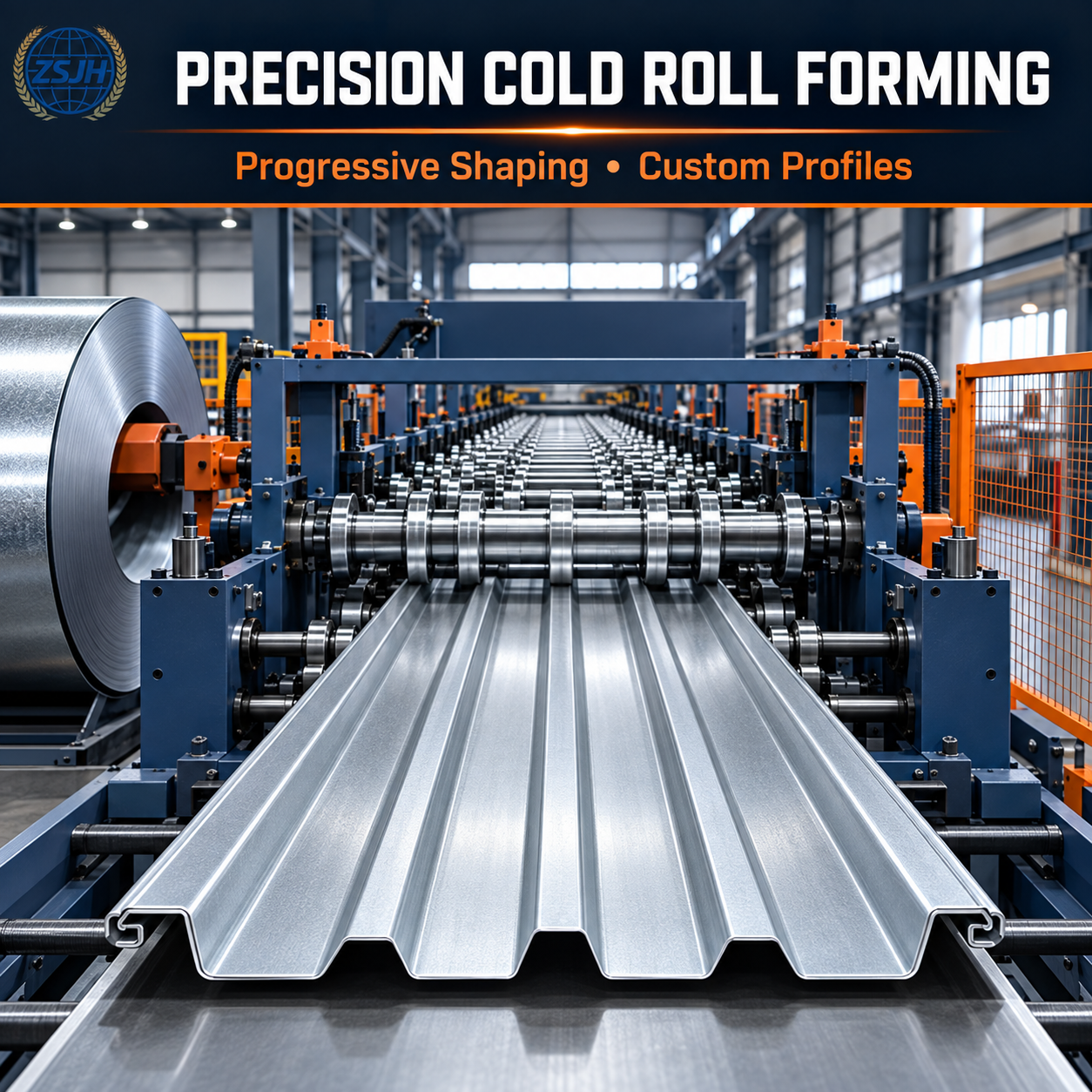
Cold-forming equipment can produce different U-shaped, Z-shaped, omega-style or project-specific profiles, subject to tooling and manufacturing capabilities.
The profiled geometry distributes steel away from the wall’s neutral axis and can provide useful bending stiffness while controlling the mass of the section.
Pile length may be coordinated according to excavation depth, wall height, embedment requirements, equipment capacity and transportation limitations.
Progressive roll-forming provides repeatable folds, profile depth and interlock geometry when the production line and tooling are correctly controlled.
Certain cold-formed profiles may have a lower unit mass than heavier hot-rolled piling sections, which can simplify handling for suitable projects. Actual lifting and installation requirements depend on the selected section.
Where project and soil conditions permit, cold-formed piles can be used for temporary trench support and subsequently extracted. Piles must be inspected before any proposed reuse.
Products may be supplied with an as-rolled, pickled, shop-primed, galvanized or project-specified protected surface, subject to material availability and manufacturing agreement.
Cold-formed steel sheet piles can be considered for:
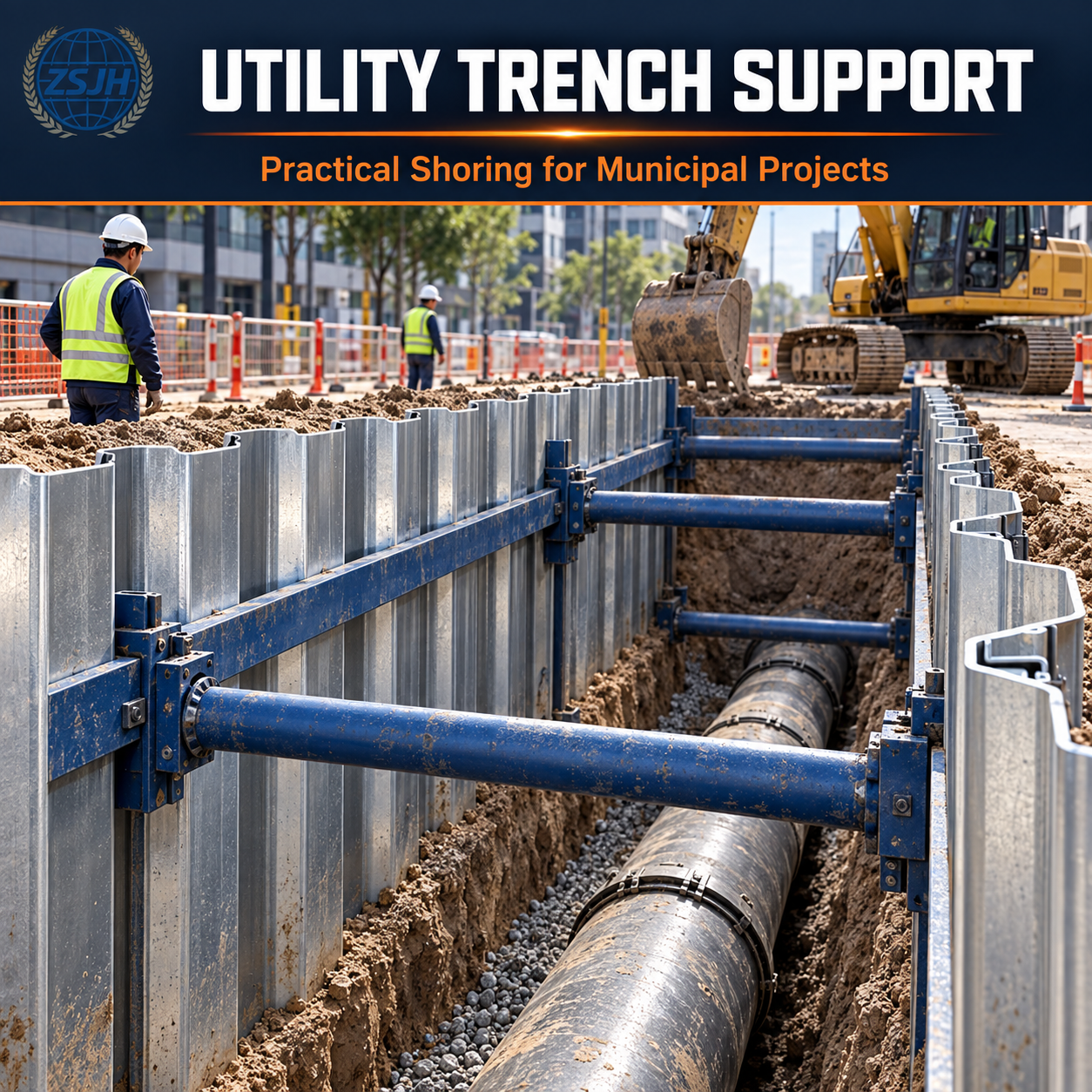
Utility pipeline trenches
Municipal drainage works
Sewer and water-supply projects
Shallow excavation support
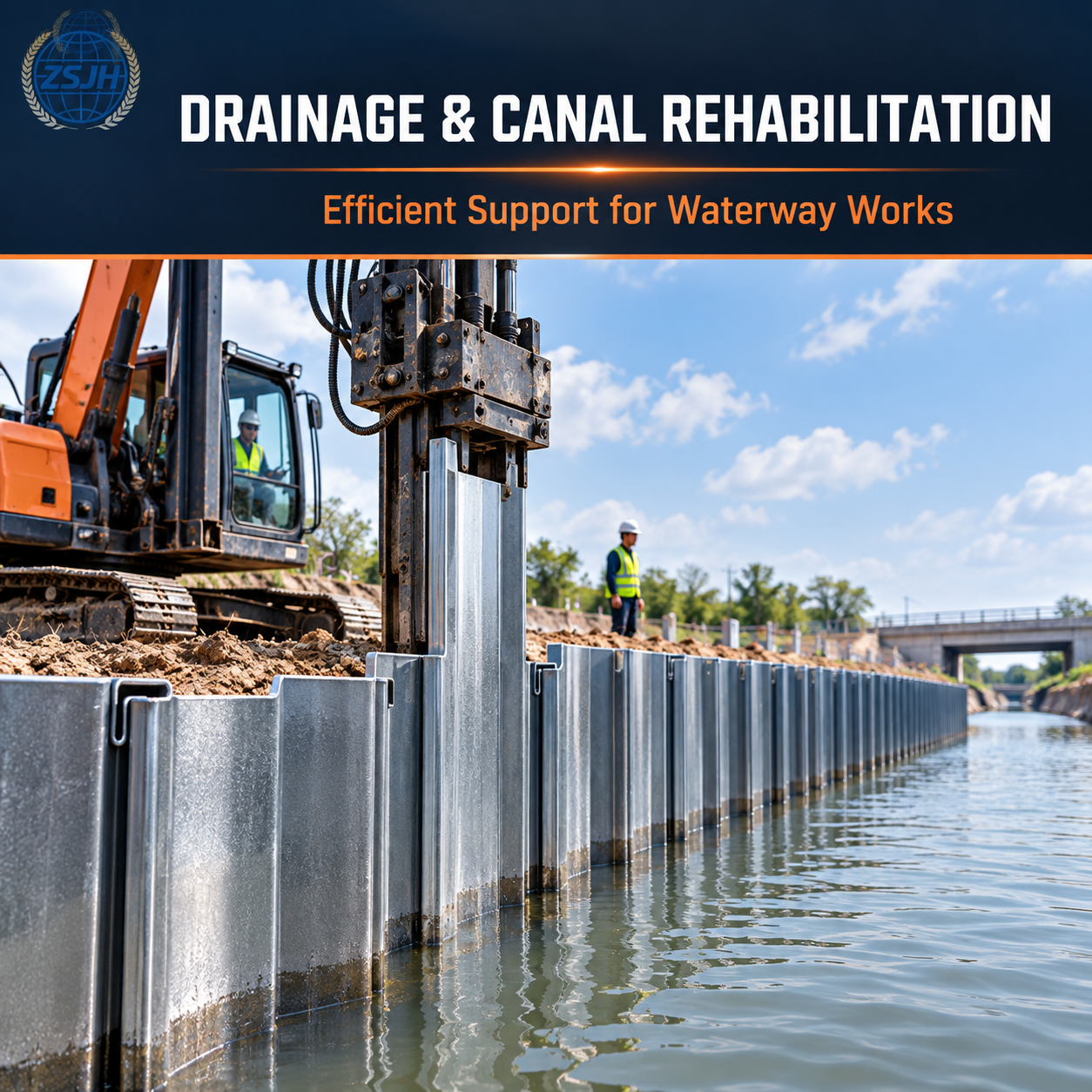
Canal rehabilitation
Small river and drainage-channel walls
Erosion-control structures
Lake and pond edge stabilization
Temporary earth-retaining works
Roadside drainage construction
Small pumping stations
Culvert installation
Flood-control improvement works
Agricultural water-management projects
Landscape and waterfront retaining walls
The product is particularly suitable for projects requiring:
Flexible section and length selection
Rapid linear-wall installation
Compact construction equipment
Temporary or semi-permanent support
Municipal and utility infrastructure
Shallow to moderate retaining heights
Controlled material and transportation costs
Installation in restricted working areas
Cold-formed piling should not automatically be selected solely because a project is described as “light” or “temporary.” The wall must still satisfy all applicable structural, geotechnical, hydraulic and construction-stage requirements.
The flat steel feed material is formed into a structural profile containing a web, folds or flanges and interlocking edges. The finished shape provides greater bending stiffness than an unformed flat plate of comparable material.
Adjacent piles are connected through their formed edge interlocks. When correctly engaged and installed, the individual sections create a continuous retaining wall.
Depending on wall height and loading, the sheet piles may be used as:
Cantilever walls
Internally braced trench walls
Walls with walers and struts
Anchored retaining walls
Temporary excavation barriers
The appropriate arrangement must be determined by engineering analysis.
The wall can retain soil and may reduce water passage through the excavation boundary. Standard cold-formed interlocks, however, must not automatically be described as completely watertight.
| Parameter | Available Specification |
|---|---|
| Product Name | Cold-Formed Steel Sheet Pile |
| Manufacturing Method | Continuous roll-forming or approved press-forming process |
| Profile Type | U-shaped, Z-shaped, omega-style or customized interlocking profile |
| Base Material | Structural steel strip, coil or plate suitable for cold forming |
| Steel Grade | According to the specified product standard and project requirements |
| Reference Standards | EN 10249-1/-2, ASTM A857/A857M or another agreed standard |
| Section Width | According to the selected profile |
| Section Depth | According to the selected profile |
| Material Thickness | According to the selected profile and production capability |
| Unit Mass | According to the selected profile |
| Moment of Inertia | According to the confirmed section data |
| Section Modulus | According to the confirmed section data and wall configuration |
| Length | Project-specific, subject to production, handling and transportation limits |
| Interlock | Cold-formed interlocking edge |
| Surface Condition | As rolled or project-specified treatment |
| Coating Options | Galvanizing, shop primer or another agreed system, subject to availability |
| Edge Condition | Formed and trimmed according to the selected profile |
| Dimensional Tolerances | According to the applicable product standard or purchase specification |
| Fabrication Options | Cutting, lifting holes or approved project-specific processing |
| Marking | According to the confirmed order requirements |
| Inspection Documents | According to the purchase specification |
| Packaging | Secured bundles suitable for handling and export transportation |
All dimensions and section properties are profile-specific. Width, depth, thickness, unit mass, moment of inertia and section modulus must be confirmed from the technical datasheet of the selected product.
Standards and steel grades belonging to different specification systems should not be treated as automatically equivalent.
Material selection should account for:
Required yield strength
Tensile properties
Elongation
Cold-forming suitability
Weldability, where applicable
Material thickness
Installation stresses
Corrosion allowance
Coating compatibility
Applicable national or project standard
The feed material must possess suitable forming characteristics. Inappropriate material or an excessively severe bending radius can increase the risk of cracking or dimensional inconsistency.
Structural steel coil, strip or plate is selected according to the ordered grade, thickness, width and surface condition.
The raw material may be inspected for:
Material identification
Chemical composition documentation
Mechanical properties
Thickness and width
Flatness
Surface condition
Edge quality
For continuous production, the steel coil is mounted on an uncoiler and fed into the line under controlled tension.
The steel passes through leveling equipment to reduce coil set and provide stable feeding into the forming stands.
A sequence of rollers gradually bends the material into the specified profile at ambient temperature. Progressive forming helps control local strain, profile geometry and dimensional consistency.
The longitudinal edges are formed into the required interlock geometry. Tooling alignment is important for reliable engagement between adjacent piles.
Calibration stands control overall width, profile depth, straightness and interlock position.
The finished section is measured and cut to the ordered project length using suitable production equipment.
Finished-product checks may include:
Profile-width measurement
Section-depth measurement
Material-thickness verification
Length and straightness inspection
Interlock engagement checks
Surface-condition inspection
Cut-edge inspection
Unit-mass verification
Marking and document review
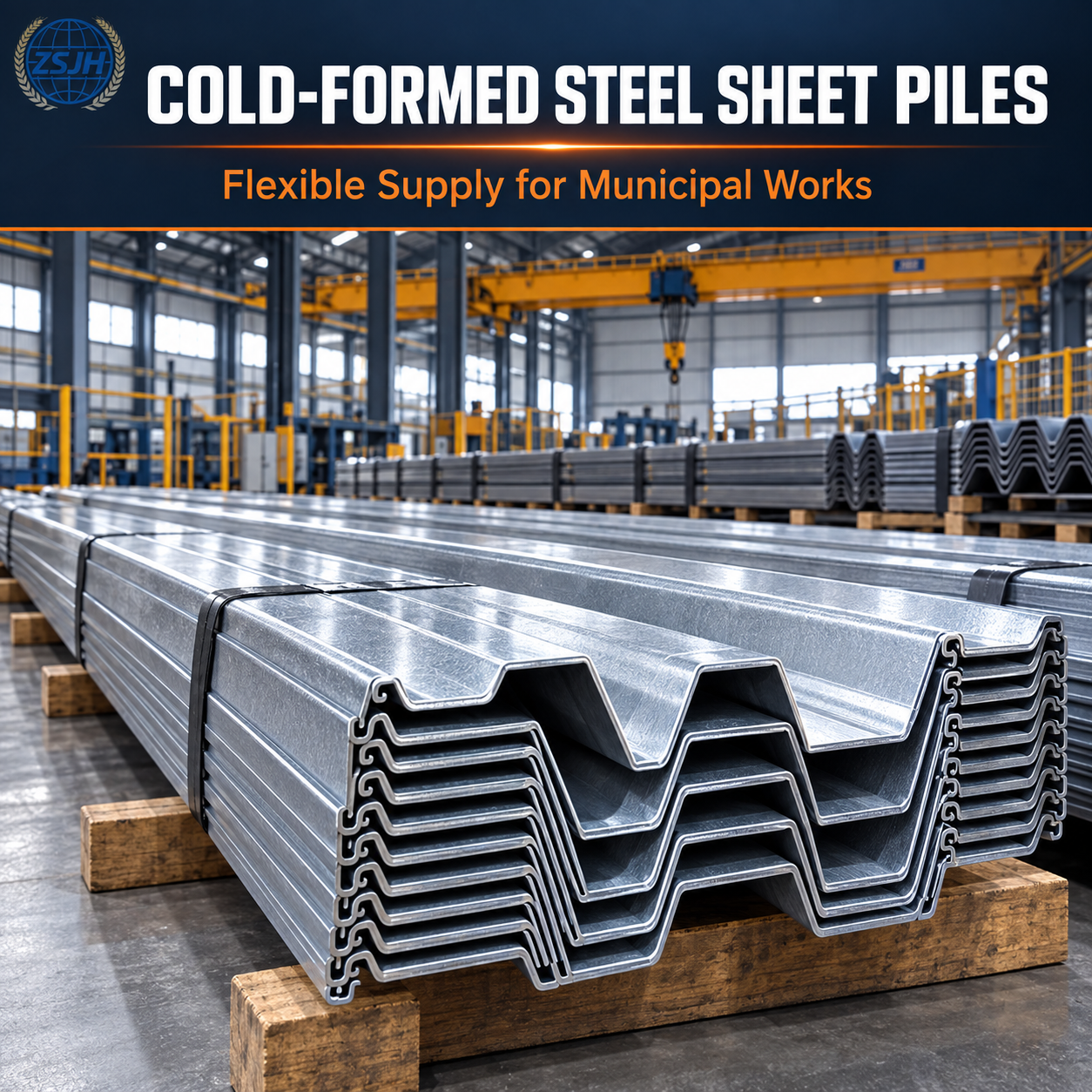
Qualified piles are stacked, separated where necessary, secured with suitable straps and prepared for loading and export transportation.
Cold forming allows profile geometry to be coordinated with tooling, production limits and project requirements.
Continuous coil-fed production can support consistent manufacturing and project-length cutting for suitable order quantities.
Piles supplied in confirmed lengths can reduce field cutting, material waste and additional site preparation.
Profiles can often be nested or stacked in compact bundles, depending on their geometry.
Suitable piles may be installed using vibratory equipment, hydraulic pressing, excavator-mounted attachments or other approved methods.
Temporary piles may be extracted where site conditions permit, reducing the amount of permanent material left underground.
At the end of their usable life, steel piles can enter established recycling streams, subject to local recovery arrangements.
A project-specific method statement should address:
Installation equipment
Required driving or pressing force
Pile alignment and verticality
Guide-frame requirements
Interlock orientation
Soil obstructions
Hard driving and refusal criteria
Risk of profile deformation
Trench support sequence
Waler and strut installation
Groundwater control
Vibration and noise restrictions
Adjacent buildings and utilities
Pile extraction procedures
Because some cold-formed sections may have lower local stiffness than heavy hot-rolled profiles, lifting points, pitching procedures, guide systems and driving equipment must be selected carefully to avoid local damage or buckling.
For utility and pipeline trenches, sheet piles are only one component of the complete support system. A trench may also require:
Horizontal walers
Cross-lot struts
Hydraulic trench braces
Internal frames
Safe access systems
Edge protection
Dewatering equipment
Excavation monitoring
Strut spacing, waler capacity and installation sequence must be designed according to excavation depth, soil pressure and construction loads.
Durability requirements depend on whether the piles are temporary, permanent, buried, exposed to freshwater or installed in a more aggressive environment.
Possible protection strategies include:
Design corrosion allowance
Galvanized feed material or post-fabrication galvanizing
Shop-applied primer
Project-specific coating systems
Cathodic protection for suitable applications
Concrete capping or localized encasement
Planned inspection and maintenance
Galvanizing and forming sequence must be technically coordinated. Coating thickness, bend severity and forming practice can affect the appearance and integrity of a metallic coating.
Interlocked cold-formed piles may reduce groundwater inflow, but untreated interlocks should not be assumed to provide a fully watertight barrier.
Where seepage control is important, the project may require:
Compatible interlock sealant
Selected joint welding
Filter layers
Drainage systems
Dewatering wells or pumps
Grouting
Water-level monitoring
The appropriate method should be based on soil permeability, groundwater pressure and allowable inflow.
ZSJH can coordinate the following according to technical feasibility:
Profile shape
Section width and depth
Material thickness
Steel grade
Customized length
Interlock geometry
Surface condition
Galvanized or coated material
Cut-to-length processing
Lifting-hole preparation
Product marking
Packaging requirements
Inspection documents
Custom sections may require tooling confirmation, trial forming and minimum order quantities.
Hot-rolled sheet piles are formed at elevated temperature and normally incorporate hot-rolled interlocks. Cold-formed piles are produced from steel strip or plate by bending at ambient temperature. Their profile ranges, interlock designs and section properties differ.
Not necessarily. Their suitability depends on the selected section properties, steel grade, wall configuration, soil conditions and support system. Engineering calculations are required for every project.
Yes, subject to tooling, production capacity, technical feasibility and order quantity. A drawing and required section properties should be provided for evaluation.
Galvanized material may be available, but material thickness, coating properties, bend geometry and manufacturing sequence must be technically confirmed.
Standard interlocks are not inherently completely watertight. Sealant, welding or another engineered groundwater-control method may be required.
Yes, when the sheet piles, walers, struts, excavation sequence and groundwater control are designed for the actual trench conditions.
Possible equipment includes vibratory drivers, press-in equipment and excavator-mounted attachments. Selection depends on section stiffness, pile length, soil resistance, noise restrictions and site access.
Temporary piles may be extracted where conditions permit. Before reuse, inspect them for permanent deformation, cracks, damaged interlocks, section loss and damaged pile ends.
Yes. Lengths can be produced according to the confirmed piling schedule, subject to manufacturing, lifting and transportation limits.
Please provide:
Required profile or section drawing
Applicable product standard
Steel grade
Material thickness
Pile width and depth
Individual pile length
Total quantity
Surface-treatment requirements
Inspection-document requirements
Packaging requirements
Destination port
Required delivery schedule
ZSJH supports municipal, civil, foundation, water-management and temporary retaining projects with steel products and coordinated supply services.
Our team can review profile drawings, material requirements, lengths, surface conditions and processing needs according to available manufacturing capabilities.
Raw-material verification, forming-process control, dimensional checks, interlock inspection, length verification and surface inspection are carried out according to the confirmed order.
Cutting, lifting-hole preparation, marking, coating coordination and other approved processing options can be arranged according to project requirements.
Finished piles are bundled and protected according to their profile, length and international transportation requirements.
ZSJH supports specification confirmation, drawing review, quotation preparation, production coordination, inspection-document preparation and shipment communication.
Send ZSJH your profile drawing or required section designation, steel grade, material thickness, pile length, quantity, surface treatment, inspection requirements and destination port.
If the section has not yet been selected, please also provide the intended application, excavation or retaining height, soil conditions, groundwater level, external loads, corrosion environment and installation limitations.
ZSJH can assist with comparing available supply options. Final structural capacity, embedment, support arrangement and installation method must be approved by the project’s qualified engineers.


