:sales@zsjhsteelgroup.com WhatsApp:+86-15122582058







| Quantity: | |
|---|---|


ZSJH
The web and flanges form a continuous Z-shaped section, allowing the wall system to develop efficient structural properties when adjacent piles are correctly interlocked.
Compared with profiles whose interlocks are located closer to the wall centerline, the interlocks of Z-type sheet piles are generally positioned near the outer faces of the wall. This arrangement can contribute to efficient section performance.
Each pile connects to the next through integral hot-rolled interlocks. Correct interlock engagement creates a continuous wall capable of retaining soil and supporting lateral loads when incorporated into a properly engineered system.
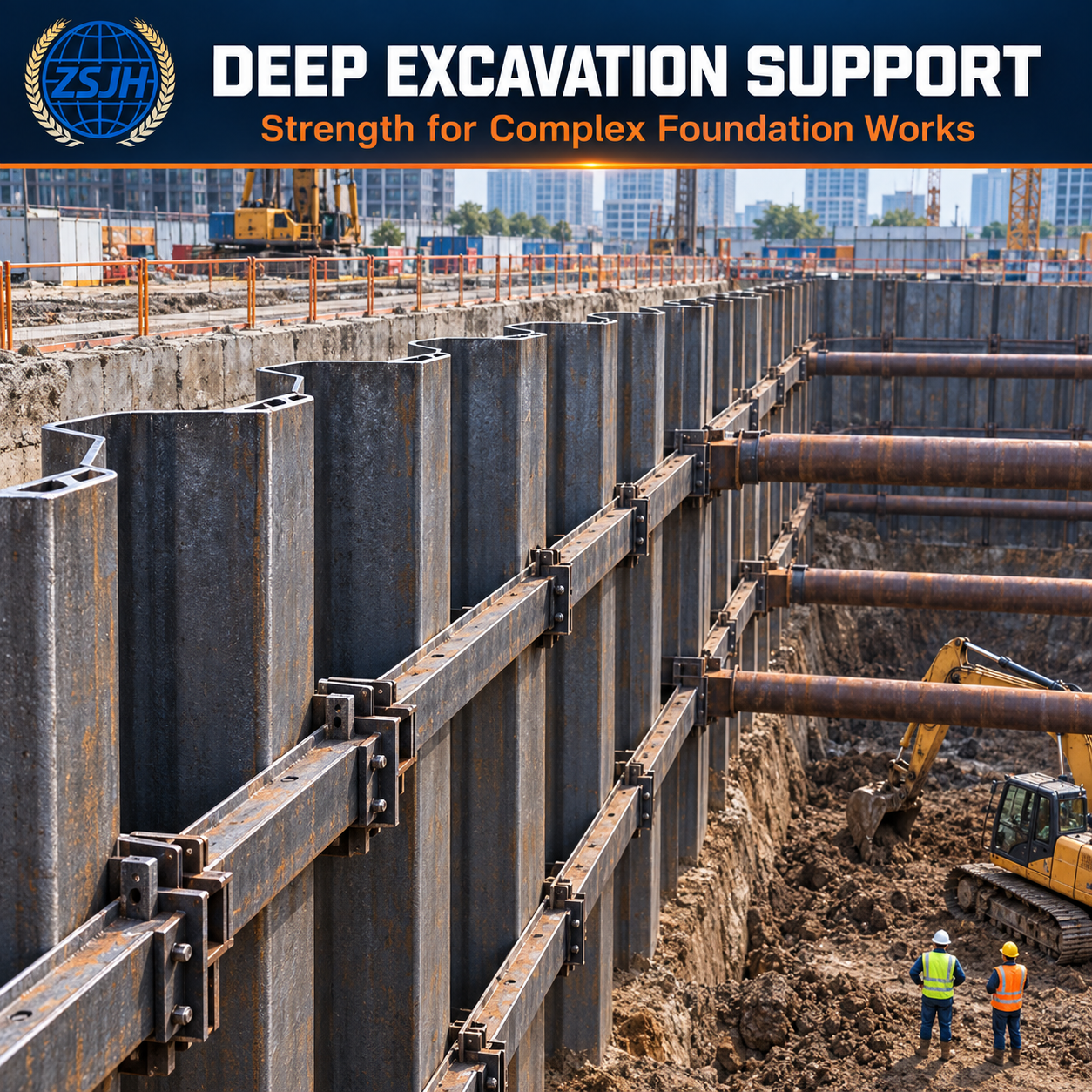
Z-type sheet piles may be used in cantilever, anchored or internally braced walls. The appropriate configuration depends on excavation depth, soil pressure, groundwater, deformation limits and surrounding structures.
A suitable Z-profile can provide high bending resistance relative to its mass, helping engineers balance structural performance and material consumption.
The product can be considered for deep excavations, marine walls and infrastructure projects with demanding lateral-load requirements.
Interlocks are formed during the hot-rolling process rather than attached separately. Their geometry is controlled according to the selected product standard and profile.
Different profiles offer different widths, depths, thicknesses, unit masses, moments of inertia and section moduli, allowing selection according to project demand.
Pile length can be specified according to the design toe level, retained height, soil conditions, transportation limitations and available production range.
Depending on site conditions, Z-type sheet piles can be installed using vibratory hammers, impact hammers or hydraulic press-in equipment.
The piles may form permanent retaining structures or be extracted from temporary works. Any pile intended for reuse should be inspected after extraction.
ZSJH Z-type steel sheet piles can be considered for:
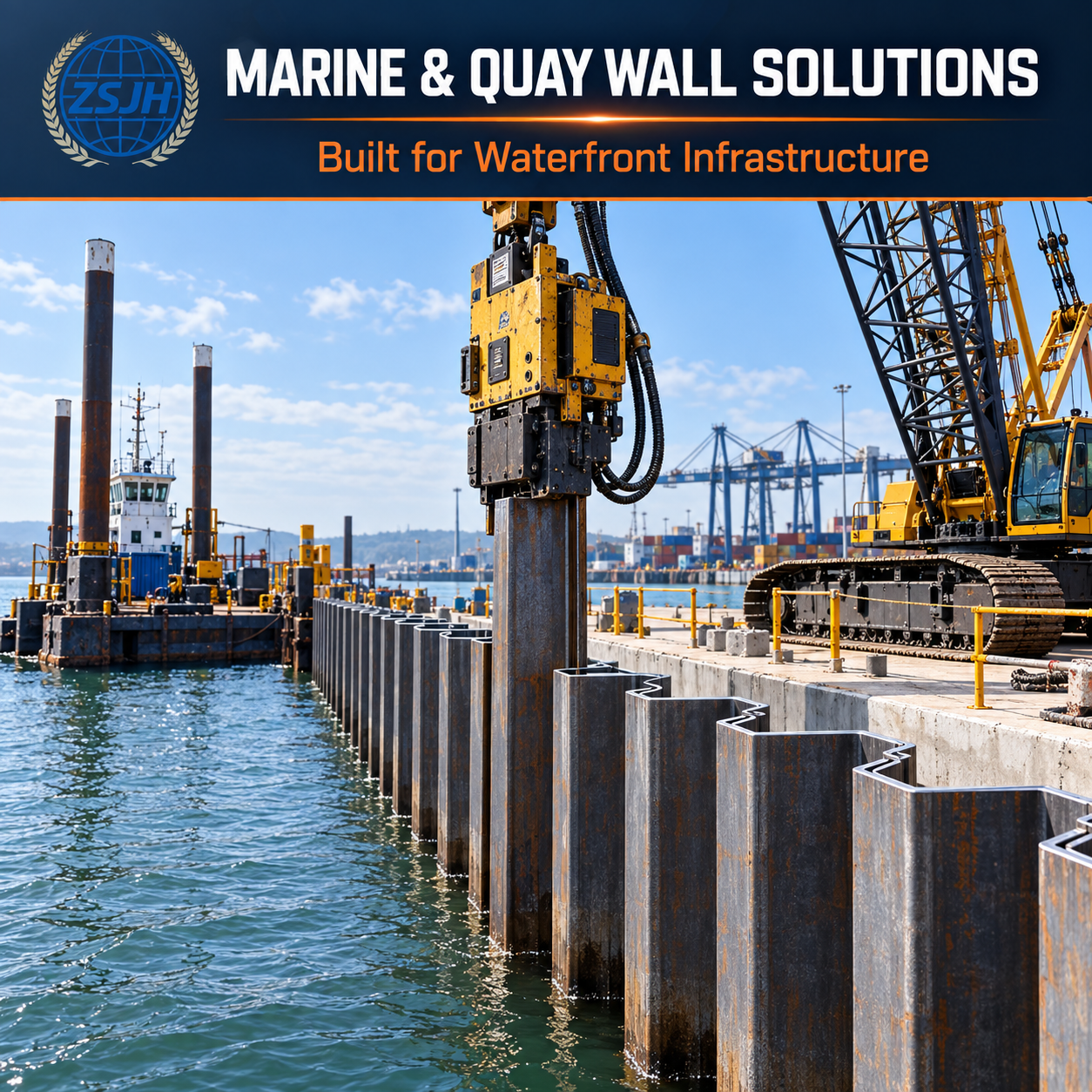
Quay walls and harbor structures
Marine terminals and waterfront developments
Bulkhead and dock-wall construction
Deep foundation excavations
Basement retaining systems
Bridge-abutment construction
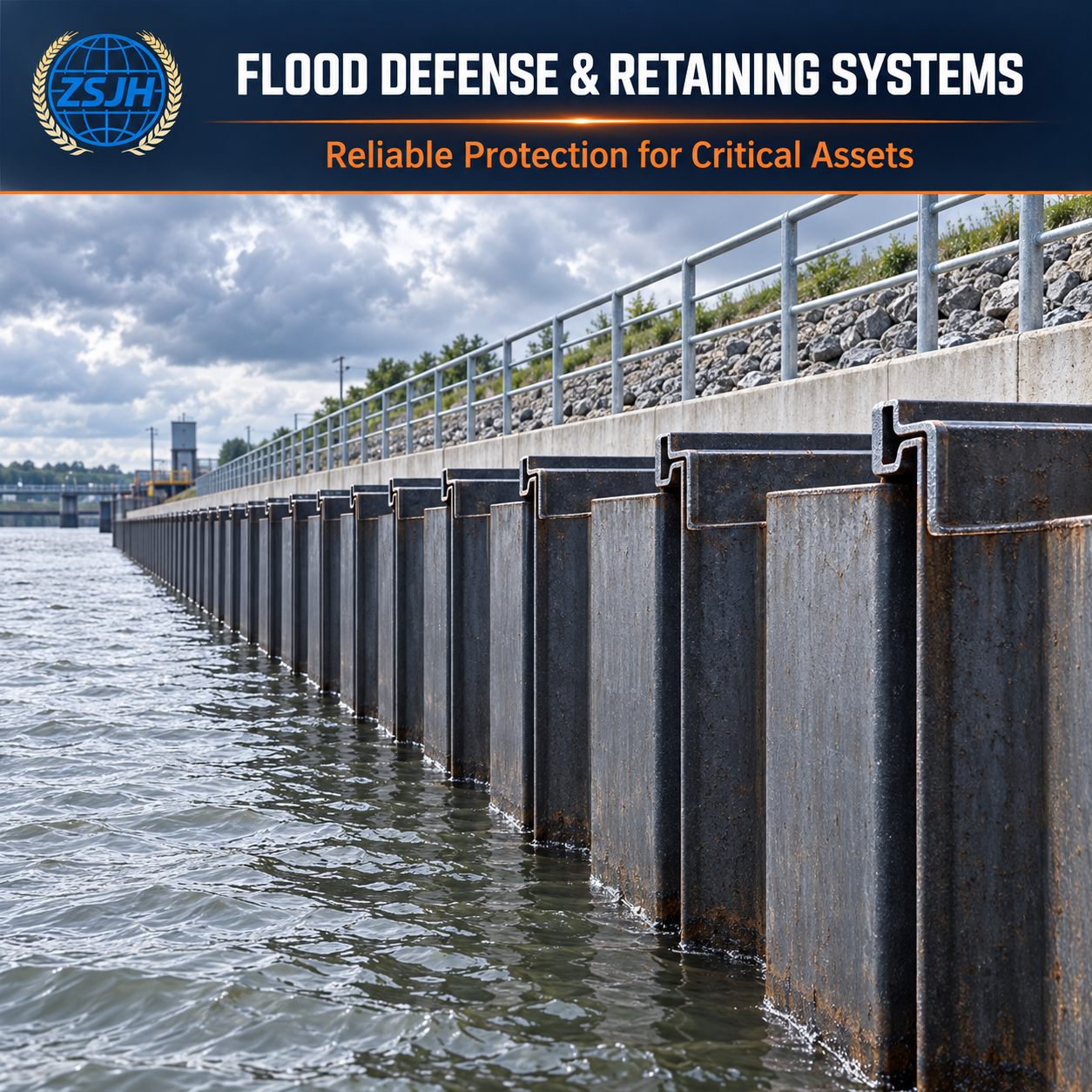
Flood-defense walls and levee reinforcement
Riverbank and canal stabilization
Road and railway retaining structures
Pumping stations and underground facilities
Cut-off and containment structures
Temporary earth-retaining works
Industrial waterfront infrastructure
Coastal-protection projects
The product is suitable for civil, marine, transportation, municipal, energy and industrial projects requiring a continuous steel retaining wall.
Important design considerations include:
Soil stratification and geotechnical properties
Groundwater level and water-pressure difference
Retained height and excavation depth
Lateral earth pressure and external surcharge
Required bending resistance and wall stiffness
Maximum permitted wall movement
Toe penetration and overall stability
Anchor or internal-bracing arrangement
Driving resistance and installation equipment
Nearby buildings and underground utilities
Noise and vibration restrictions
Corrosion environment and design life
Applicable local codes and project standards
| Parameter | Available Specification |
|---|---|
| Product Name | Hot-Rolled Z-Type Steel Sheet Pile |
| Product Form | Interlocking Z-shaped structural section |
| Manufacturing Method | Hot rolled |
| Steel Type | Structural carbon steel or high-strength structural steel |
| Steel Grade | Selected according to the specified product standard and project requirements |
| Common EN Grade Options | S240GP, S270GP, S320GP, S355GP, S390GP or S430GP, subject to availability |
| Other Grade Options | ASTM, JIS, GB or project-specified grades by agreement |
| Reference Standards | EN 10248, ASTM A328/A328M, ASTM A572/A572M, ASTM A690/A690M, JIS A 5528, GB/T 20933 or an agreed project standard |
| Section Width | Determined by the selected Z-profile |
| Section Depth | Determined by the selected Z-profile |
| Web Thickness | Determined by the selected Z-profile |
| Flange Thickness | Determined by the selected Z-profile |
| Unit Mass | Determined by the selected Z-profile |
| Moment of Inertia | According to the selected section and wall configuration |
| Section Modulus | According to the selected section and wall configuration |
| Length | Project-specific, subject to rolling and transportation capabilities |
| Interlock Type | Integral hot-rolled interlock |
| Surface Condition | As rolled; blasting, coating or other treatment by agreement |
| End Condition | Mill cut, saw cut or project-specified preparation |
| Fabrication Options | Lifting holes, welding, splicing or other agreed processing |
| Dimensional Tolerances | According to the applicable product standard |
| Marking | According to the order, standard and identification requirements |
| Inspection Documents | According to the purchase specification |
| Packaging | Secured bundles suitable for lifting and export transportation |
The standards and grades shown above represent different specification systems and must not be regarded as automatically equivalent. The applicable standard, grade, profile and mechanical properties must be confirmed in the purchase order.
Z-type sheet piles are available in multiple section sizes. Each section has its own:
Nominal width and depth
Web and flange thickness
Cross-sectional area
Unit mass
Moment of inertia
Elastic section modulus
Plastic section modulus
Coating area
Interlock geometry
These values should be taken from the confirmed manufacturer’s section table. Product performance must not be determined from section depth or steel grade alone.
The selected wall should be checked for bending, shear, deflection, interlock behavior, toe stability, overall stability, anchor forces, brace loads and installation stresses as applicable.
The chemical composition of the steel is controlled according to the ordered grade and applicable material standard.
Molten steel is cast into suitable semi-finished products for subsequent profile rolling.
The semi-finished steel is reheated under controlled conditions to achieve the temperature required for hot deformation.
High-pressure water or suitable descaling equipment removes surface oxide before and during rolling.
The heated steel passes through a sequence of shaped rolls. The web, flanges and interlocks are progressively formed into the specified Z-shaped section.
The rolled profiles are cooled under controlled production conditions to support dimensional stability and required material properties.
Mechanical straightening equipment is used to control sweep, camber and overall pile alignment within the requirements of the specified standard.
Piles are cut to the ordered length. Additional processing, such as lifting holes or approved splice preparation, can be provided when specified.
Inspection may include:
Chemical-composition verification
Mechanical-property testing
Section-dimension measurement
Length and straightness inspection
Unit-mass verification
Surface-condition inspection
Interlock-geometry checks
Interlock-engagement checks
Product marking and document review
Finished piles are aligned, secured in bundles and identified for safe handling, storage and transportation.
The Z-profile positions material away from the wall’s neutral axis, providing efficient structural behavior for appropriately designed retaining systems.
Wider sections may reduce the number of individual piles and interlocks required for a given wall length. The actual benefit depends on the selected section.
Properly manufactured and engaged interlocks allow individual piles to form a continuous structural wall.
The piles can be incorporated into cantilever, anchored, tied-back or internally braced support systems.
Sheet-pile installation can reduce extensive excavation and formwork compared with certain conventional retaining-wall methods, depending on project conditions.
Temporary piles may be extracted and considered for reuse when their remaining condition satisfies the requirements of the next project.
Steel sheet piles can enter established recycling channels after their useful service life, subject to local recovery practices.
The appropriate installation method should be selected after evaluating soil conditions, pile length, section stiffness, site access and environmental restrictions.
Common installation equipment includes:
Vibratory pile hammers
Impact pile hammers
Hydraulic press-in systems
Crane-mounted piling equipment
Leader-guided piling rigs
Guide frames are commonly used to control pile position, alignment and verticality. Pre-augering, pre-drilling or other installation aids may be considered where permitted by the engineer and local regulations.
Installation planning should account for:
Pitching and lifting procedures
Interlock orientation
Wall alignment
Driving sequence
Penetration rate
Driving resistance
Obstructions and hard soil layers
Refusal criteria
Noise and vibration monitoring
Potential interlock damage
Adjacent structures and services
Standard sheet-pile interlocks should not be described as completely watertight. Interlocked walls can restrict soil movement and reduce water passage, but actual seepage depends on:
Interlock geometry and condition
Installation accuracy
Groundwater pressure
Soil particles within the interlocks
Wall length and number of connections
Construction tolerances
Sealing treatment
Where water control is important, an engineered solution may include interlock sealant, welded interlocks, drainage, pumping or another specified system. The required treatment should be determined by the project designer.
Carbon-steel sheet piles may corrode when exposed to soil, freshwater, seawater, tidal zones or industrial environments. Durability design should therefore consider the actual corrosion zones and required service life.
Available project strategies may include:
Sacrificial corrosion allowance
Protective coating systems
Abrasive blasting and specified surface preparation
Cathodic protection
Concrete facing or encasement in selected areas
Selection of a marine-environment steel grade
Inspection and maintenance programs
Coating type, dry-film thickness, preparation grade and application area should be stated in the purchase specification. Service life cannot be determined solely from the initial thickness or steel grade.
ZSJH can coordinate the following options subject to technical confirmation:
Z-profile and section designation
Steel grade and applicable standard
Customized pile length
As-rolled or prepared surface
Project-specified coating system
Lifting-hole preparation
Pile-end preparation
Approved welding and splicing
Special identification and marking
Inspection and testing requirements
Export bundling and shipping arrangements
Z-type piles have interlocks located near the outer faces of the wall, while U-type piles have a U-shaped profile with interlocks positioned differently. Their effective wall properties, installation arrangements and handling characteristics differ. Selection should be based on engineering calculations and project conditions.
The engineer should consider bending moment, required stiffness, excavation depth, water pressure, soil conditions, corrosion allowance, driveability, anchor or brace configuration and permitted deformation.
No. Structural capacity depends on both the selected section properties and the specified steel grade. “High strength” should refer to a confirmed grade and design requirement rather than profile shape alone.
No standard interlock should automatically be considered completely watertight. Sealant, welding or another engineered seepage-control measure may be required.
Yes, when the section, steel grade, corrosion allowance, coating or cathodic-protection system is designed for the actual marine exposure and required service life.
Yes. Length can be specified according to the piling schedule, subject to manufacturing range, handling capability and transportation limitations.
Yes, when approved by the project engineer. Welding procedures, splice locations, weld inspection and acceptance requirements must be clearly specified.
Piles used for temporary works may be extracted. Before reuse, they should be checked for straightness, deformation, section loss, cracks, damaged pile ends and interlock condition.
The choice between vibratory, impact and press-in equipment depends on soil resistance, pile length, profile stiffness, noise restrictions, vibration limits and site access.
Please provide:
Section designation or required section properties
Applicable product standard
Required steel grade
Individual pile length
Total quantity or wall area
Surface-treatment requirements
Lifting-hole or fabrication requirements
Inspection-document requirements
Destination port
Required delivery schedule
ZSJH supports steel sheet piling for marine, foundation, retaining and infrastructure projects.
Our team assists with comparing available profiles, standards, steel grades, lengths and supply conditions based on the customer’s confirmed requirements.
Material documents, section dimensions, straightness, surface condition, length and marking can be checked according to the purchase specification.
Cutting, lifting holes, specified surface treatment, welding or other processing can be coordinated when included in the approved order requirements.
Piles are secured in suitable bundles and marked to support identification, lifting, inland transport and international shipping.
ZSJH supports technical clarification, quotation preparation, document confirmation, production coordination and delivery communication.
Send us your piling schedule or project drawings together with the required Z-profile, steel grade, applicable standard, individual pile length, quantity, surface treatment, processing requirements and destination port.
If the section has not yet been selected, you may also provide the intended application, design wall height, soil report, groundwater conditions, design loads, required service life and installation restrictions. ZSJH can assist with supply-option comparisons, while final structural and geotechnical selection remains subject to approval by the project’s qualified engineers.


