:sales@zsjhsteelgroup.com WhatsApp:+86-15122582058






| Quantity: | |
|---|---|


ZSJH
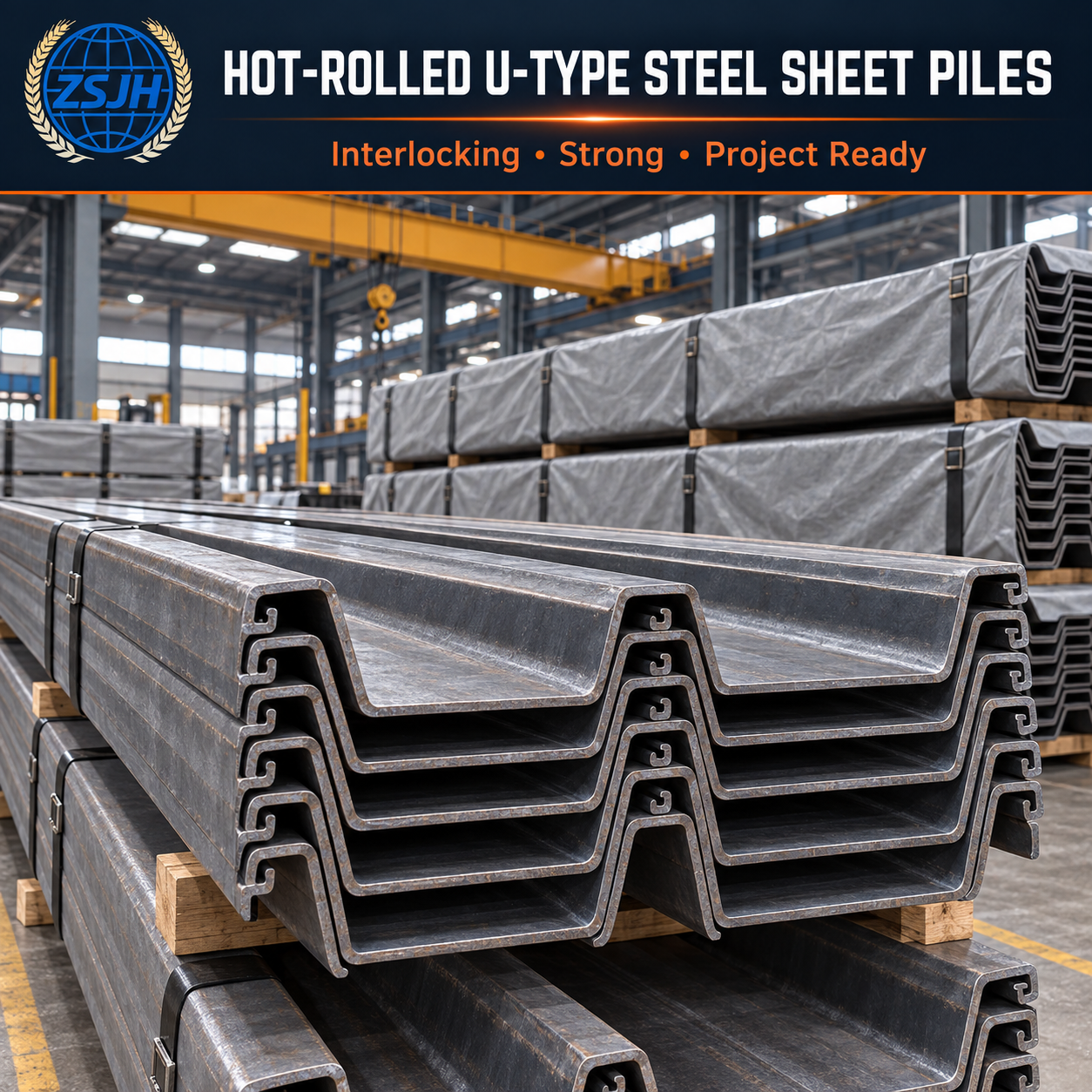
The interlocks are formed as part of the section during hot rolling. Correctly matched interlocks allow adjacent piles to connect and form a continuous retaining wall.
A range of U profiles can be selected to meet different bending-moment and wall-stiffness requirements. Section properties depend on the selected profile and installation configuration.
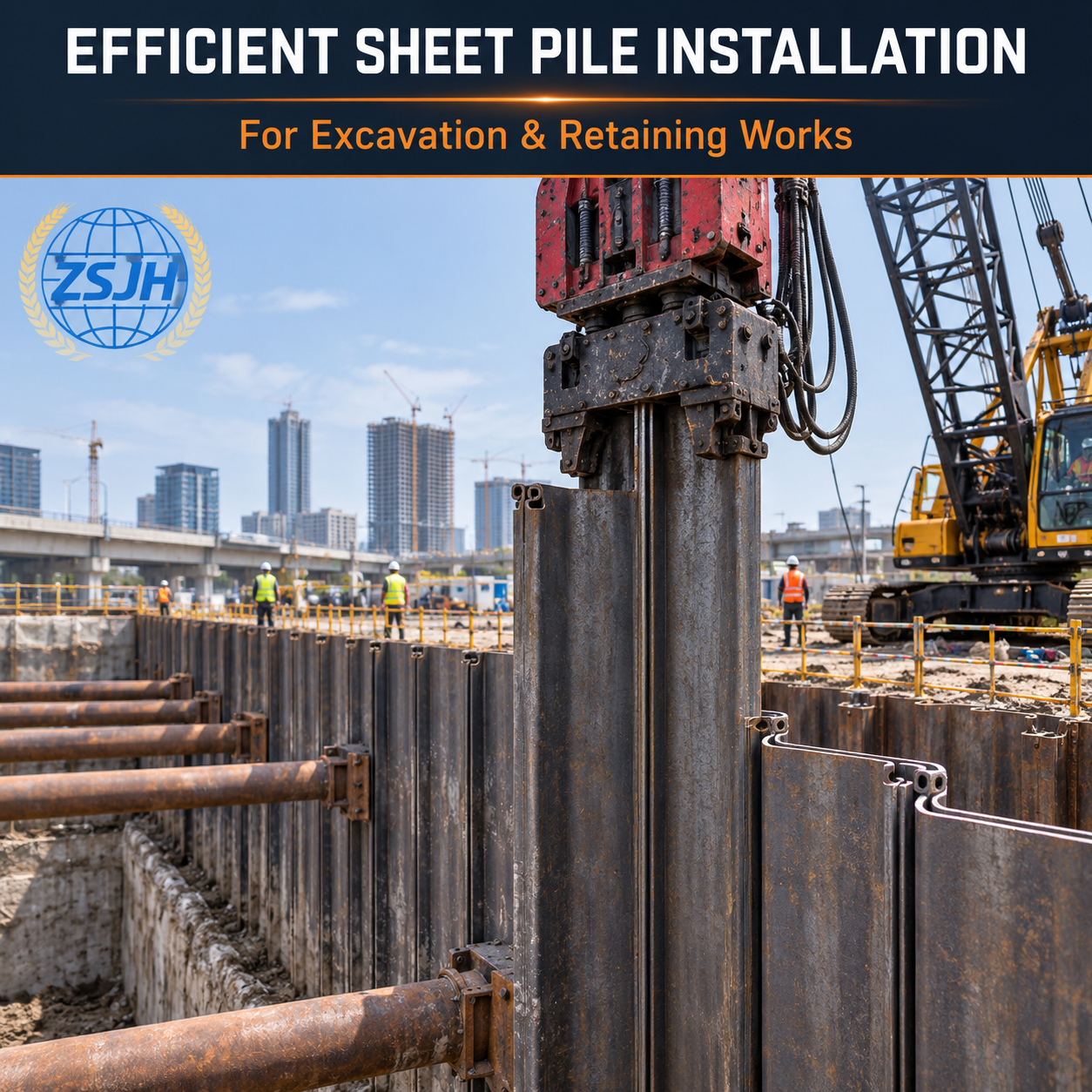
The piles may be installed using vibratory hammers, impact hammers or press-in equipment, subject to soil conditions, environmental restrictions and an approved installation method.
Pile length can be selected according to the required toe penetration, retained height, transportation limits and available production range.
Steel sheet piles can be used as permanent structural components or extracted for possible reuse in temporary works. Reuse is subject to inspection of straightness, remaining section, interlocks and extraction damage.
Depending on the environment, piles may be supplied with an as-rolled surface or specified surface preparation, protective coating, corrosion allowance or compatible cathodic-protection strategy.
Hot-rolled U-type steel sheet piles are commonly considered for:
Deep excavation and foundation-pit support
Basement and underground structure construction
Bridge abutments and pier cofferdams
Temporary construction cofferdams
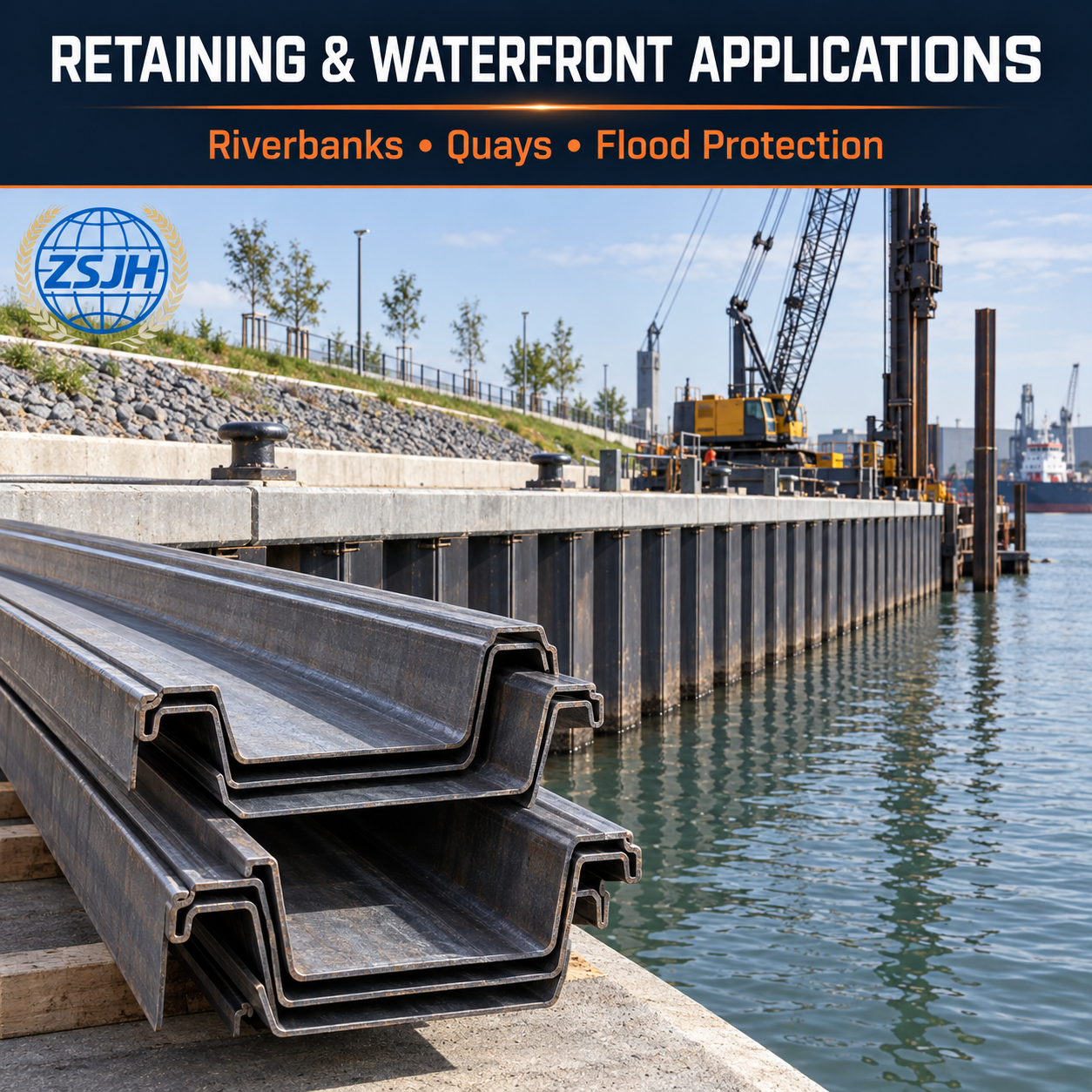
Quay walls, wharves and port facilities
Riverbank and canal reinforcement
Flood-protection and water-control structures
Road and railway retaining works
Utility trenches and pumping stations
Temporary earth-retaining systems
Marine and waterfront construction
Cut-off or containment walls with an engineered sealing system
The product is suitable for civil, marine, municipal, transportation and industrial infrastructure projects requiring a continuous steel retaining system.
Selection must consider:
Soil stratification and strength
Groundwater conditions and hydrostatic pressure
Required excavation or retaining depth
Structural bending moment and deflection limits
Toe penetration and overall wall stability
Surcharge and construction loads
Driving resistance and installation equipment
Adjacent-building vibration and noise restrictions
Corrosion category and required design life
Anchored, braced or cantilever wall configuration
Local design codes and construction standards
| Parameter | Available Option |
|---|---|
| Product Name | Hot-Rolled U-Type Steel Sheet Pile |
| Profile | U-type or Larssen-type interlocking section |
| Manufacturing Method | Hot rolled |
| Supply Configuration | Single piles, paired piles or project-specific bundles |
| Steel Grade | Grade selected according to the specified standard and structural requirements |
| Common Grade Options | S240GP, S270GP, S320GP, S355GP, S390GP or S430GP, subject to availability and specification |
| Reference Standards | EN 10248, ASTM A328/A328M, JIS A 5528, GB/T 20933 or another agreed standard |
| Section Width | According to the selected profile |
| Section Height | According to the selected profile |
| Web and Flange Thickness | According to the selected profile |
| Unit Mass | According to the selected profile |
| Moment of Inertia | According to the selected section and wall arrangement |
| Section Modulus | According to the selected section and wall arrangement |
| Length | Project-specific, subject to production, handling and transportation limitations |
| Interlock | Integral hot-rolled interlocking design |
| Surface Condition | As rolled; optional surface preparation or coating by agreement |
| End Processing | Mill cut, saw cut or other agreed processing |
| Connection Options | Pairing, crimping, tack welding or project-specific preparation by agreement |
| Dimensional Tolerances | According to the applicable product standard |
| Marking | Bundle or piece marking according to the purchase agreement |
| Packaging | Secured bundles suitable for handling and export transportation |
| Inspection Documents | Supplied according to the purchase order and agreed standard |
Steel grades listed under different standards are not automatically equivalent. Grade, section geometry, mechanical properties, tolerances and inspection requirements must be confirmed in the purchase specification.
The interlocks connect adjacent piles and help maintain wall continuity during installation. Actual system performance depends on pile alignment, interlock condition, driving accuracy, soil resistance and the selected installation method.
Standard sheet-pile interlocks should not be described as completely watertight. Where reduced seepage is required, the design may include interlock sealant, welding or another engineered sealing treatment. Cofferdams and groundwater-control projects may also require pumping, drainage and monitoring measures.
For U-type walls, interlock shear transfer and possible interlock slip should be considered when determining effective wall properties. Pairing, crimping or welding may be specified when required by the structural design.
Steel chemistry is controlled according to the required grade. The steel is cast into suitable semi-finished material for rolling.
The semi-finished steel is reheated to the controlled temperature required for hot forming.
Oxide scale is removed before profile rolling to support consistent forming and surface condition.
The heated steel passes through a sequence of shaped rolls. The web, flanges and integral interlocks are progressively formed into the specified U-section geometry.
The rolled sections are cooled under controlled production conditions to achieve the required dimensional and material characteristics.
The piles are straightened and cut to the ordered length within the tolerances of the agreed standard.
Relevant checks may include:
Chemical composition review
Mechanical-property verification
Profile and dimensional inspection
Length and straightness checks
Unit-mass verification
Surface-condition inspection
Interlock fit or engagement checks
Marking and documentation review
Finished piles are aligned, secured in bundles and marked for handling, storage and transportation.
The interlocking arrangement creates a continuous wall capable of retaining soil when properly designed and installed.
Different profiles allow engineers to balance structural capacity, pile weight, installation requirements and project economy.
Piles can be delivered in specified lengths and, where agreed, supplied with handling holes, paired sections or other project-specific preparation.
U-type piles can be nested to improve stacking and transportation efficiency, subject to the selected profile and bundle arrangement.
Sheet piling can be incorporated into cantilever, anchored or internally braced retaining systems.
Where soil and installation conditions permit, temporary piles may be extracted after construction. Their suitability for reuse must be assessed after extraction.
At the end of its usable life, steel can enter established recycling streams, subject to local recovery arrangements.
A pile-driving and installation plan should be prepared before construction. It should address:
Pile-driving equipment and required energy
Driveability and refusal risk
Guide frames and verticality control
Interlock orientation and engagement
Obstructions and hard soil layers
Vibration and noise limits
Adjacent structures and underground services
Pitching, lifting and handling procedures
Splicing requirements
Monitoring of wall movement and groundwater
Extraction procedures for temporary piles
Driving shoes, pre-drilling, water jetting or other installation aids should only be used when permitted by the project design and site conditions.
Uncoated carbon steel will experience corrosion when exposed to soil, freshwater, seawater or the atmosphere. Durability design should therefore consider the actual exposure zones and intended service life.
Possible measures include:
Design corrosion allowance
Protective coating systems
Cathodic protection
Concrete encasement in selected zones
Inspection and maintenance planning
Selection of an appropriate steel grade and section thickness
The protective system should be specified by the project engineer. Service life should not be stated solely from the steel grade or initial pile thickness.
U-type piles have a U-shaped cross-section and can be nested compactly for transportation. Z-type piles position their interlocks away from the wall’s neutral axis and may be preferred for particular structural configurations. The correct type depends on structural demand, installation conditions, availability and project economics.
Selection is based on required bending resistance, wall stiffness, retained height, groundwater, soil pressure, surcharge, corrosion allowance, driveability and the planned bracing or anchoring system.
Standard interlocks can restrict soil movement and reduce water passage, but they are not inherently completely watertight. Sealant, welding or another engineered treatment may be required when seepage control is critical.
Common options include vibratory hammers, impact hammers and hydraulic press-in systems. Equipment selection depends on soil conditions, pile section, penetration depth, vibration restrictions and site access.
Temporary piles may be extracted and potentially reused. Before reuse, the piles should be inspected for deformation, cracking, section loss, damaged ends and interlock condition.
Yes. Lengths can be produced or processed according to project requirements, subject to available rolling range, handling capability and transportation restrictions.
Yes, where permitted by the design. Splice details, welding procedures, inspection requirements and splice locations must be approved for the project.
They can be used in marine and waterfront structures when the section, corrosion allowance, protective system and installation method are designed for the actual exposure and service life.
Please provide the required standard, steel grade, section designation, pile length, quantity, surface treatment, pairing or welding requirements, inspection documentation, delivery destination and project schedule.
ZSJH can assist with available-section comparisons and supply coordination based on project information. Final structural and geotechnical approval must be provided by the project’s qualified engineer.
ZSJH supports the review of section designation, grade, length, quantity, surface condition and delivery requirements before production or procurement.
Single piles, paired piles, customized lengths and agreed processing options can be coordinated according to project requirements and manufacturing availability.
Material documentation, dimensions, straightness, length, surface condition and interlock compatibility are checked according to the applicable order requirements.
Cutting, pairing, crimping, welding, lifting-hole preparation and specified surface treatment can be arranged when included in the confirmed purchase specification.
Bundles are secured and marked to support lifting, identification, inland transport and international delivery.
Our team assists with product comparison, drawing confirmation, quotation preparation, production coordination and shipping documentation.
Send ZSJH your project drawings or piling schedule together with the required section, standard, steel grade, pile length, quantity, surface treatment, connection requirements, inspection documents and destination port.
If the section has not yet been finalized, please also provide the intended application, soil report, retained height, groundwater level, design loads, required design life and installation limitations. Final engineering selection remains subject to approval by the project’s structural and geotechnical professionals.


