:sales@zsjhsteelgroup.com WhatsApp:+86-15122582058







| Quantity: | |
|---|---|


ZSJH
| Feature | UPN Channel | UPE Channel |
|---|---|---|
| General Profile | European standard channel | European parallel-flange channel |
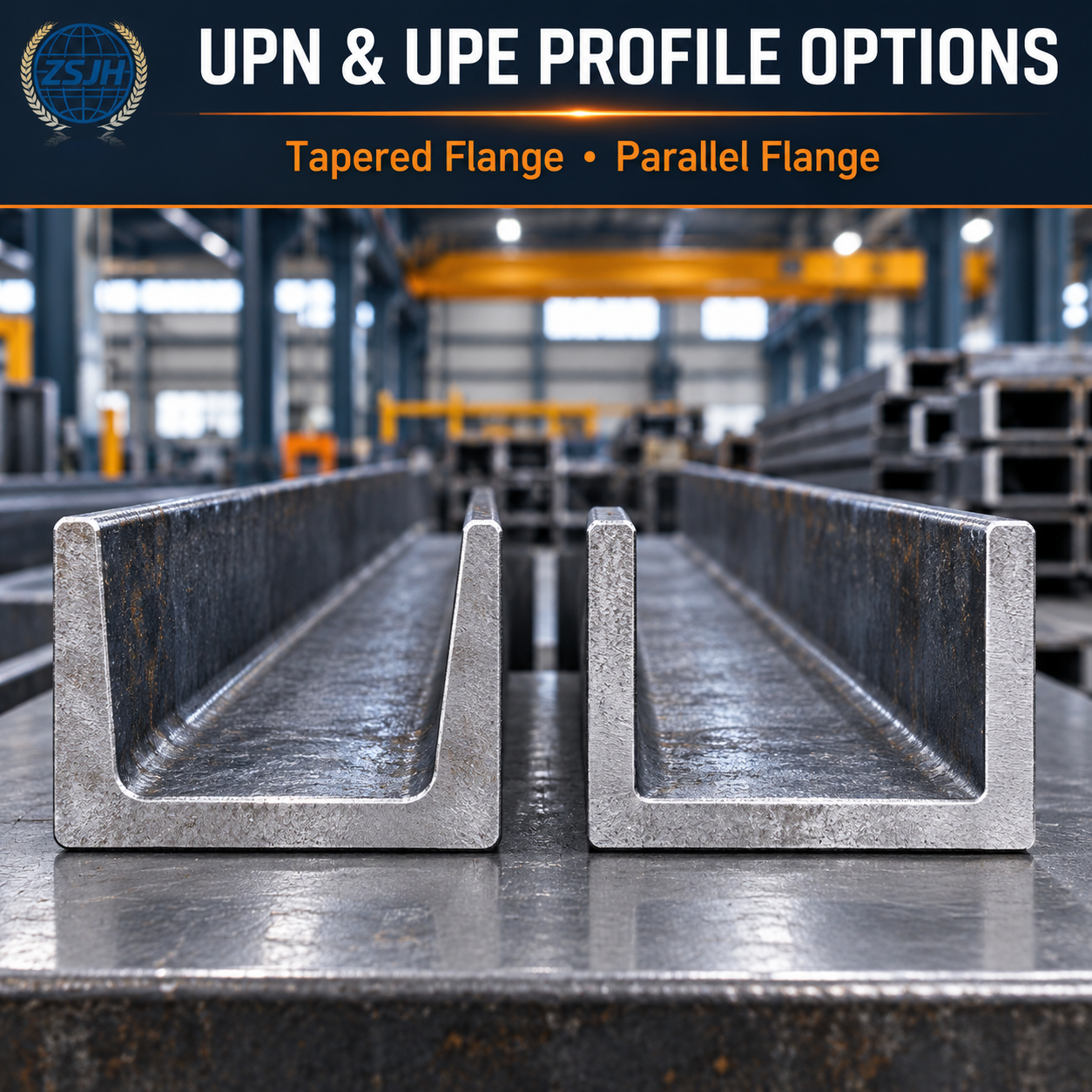
| Inner Flange Faces | Tapered | Substantially parallel |
| Connection Surface | May require detailing that accounts for flange taper | Parallel faces may simplify certain connections |
| Internal Profile | Traditional channel geometry | More uniform internal flange spacing |
| Typical Selection Basis | Availability, established designs and required section properties | Connection convenience, profile geometry and required section properties |
| Dimensions and Mass | According to the selected UPN designation | According to the selected UPE designation |
| Structural Use | Subject to engineering design | Subject to engineering design |
UPN and UPE sections are not interchangeable solely on the basis of nominal depth. Their flange width, thickness, mass and structural properties must be checked separately.
UPN and UPE channels are supplied according to recognized European section designations, supporting consistent engineering, procurement and fabrication.
The channel-shaped cross-section provides useful bending resistance and stiffness for correctly oriented and adequately restrained structural members.
The web and flanges can be drilled, bolted or welded according to approved connection details and the selected steel grade.
Common structural-steel grades can be supplied according to the applicable material standard and project requirements.
Channels can be cut to specified project lengths, subject to available stock, rolling range, handling capability and transportation limits.
Cutting, drilling, coping, welding, blasting, priming and other approved processing can be coordinated before shipment.
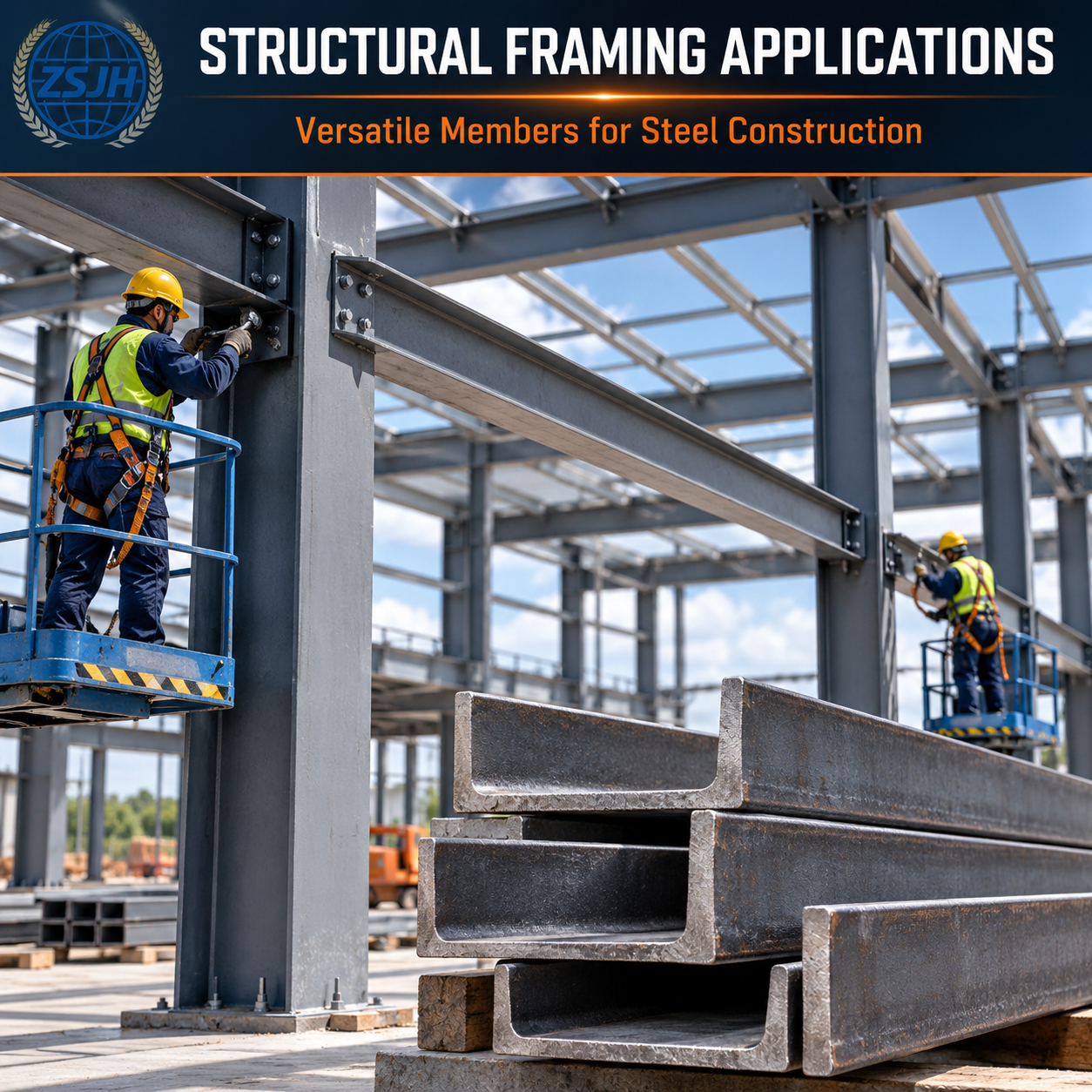
UPN and UPE channels can be used in structural frames, machinery supports, secondary steelwork, platforms, stairs and fabricated assemblies.
UPN/UPE steel channels are commonly considered for:
Industrial building frames
Secondary structural members
Support beams and edge beams
Roof and wall framing
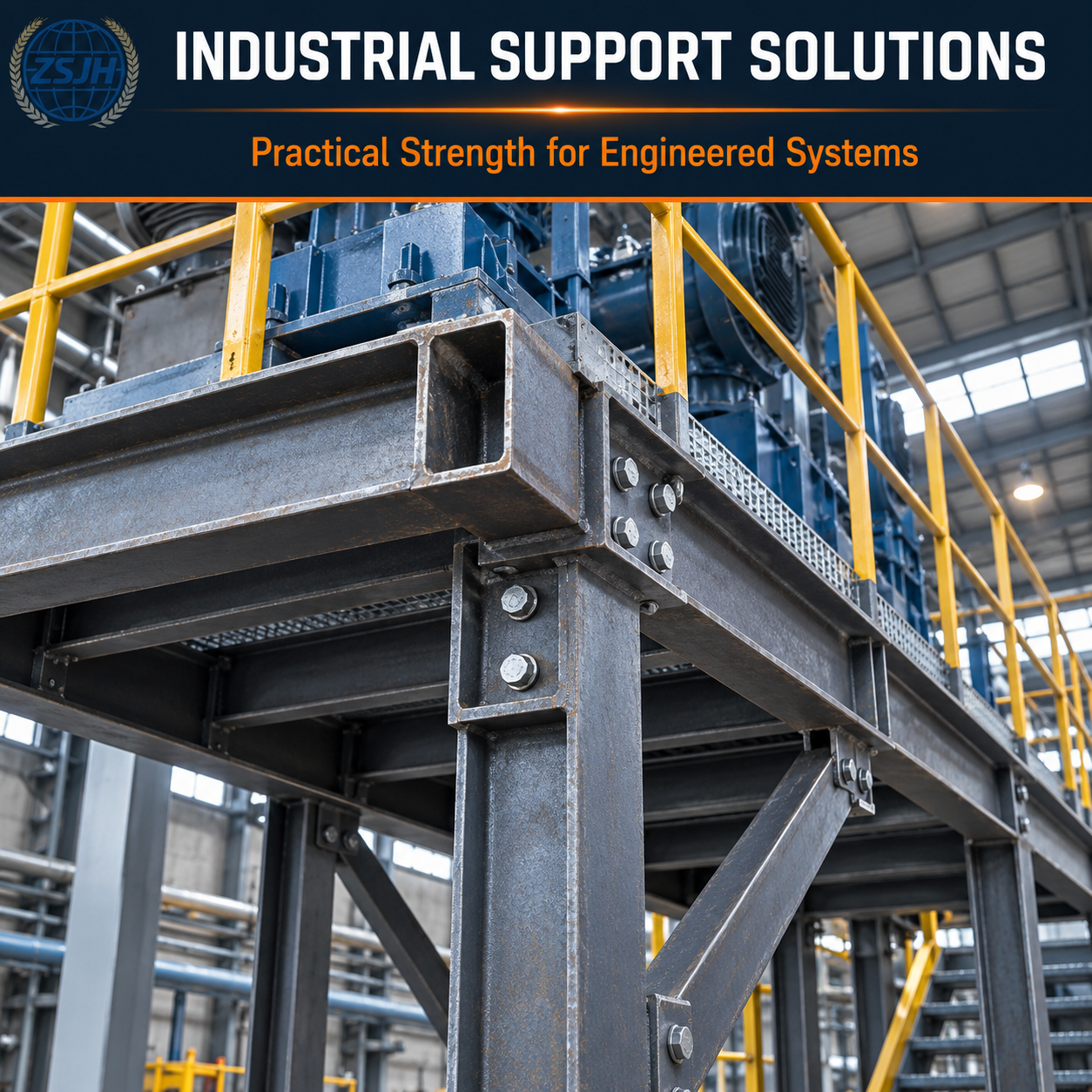
Equipment-support structures
Machinery bases
Maintenance platforms
Mezzanine framing
Stair stringers
Walkway supports
Conveyor-support systems
Steel racks and frames
Vehicle and trailer fabrication
Bridge and infrastructure components
General welded steel assemblies
Structural strengthening works
The product is suitable for industrial, commercial, infrastructure and equipment-manufacturing projects requiring standardized hot-rolled channel sections.
Selection should consider:
Design load
Clear span
Support conditions
Channel orientation
Major- and minor-axis bending
Shear
Axial load
Torsion
Lateral-torsional buckling
Local connection forces
Deflection limits
Fire-protection requirements
Corrosion environment
Fabrication and erection method
Because a channel is an open, unsymmetrical section, its shear center does not generally coincide with its centroid. Loads applied away from the shear center may produce torsion. Adequate restraint and connection detailing are therefore important.
| Parameter | Available Specification |
|---|---|
| Product Name | Hot-Rolled UPN/UPE Steel Channel |
| Section Series | UPN or UPE |
| Manufacturing Method | Hot rolled |
| Material | Structural carbon steel or low-alloy structural steel |
| Common EN Steel Grades | S235JR, S275JR and S355JR; other subgrades by agreement |
| Material Standard | EN 10025 series or another agreed standard |
| Section Dimensions and Mass | According to EN 10365 and the selected designation |
| Shape and Dimensional Tolerances | According to EN 10279 or the agreed specification |
| Section Height | According to the selected UPN or UPE designation |
| Flange Width | According to the selected designation |
| Web Thickness | According to the selected designation |
| Flange Thickness | According to the selected designation |
| Root Radius | According to the selected designation |
| Unit Mass | According to the selected designation |
| Cross-Sectional Area | According to the selected designation |
| Moment of Inertia | According to the selected designation and axis |
| Section Modulus | According to the selected designation and axis |
| Length | Standard mill or stock lengths and custom-cut lengths, subject to availability |
| Surface Condition | As rolled, blast cleaned, shop primed or otherwise treated by agreement |
| Edge Condition | Mill cut, saw cut or processed according to the order |
| Processing | Cutting, drilling, coping and welding by agreement |
| Inspection Documents | According to the purchase order |
| Marking | Grade, size, heat or bundle identification as agreed |
| Packaging | Bundled and secured for export transportation |
The table lists available specification categories rather than guaranteed values. Final dimensions, mass, tolerances, grade, length and surface condition must be stated in the confirmed order.
Steel grades from different national standards should not be treated as automatically equivalent.
The steel grade should be selected according to:
Required yield strength
Tensile strength
Impact toughness
Service temperature
Plate or section thickness
Welding requirements
Forming requirements
Applicable design standard
Project inspection requirements
For projects requiring low-temperature impact properties, the appropriate toughness subgrade should be specified rather than relying only on the basic strength designation.
The section provides different bending properties about its major and minor axes. The orientation of the channel relative to the applied load must be considered during design.
UPN and UPE channels are open sections and generally have lower torsional rigidity than closed hollow sections. Eccentric loads may cause twisting unless suitable restraint or paired-member arrangements are provided.
Two channels may be arranged back-to-back or face-to-face to form a built-up member. Spacing, connection plates, bolts or welds must be designed to ensure the required composite behavior.
Loads introduced through one flange or a limited area of the web may require checks for local yielding, web crippling, buckling or connection failure.
Steel chemistry is controlled according to the ordered structural grade. Molten steel is cast into semi-finished material suitable for section rolling.
The semi-finished steel is reheated under controlled conditions to reach the temperature required for hot deformation.
Oxide scale is removed before and during rolling to support profile formation and surface control.
The heated material passes through initial rolling stands to reduce the section and begin forming the channel profile.
Shaped rolls progressively form the web, flanges and internal radii. UPN and UPE require different roll geometries because their flange configurations differ.
The section passes through finishing stands to achieve the required profile geometry and dimensional consistency.
The channels are transferred to a cooling bed and cooled under controlled production conditions.
Mechanical straightening equipment controls sweep, camber and overall alignment.
The sections are cut to mill or customer-specified lengths within the agreed manufacturing range.
Finished sections may be checked for:
Steel grade and material documents
Section height
Flange width
Web and flange thickness
Length
Straightness
Mass
Surface condition
Cut-end condition
Product marking
Qualified channels are aligned, bundled, strapped and identified for storage, lifting and transportation.
ZSJH can coordinate:
Saw cutting
Flame or plasma cutting where appropriate
CNC drilling
Slot and hole preparation
End coping
Notching
Base or end plates
Stiffener welding
Built-up paired channels
Abrasive blasting
Shop primer
Hot-dip galvanizing by agreement
Component marking
Export packaging
All fabricated connections should follow approved drawings and qualified welding procedures where required.
Hot-rolled channels provide a robust base material for bolted and welded steel assemblies.
Recognized UPN and UPE designations simplify communication between designers, purchasers and fabricators.
Channels are useful for edge members, framing supports and other applications that do not require a doubly symmetrical section.
The relatively flat web provides a practical surface for bolt holes, connection plates and attachments.
Channels can be blast cleaned, primed, painted or galvanized when the selected process is compatible with the project requirements.
Steel channels can enter established recycling streams at the end of their service life, subject to local recovery practices.
As-rolled carbon steel requires an appropriate protection strategy when exposed to moisture or corrosive environments.
Available strategies may include:
Shop primer
Multi-layer paint system
Hot-dip galvanizing
Metallizing
Fire-protective coating
Corrosion allowance
Inspection and maintenance planning
The coating system should be selected according to exposure category, required durability, surface-preparation grade and maintenance access.
Drainage and detailing are also important. Horizontal channels should be positioned or provided with drainage measures to prevent long-term water accumulation inside the profile.
Welding requirements depend on the steel grade, section thickness, joint restraint and service conditions.
The fabrication plan should consider:
Material weldability
Welding procedure
Filler metal
Preheat where required
Heat input
Distortion control
Flange geometry
Access to the root area
Visual inspection
Specified nondestructive testing
For UPN sections, tapered inner flange faces may affect the fit of connection plates and washers. Tapered washers or specially detailed connections may be needed for certain bolted arrangements.
UPN channels have tapered inner flange faces, while UPE channels have substantially parallel flange faces. Their dimensions, mass and section properties also differ.
Not automatically. The designer must compare flange width, thickness, mass, section properties, connection geometry and structural capacity.
UPE parallel flanges may simplify certain plate and bolt connections. However, the preferred section depends on the complete structural design and local availability.
They may be used as beams where engineering calculations confirm bending, shear, deflection, stability and connection capacity. Their open-section torsional behavior must be considered.
Yes. Channels can be arranged back-to-back or face-to-face. The connecting bolts, plates or welds must be designed to achieve the intended structural behavior.
Yes. Custom cutting can be coordinated within available stock, production, handling and transportation limits.
Yes. Cutting, drilling, coping and welding can be supplied according to approved drawings and confirmed fabrication requirements.
Hot-dip galvanizing may be provided by agreement. Venting, drainage, steel chemistry, component geometry and dimensional effects should be reviewed before galvanizing.
Please provide the section series, exact designation, steel grade, length, quantity, applicable standard, surface treatment, processing drawings, inspection-document requirements and destination port.
The size should be selected by a qualified engineer based on loads, span, member orientation, buckling, torsion, connections, deflection and applicable design standards.
ZSJH supplies structural sections and processed steel components for industrial buildings, equipment structures and infrastructure projects.
Our team helps confirm the required series, designation, steel grade, length, quantity and applicable standard before order placement.
Cutting, drilling, coping, welding, blasting, priming, galvanizing coordination and component marking can be provided according to confirmed requirements.
Material identification, dimensions, length, straightness, surface condition and processing quality are checked according to the purchase specification.
Channels are bundled, supported and securely strapped according to their dimensions and international transportation requirements.
ZSJH supports specification clarification, drawing review, quotation preparation, production coordination, inspection documentation and shipment arrangements.
Send ZSJH the required UPN or UPE designation, steel grade, individual length, quantity, applicable standard, surface treatment, processing drawings and destination port.
If the section has not yet been selected, please provide the intended application, design loads, span, support conditions, connection method, corrosion environment and applicable design code.
ZSJH can assist with product availability and supply-option comparison. Final structural selection and connection design must be approved by the project’s qualified engineer.


