:sales@zsjhsteelgroup.com WhatsApp:+86-15122582058






| Quantity: | |
|---|---|


ZSJH
Bearing-bar depth, thickness, spacing and clear span can be selected according to the required uniformly distributed load, concentrated load and operating conditions.
Standard, close-mesh and customized spacing options are available to meet different requirements for strength, drainage, pedestrian safety and object-drop prevention.
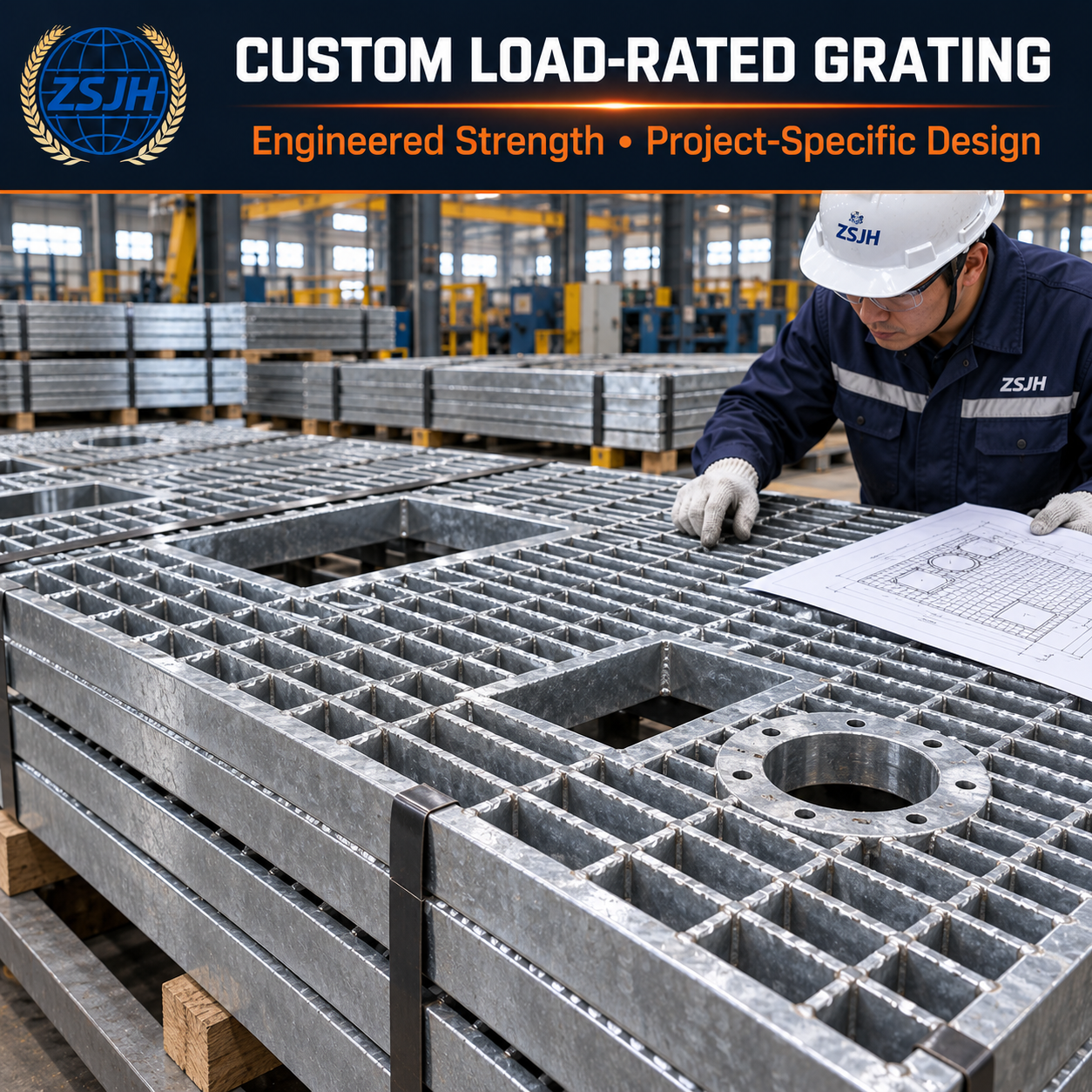
Panels can be manufactured with banded edges, pipe openings, equipment cut-outs, toe plates and irregular profiles according to approved drawings.
ZSJH supplies welded grating, pressure-locked grating, I-bar grating and compound grating for different architectural and industrial requirements.
Hot-dip galvanizing provides long-term protection for the steel surface, welded joints, edges and fabricated openings.
Project-specific panel dimensions and identification marks help reduce on-site cutting, improve installation accuracy and shorten construction time.
Custom load-rated steel grating is widely used for:
Industrial flooring systems
Elevated working platforms
Equipment maintenance platforms
Factory and warehouse walkways
Power plant access systems
Petrochemical facilities
Mining and mineral-processing plants
Offshore and marine platforms
Drainage trench covers
Heavy-duty traffic areas
Bridge maintenance walkways
Stair treads and landings
Loading and logistics facilities
Wastewater treatment plants
Architectural ventilation screens
Projects with pipe or equipment penetrations
The 30 × 100 mm nominal configuration is a commonly selected mesh arrangement for industrial platforms, walkways and general access flooring. It provides a practical balance of strength, open area, drainage and material efficiency.
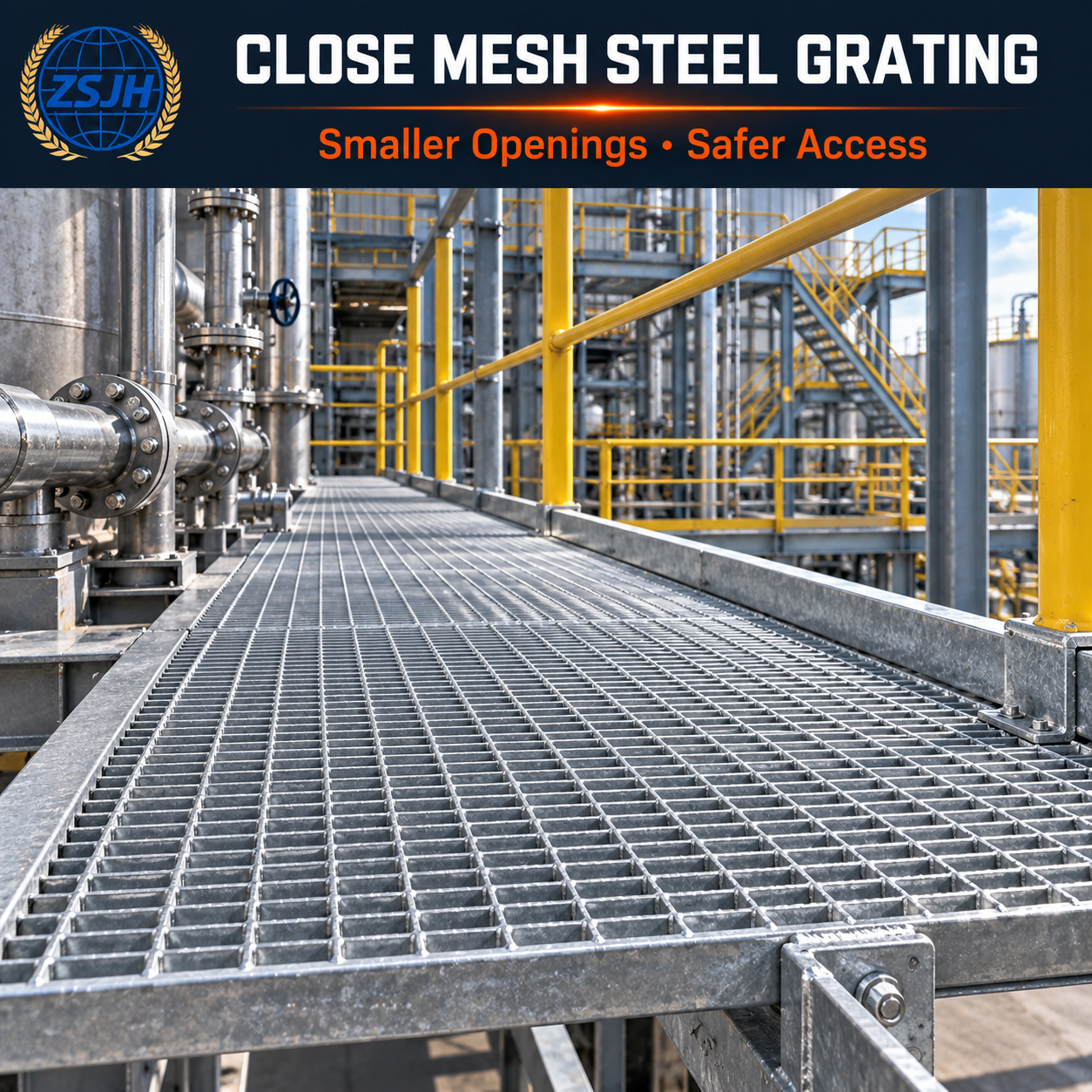
With closer cross-bar spacing, the 30 × 50 mm configuration provides a denser grid and improved lateral stability. It is suitable for applications requiring smaller openings or additional surface support.
Close-mesh grating uses reduced spacing between bearing bars or cross bars. It can help improve pedestrian comfort, reduce the risk of small objects passing through and meet specialized access requirements.
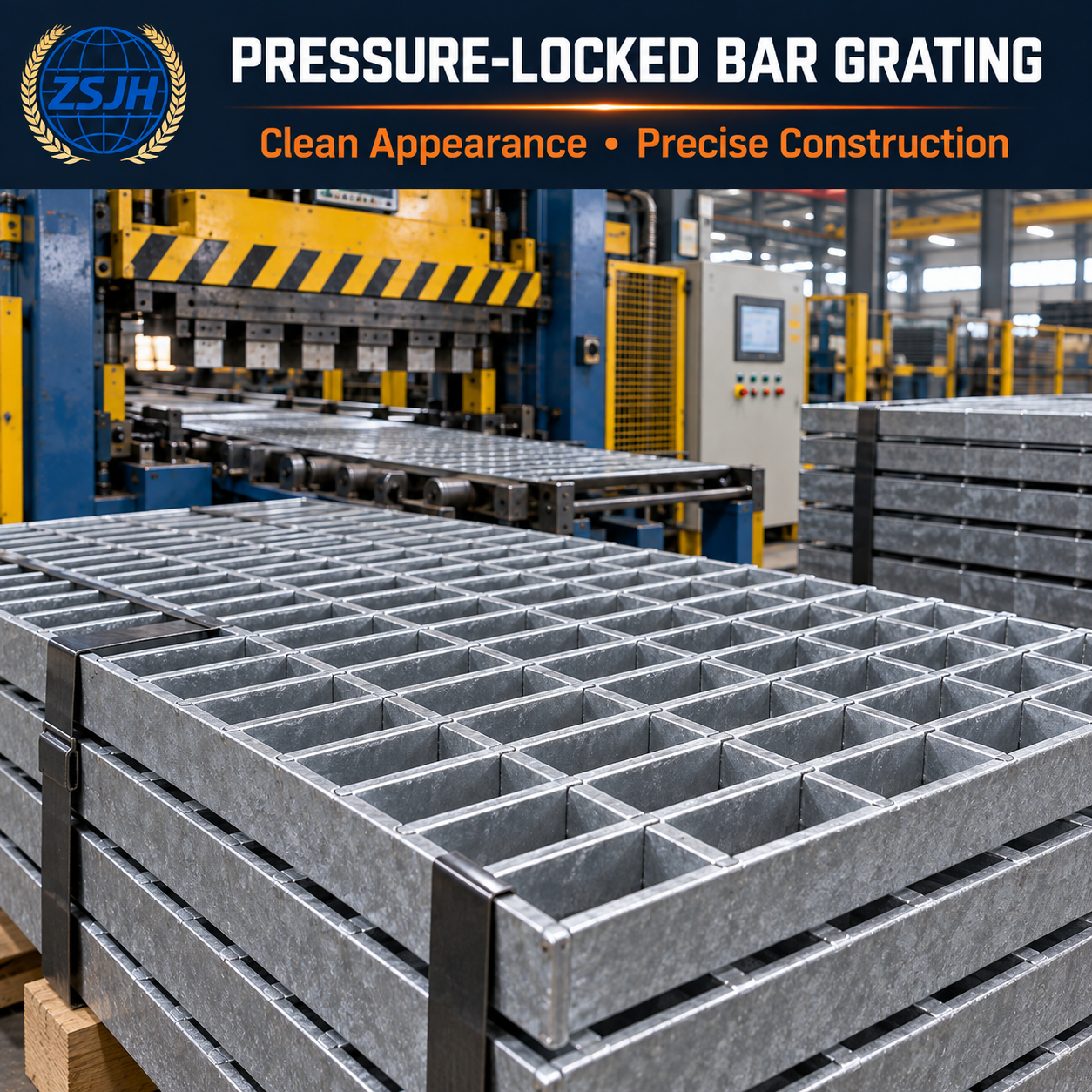
Pressure-locked grating is produced by mechanically pressing cross bars into pre-punched or notched bearing bars. It offers clean intersections, accurate spacing and an attractive appearance for industrial and architectural applications.
I-bar grating uses specially shaped bearing bars designed to reduce panel weight while maintaining efficient structural performance. It is suitable for projects where weight control and open-area efficiency are important.
Compound grating combines an open steel grating base with a checkered plate or solid top plate. It is suitable for applications requiring a more closed walking surface while retaining structural support underneath.
Banding bars can be added around panel edges, openings and cut-outs to improve stability, provide a finished edge and simplify installation around pipes, columns and equipment.
| Specification | Available Options |
|---|---|
| Product Type | Welded, pressure-locked, close-mesh, I-bar or compound grating |
| Base Material | Carbon steel, stainless steel or specified steel grade |
| Bearing-Bar Surface | Plain or serrated |
| Bearing-Bar Profile | Flat bar or I-shaped bar |
| Common Bearing-Bar Depth | 20–100 mm |
| Common Bearing-Bar Thickness | 3–10 mm |
| Bearing-Bar Pitch | Commonly 30 mm or 40 mm; customizable |
| Cross-Bar Pitch | Commonly 50 mm or 100 mm; customizable |
| Common Mesh Configuration | 30 × 100 mm, 30 × 50 mm or customized |
| Cross-Bar Type | Twisted square bar, round bar or flat bar |
| Panel Dimensions | Standard sizes or manufactured according to drawings |
| Surface Treatment | Hot-dip galvanized, painted, untreated or customized |
| Edge Treatment | Open edge, banded edge or reinforced banding |
| Custom Processing | Openings, curved edges, angled cuts and special profiles |
| Fixing Method | Clips, clamps, bolts or welding |
| Accessories | Fasteners, toe plates, stair nosing and support components |
Mesh dimensions are generally specified using the nominal bearing-bar pitch and cross-bar pitch. Exact terminology and tolerances should be confirmed according to the applicable project standard.
The correct steel grating specification should not be selected by mesh size alone. The following factors must be considered:
Clear span between supporting beams
Uniformly distributed load
Concentrated or point load
Pedestrian, equipment or vehicle traffic
Bearing-bar direction
Required deflection limit
Panel dimensions
Fixing method
Corrosive exposure
Applicable design standard
Required safety factor
For load-rated applications, customers should provide the support layout, loading information and operating conditions. ZSJH can review the information and recommend an appropriate bearing-bar configuration. Load tables or engineering calculations can be prepared according to the agreed project requirements.
Project drawings, panel schedules, support spacing, load requirements and installation details are reviewed before production.
Bearing bars, cross bars and banding materials are selected according to the specified grade, dimensions and structural requirements.
Steel bars are cut to controlled lengths. For pressure-locked grating, notches or slots are prepared according to the required spacing and connection design.
Bearing bars are positioned parallel to the load direction. Cross bars are installed at the specified pitch using welding or pressure-locking equipment.
Panels are cut according to approved drawings. Pipe penetrations, equipment openings, column cut-outs and irregular edges can be fabricated before surface treatment.
Banding bars are attached around panel perimeters and openings where required. Reinforced banding can be added to support specific installation or loading conditions.
Completed panels can be hot-dip galvanized, painted or supplied untreated. Galvanizing is performed after fabrication so that cut edges, welds and banding areas receive protective coverage.
Quality inspections may include:
Material and grade verification
Panel length and width inspection
Bearing-bar and cross-bar pitch measurement
Bearing-bar direction verification
Weld or pressure-lock connection inspection
Panel flatness inspection
Opening and cut-out position checks
Edge-banding inspection
Surface treatment inspection
Final visual inspection
Panels can be labeled according to fabrication drawings, installation areas or panel schedules. Finished products are securely bundled for loading and international transportation.
Configurable load-bearing performance
Multiple mesh sizes and structural options
High strength-to-weight ratio
Accurate fabrication according to drawings
Custom openings and irregular shapes available
Effective drainage and ventilation
Plain or anti-slip serrated surfaces
Durable galvanized protection
Reduced on-site cutting and adjustment
Easy installation and replacement
Suitable for standard and complex engineering layouts
Complete panel, accessory and support-component supply
These dimensions generally refer to the nominal bearing-bar pitch and cross-bar pitch. Because terminology may vary between markets and standards, the required spacing should be clearly marked on the technical drawing before production.
Not necessarily. Load capacity mainly depends on the bearing-bar depth, thickness, spacing, steel grade and clear span. A smaller mesh may provide a denser walking surface, but the complete structural configuration must be evaluated.
Bearing bars must normally span between the supporting beams because they carry the primary load. The bearing-bar direction should be clearly shown on the installation or fabrication drawings.
Welded grating uses resistance welding to connect cross bars to bearing bars, providing strong and economical panels for industrial applications. Pressure-locked grating uses mechanically interlocked bars and offers cleaner intersections and greater architectural flexibility.
I-bar grating can reduce panel weight while maintaining efficient structural performance. The final suitability depends on the required load, span and selected bearing-bar profile.
Yes. We can manufacture angled panels, curved edges, pipe openings, equipment cut-outs and other special shapes according to approved fabrication drawings.
On-site cutting after galvanizing can damage the protective zinc coating. Whenever possible, all openings and edge banding should be completed before galvanizing. If field cutting is unavoidable, the exposed steel should receive an appropriate repair treatment.
Yes, but the panel and supporting structure must be specifically designed for the wheel load, axle load, contact area, span and impact conditions. Standard pedestrian grating should not be used for vehicle traffic without engineering verification.
Load information can be provided based on the selected grating specification and applicable calculation requirements. Please send the bearing-bar size, spacing, span and required load conditions.
For an accurate quotation, please provide:
Grating type
Material grade
Bearing-bar size
Bearing-bar and cross-bar spacing
Plain or serrated surface
Panel dimensions
Clear span and required load
Surface treatment
Edge-banding requirements
Drawings and panel schedules
Quantity
Required standard
Delivery destination
ZSJH considers mesh spacing, bearing-bar direction, clear span, operating load and installation conditions when developing a grating solution.
We manufacture standard panels as well as complex grating with banded edges, irregular shapes, pipe openings and equipment cut-outs.
Welded, pressure-locked, close-mesh, I-bar and compound grating options allow customers to select products according to performance, appearance and budget requirements.
Material preparation, bar spacing, panel dimensions, connection quality, flatness and surface treatment are inspected throughout production.
ZSJH can supply steel grating together with stair treads, trench covers, structural steel sections, support frames, fasteners and other fabricated components.
Our team provides technical communication, production coordination, export packing and shipment support for overseas contractors, distributors and project owners.
From initial drawing review to final delivery, ZSJH maintains clear communication and responds promptly to technical and commercial requirements.
Looking for custom steel grating with specific mesh dimensions, bearing-bar sizes, load requirements or panel shapes?
Send ZSJH your technical drawings, load information, panel schedule, quantity and delivery destination. Our team will review your requirements and provide a suitable product recommendation and competitive quotation.
Request your customized steel grating quotation from ZSJH today.
Precise Specifications. Reliable Fabrication. Steel Solutions Built for Your Project.


