:sales@zsjhsteelgroup.com WhatsApp:+86-15122582058







| Quantity: | |
|---|---|


ZSJH
Top-mounted, side-mounted, socket-mounted, embedded and concrete-anchored systems are available for different supporting structures and installation conditions.
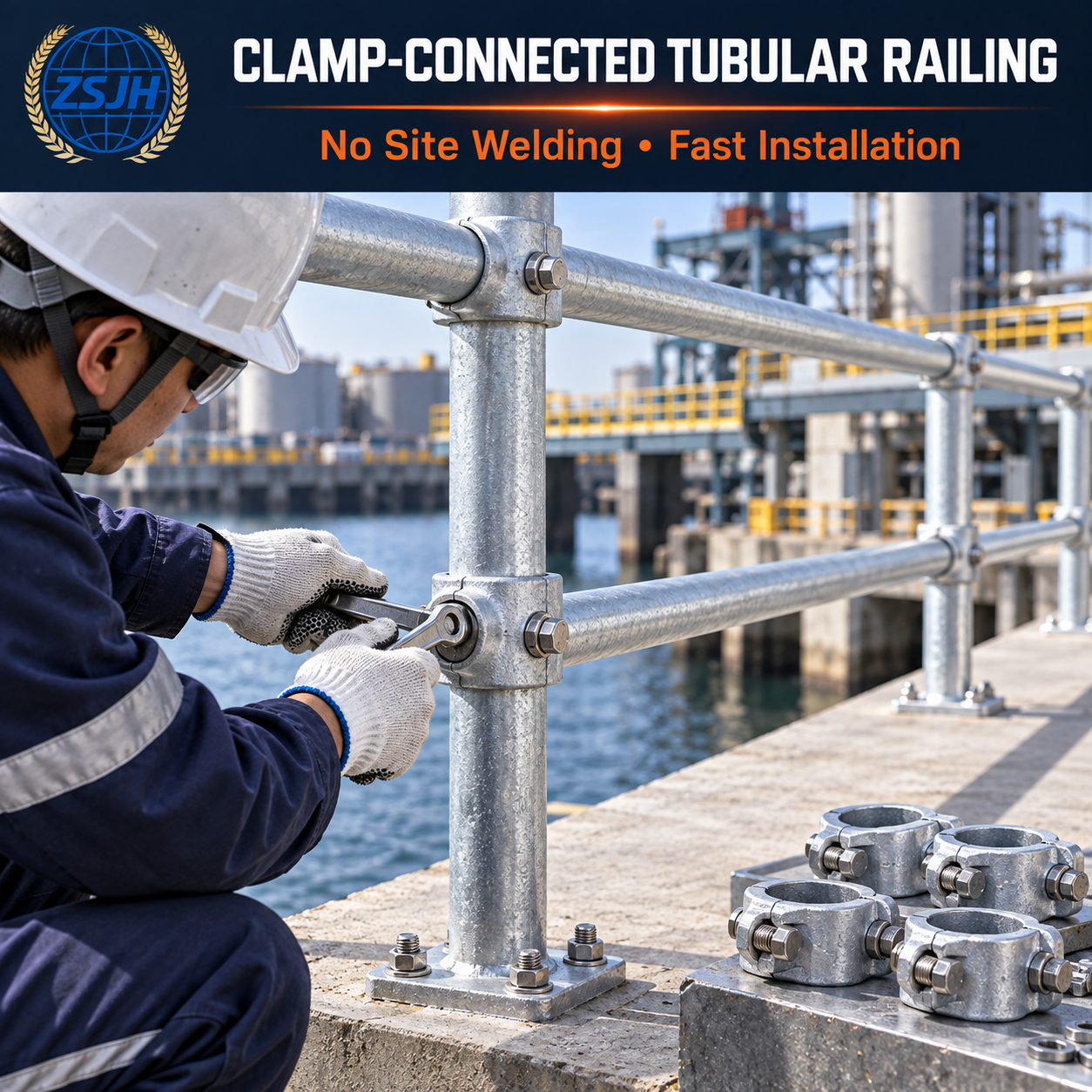
Bolted and clamp-connected railings reduce on-site welding and can simplify assembly in operating factories or locations with restricted hot-work conditions.
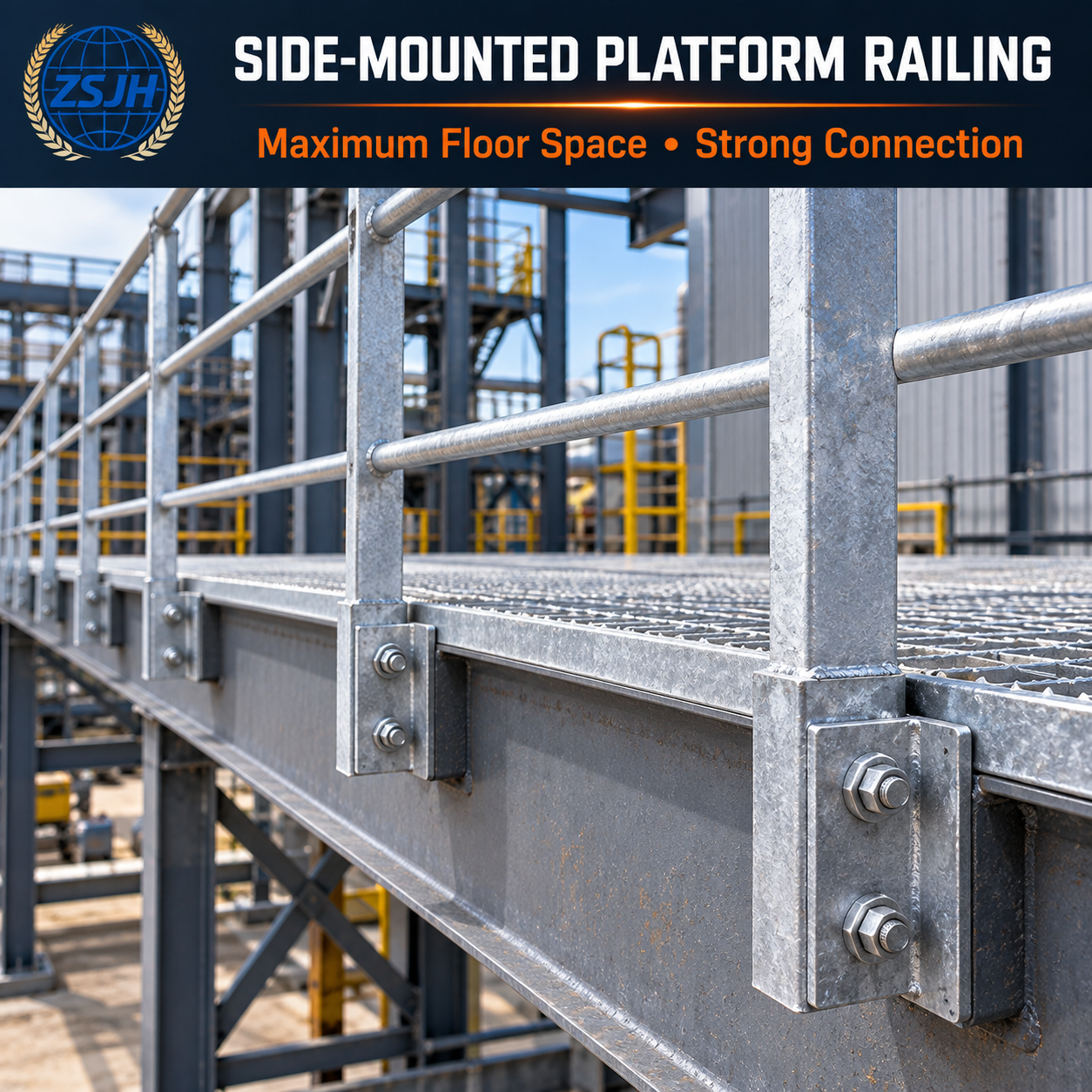
Side-mounted posts are fixed to the vertical face of the supporting beam, helping preserve the available walking width on narrow platforms and access routes.
Posts, base plates, side brackets, flanges and connection holes are fabricated under controlled factory conditions to improve fit and alignment during installation.
Socket-mounted or bolted railing sections can be removed when temporary access is required for equipment replacement, lifting operations or maintenance.
Engineered base plates, brackets, bolts and anchors transfer railing loads into the supporting steel or concrete structure.
Connection details can be customized according to the supporting member, edge distance, installation sequence, corrosion environment and applicable project requirements.
Top-mounted posts use welded or bolted base plates fixed to the upper surface of a steel beam, curb or concrete platform.
This arrangement is widely used for industrial platforms, elevated walkways, mezzanines and rooftop access areas where sufficient mounting space is available.
Side-mounted posts are attached to the vertical face of the edge beam or stair stringer using brackets or mounting plates.
This method helps maximize the clear width of the platform and keeps base plates away from the primary walking surface.
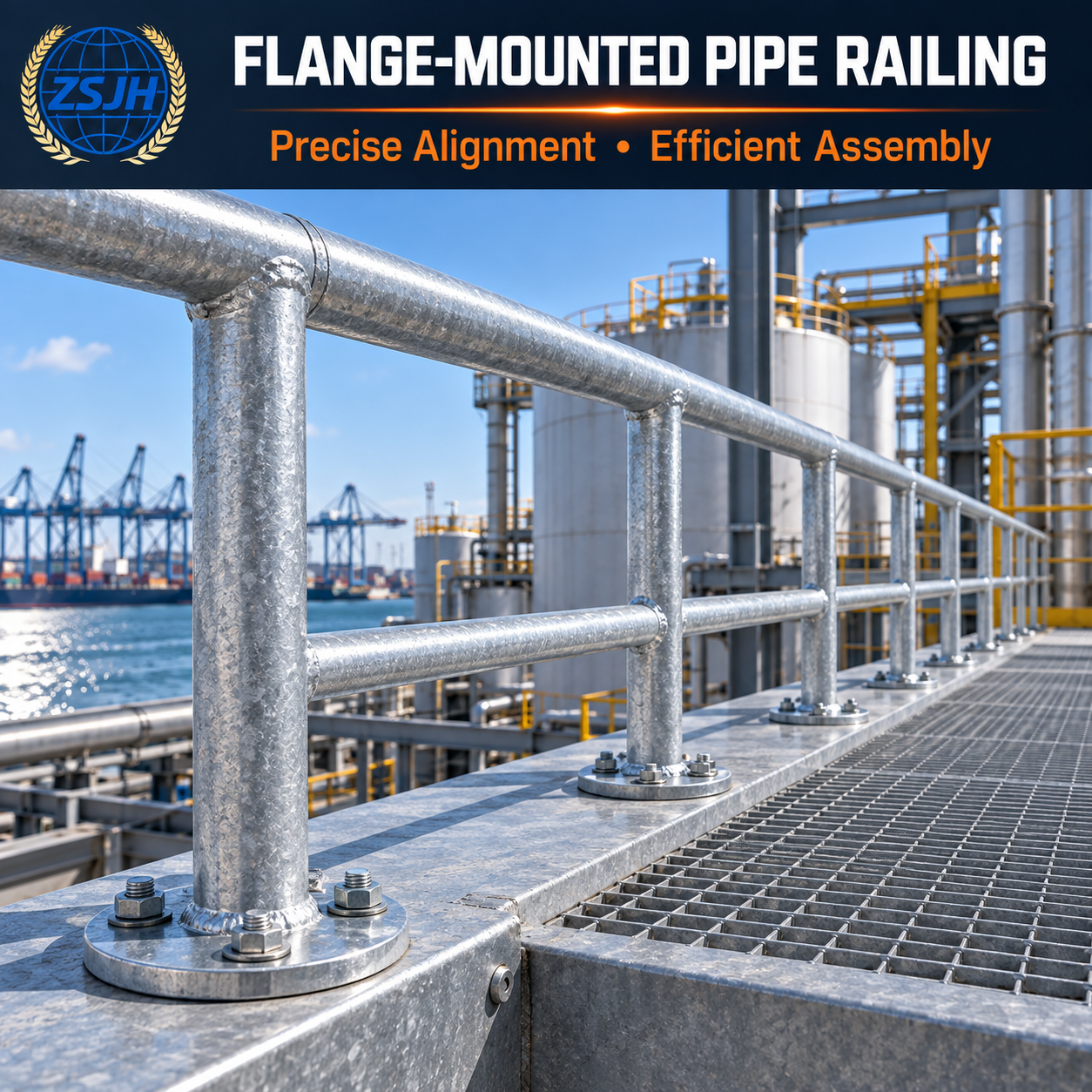
Round posts are welded to circular or square flanges and fixed with bolts. Flange mounting provides a defined bolt pattern and is suitable for prefabricated tubular railing assemblies.
Posts are inserted into fixed floor or side sockets and secured with locking pins, bolts or retention devices.
Removable railings are suitable for maintenance openings, equipment-access areas and locations where the barrier must occasionally be removed.
Mechanical clamp fittings connect the top rails, intermediate rails and posts without welding at the installation site.
These systems are useful for retrofit projects, fast installation and facilities where future adjustment may be required.
Posts can be welded directly to structural steel or mounting plates for permanent installations. Welding details should be coordinated with the supporting member and surface-treatment sequence.
Base-plated posts can be attached to concrete using suitable mechanical or chemical anchors. Anchor selection depends on the design load, concrete strength, slab thickness and edge distance.
Posts may be embedded into concrete pockets or cast-in sleeves where a clean mounting appearance and permanent installation are required.
ZSJH mounting-specific handrail systems are suitable for:
Industrial working platforms
Steel grating walkways
Factory mezzanines
Equipment maintenance decks
Steel stairways and landings
Warehouse access platforms
Rooftop maintenance routes
Loading docks
Petrochemical facilities
Power-generation plants
Mining and processing sites
Water-treatment facilities
Conveyor access systems
Ports and marine terminals
Machinery protection zones
New construction and retrofit projects
| Specification | Available Options |
|---|---|
| Product Type | Bolted, side-mounted, flange-mounted, socket-mounted or weld-on railing |
| Material | Carbon steel, galvanized steel or stainless steel |
| Rail Profile | Round pipe, square tube or rectangular hollow section |
| Typical Round Section | Approximately 32–60.3 mm outside diameter; customizable |
| Typical Square Section | Approximately 30 × 30 to 80 × 80 mm; customizable |
| Handrail Height | Manufactured according to drawings and applicable requirements |
| Post Spacing | Determined by section size, design load and mounting method |
| Base Plate | Square, rectangular or circular |
| Side Bracket | Flat plate, angle bracket or fabricated mounting assembly |
| Flange Type | Circular or square welded flange |
| Socket Type | Floor-mounted, side-mounted or embedded |
| Anchor Type | Mechanical anchor, chemical anchor or cast-in fastener |
| Bolt Grade | Selected according to structural and environmental requirements |
| Connection Method | Bolted, clamped, pinned, welded or combined |
| Intermediate Rails | One, two or customized configuration |
| Toe Board | Optional welded or bolted design |
| Surface Treatment | Hot-dip galvanized, painted, powder-coated or brushed |
| Color | Safety yellow or customized RAL color |
| Accessories | Bolts, anchors, clamps, sockets, pins, brackets and end caps |
The dimensions shown are typical reference ranges. Final sections, plates, anchors and connection details should be verified according to the design loads and supporting structure.
The railing connection must transfer the applied loads safely into the supporting beam, slab, stair stringer or platform frame.
Steel grating alone should not normally be treated as the primary structural support for railing posts unless the complete connection has been specifically engineered for that purpose.
Base-plate dimensions and thickness depend on the post section, design load, bolt arrangement and supporting surface.
The plate should provide sufficient stiffness while allowing practical access for tightening and inspection.
Concrete-anchor selection should consider:
Concrete strength
Slab or curb thickness
Distance from the concrete edge
Anchor spacing
Embedment depth
Concrete condition
Applied tension and shear loads
Indoor or outdoor exposure
Required corrosion protection
Side-mounted posts may require offset brackets, spacer plates or stiffeners to achieve the correct railing position and transfer loads to the structural member.
Connection components should have surface protection compatible with the railing system and operating environment. Carbon steel fasteners may require galvanizing or another protective coating.
Slotted holes, adjustment plates or clamp fittings can help accommodate reasonable site tolerances. Excessive misalignment should not be corrected by forcing the railing into position.
ZSJH reviews the railing layout, supporting structure, mounting position, design criteria and installation sequence.
Base plates, side brackets, sockets, flanges and anchors are coordinated with the structural steel or concrete support.
Steel pipes, hollow sections, plates, brackets and fittings are selected according to the required material grade and dimensions.
Posts and rails are cut to controlled lengths. Plates and brackets are cut to the required geometry using appropriate fabrication equipment.
Bolt holes, anchor holes, slotted adjustment holes and locking-pin positions are accurately prepared according to the approved drawings.
Top rails, corner sections and stair transitions are bent or formed where required. Brackets and plates are shaped to match the supporting structure.
Posts, rails and mounting components are positioned in fixtures to control spacing, squareness and alignment.
Base plates, flanges and brackets are welded to the posts under controlled production conditions. Welds are completed according to the approved fabrication requirements.
Bolted, clamp-connected and removable sections may be assembled before finishing to verify component fit, alignment and operation.
Weld spatter, sharp edges, oil and surface contamination are removed before the selected coating process.
Available options include:
Hot-dip galvanizing
Industrial primer and paint
Powder coating
Duplex galvanized and coated finish
Brushed stainless steel
Polished stainless steel
Inspection may include:
Material verification
Overall dimensions
Post and rail alignment
Base-plate dimensions
Bracket geometry
Bolt-hole diameter and spacing
Socket and pin fit
Weld appearance
Trial-assembly results
Surface-treatment quality
Component identification
Railing sections, brackets and fittings can be labeled according to installation drawings. Bolts, anchors, clamps and other small components are packaged separately and clearly identified to simplify site handling and installation.
Protective materials are used between finished components to reduce surface damage during loading, transportation and unloading. Packing methods can be adjusted according to shipment type and project requirements.
Multiple mounting methods available
Reduced on-site welding
Faster and cleaner installation
Side mounting preserves platform width
Removable sections support maintenance access
Accurate factory-drilled connections
Adjustable modular fittings available
Compatible with steel and concrete structures
Reliable load transfer through engineered connections
Suitable for new construction and retrofit projects
Multiple materials and finishes
Replaceable mechanical components
Simplified transportation and site handling
Complete connection hardware available
Custom fabrication according to drawings
Top-mounted posts are fixed to the horizontal surface of a platform, beam or concrete slab. Side-mounted posts are attached to the vertical face of the supporting member.
Side mounting can preserve usable floor width, while top mounting may provide easier access to the base plate and anchors.
Side-mounted railing is often preferred for narrow walkways because the posts and base plates occupy less of the walking surface. The final selection depends on the edge-beam configuration, available installation space and structural capacity.
Yes. Bolted, flange-mounted and clamp-connected systems can reduce or eliminate welding at the project site. Some components may still be welded during factory production to create prefabricated railing sections.
Railing posts should generally be connected to the supporting steel structure or a properly engineered mounting plate. Steel grating alone may not provide adequate resistance to the required railing loads.
For the most accurate proposal, please include:
Platform, stairway or walkway drawings
Steel-beam or concrete-support dimensions
Required railing height and post spacing
Preferred connection and anchor method
Applicable design criteria
Project location and environmental conditions
Required quantity
Delivery destination
Requested delivery schedule
Drawings are preferred, but sketches, photographs and basic dimensions can also be used for a preliminary evaluation.
Contact ZSJH Steel today for a customized handrail system and installation-ready connection solution.
Accurate Connections. Efficient Installation. Reliable Project Support.


