:sales@zsjhsteelgroup.com WhatsApp:+86-15122582058







| Quantity: | |
|---|---|


ZSJH
Hot-rolled plate provides the rigid flat material required for welded girders, box sections, machinery bases, support frames and large connection components.
Different carbon and low-alloy structural grades can be selected according to load-bearing, welding, forming and toughness requirements.
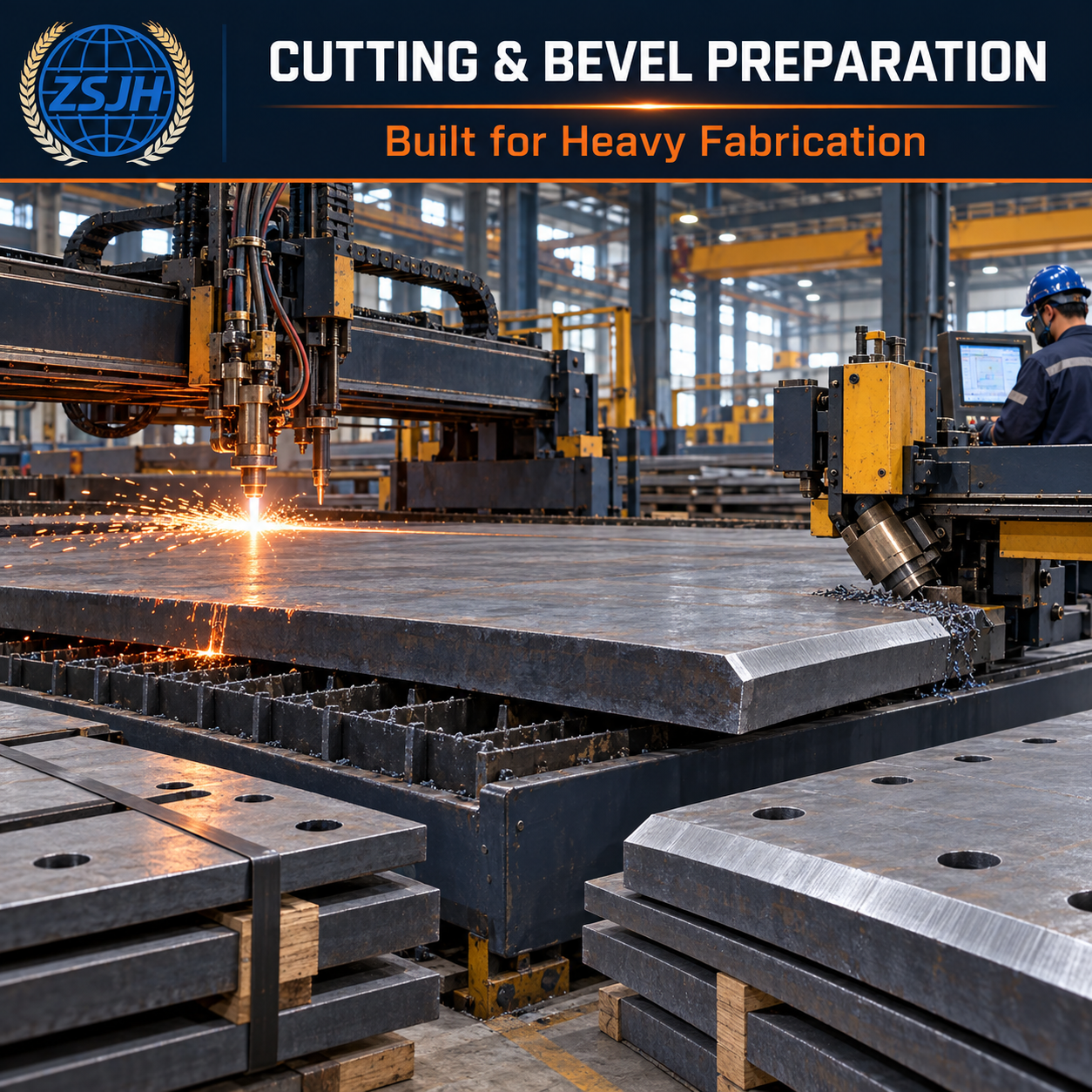
The plate can be processed by flame cutting, plasma cutting, drilling, machining, beveling, bending and welding when appropriate procedures are used.
Plates may be supplied in standard dimensions or processed into blanks and components according to confirmed drawings and tolerances.
Properly selected structural grades can support large welded assemblies. Welding consumables, preheating, heat input and inspection requirements must be matched to the material and applicable fabrication code.
Material specifications, processing, inspection documents, marking and packaging can be coordinated according to individual project requirements.
| Parameter | Available Specification |
|---|---|
| Product Name | Heavy-Gauge Hot-Rolled Steel Plate |
| Product Type | Hot-rolled carbon or low-alloy structural steel plate |
| Product Form | Flat plate, cut blank or fabricated component |
| Reference Standards | ASTM, EN, JIS, GB/T or another agreed standard |
| Grade Examples | S235, S275, S355, ASTM A36, ASTM A572, SS400, SM490, Q235 or Q355 series, subject to confirmation |
| Thickness | According to the selected grade, standard and mill capability |
| Width | Standard mill width or customized after confirmation |
| Length | Standard or cut to the agreed order dimensions |
| Delivery Condition | As rolled, normalized, normalized rolled, thermomechanically rolled or another specified condition |
| Surface | Hot-rolled mill finish |
| Edge Condition | Mill edge, sheared edge, flame-cut edge or machined edge |
| Flatness | According to the applicable standard and order specification |
| Dimensional Tolerance | According to the agreed execution standard |
| Inspection Options | Dimensional, surface, mechanical and other agreed inspections |
| Processing Services | Cutting, drilling, machining, beveling, bending, welding and blasting |
| Packaging | Standard seaworthy export packaging |
| Material Documents | According to the purchase agreement and available mill documentation |
The listed grades belong to different standards and are not automatically equivalent. Chemical composition, strength, toughness, delivery condition, thickness limits and inspection requirements must be checked before substitution.
Heavy-gauge steel plate is selected according to the structural role of the finished component. Plate thickness alone does not determine suitability.
The design should also consider:
Yield and tensile strength
Stiffness and deflection
Buckling resistance
Fatigue loading
Impact-toughness requirements
Through-thickness stress
Lamellar-tearing risk
Weld-joint configuration
Residual welding stress
Operating temperature
Corrosion allowance
Applicable safety factors
For thick welded joints or highly restrained structures, the material specification and welding procedure may require additional attention to carbon equivalent, preheating, hydrogen control, heat input and through-thickness properties.
Raw materials are melted and refined. Chemical composition is controlled according to the selected plate grade and material standard.
The refined steel is cast into slabs suitable for plate rolling.
Slabs are inspected and reheated under controlled conditions before rolling.
Surface oxide is removed before and during rolling as required.
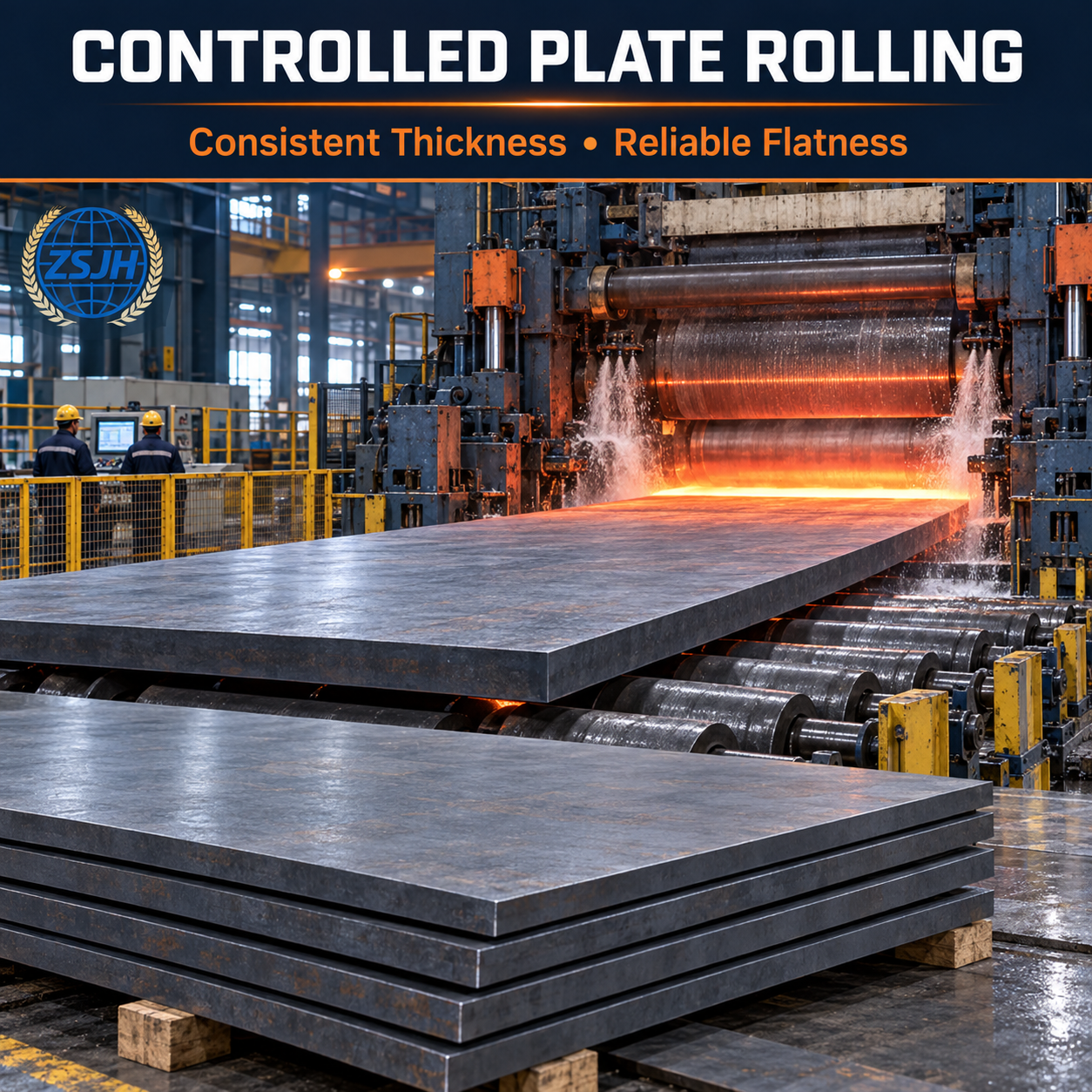
The heated slab passes through heavy rolling stands. Thickness, width and shape are progressively controlled to produce the required plate dimensions.
Depending on the grade and ordered delivery condition, the plate may undergo controlled cooling, normalization or another specified treatment.
The plate is leveled to meet the applicable flatness requirement.
Finished plates are cut to the ordered dimensions. Additional edge trimming, beveling or machining may be completed according to fabrication drawings.
Inspection may include material identification, dimensions, surface condition, flatness, chemical composition and mechanical properties.
Ultrasonic examination, impact testing or other supplementary requirements should only be included when specified in the purchase agreement and supported by the applicable standard.
Qualified plates are identified, stacked on suitable supports and secured for transportation.
Suitable for large welded structures
Available in multiple structural grades
High rigidity for heavy components
Compatible with common plate-processing methods
Custom-cut dimensions available
Suitable for box sections and plate girders
Can be supplied with prepared weld edges
Supports both material supply and component fabrication
Inspection requirements can be specified by project
Export packaging available for international transportation
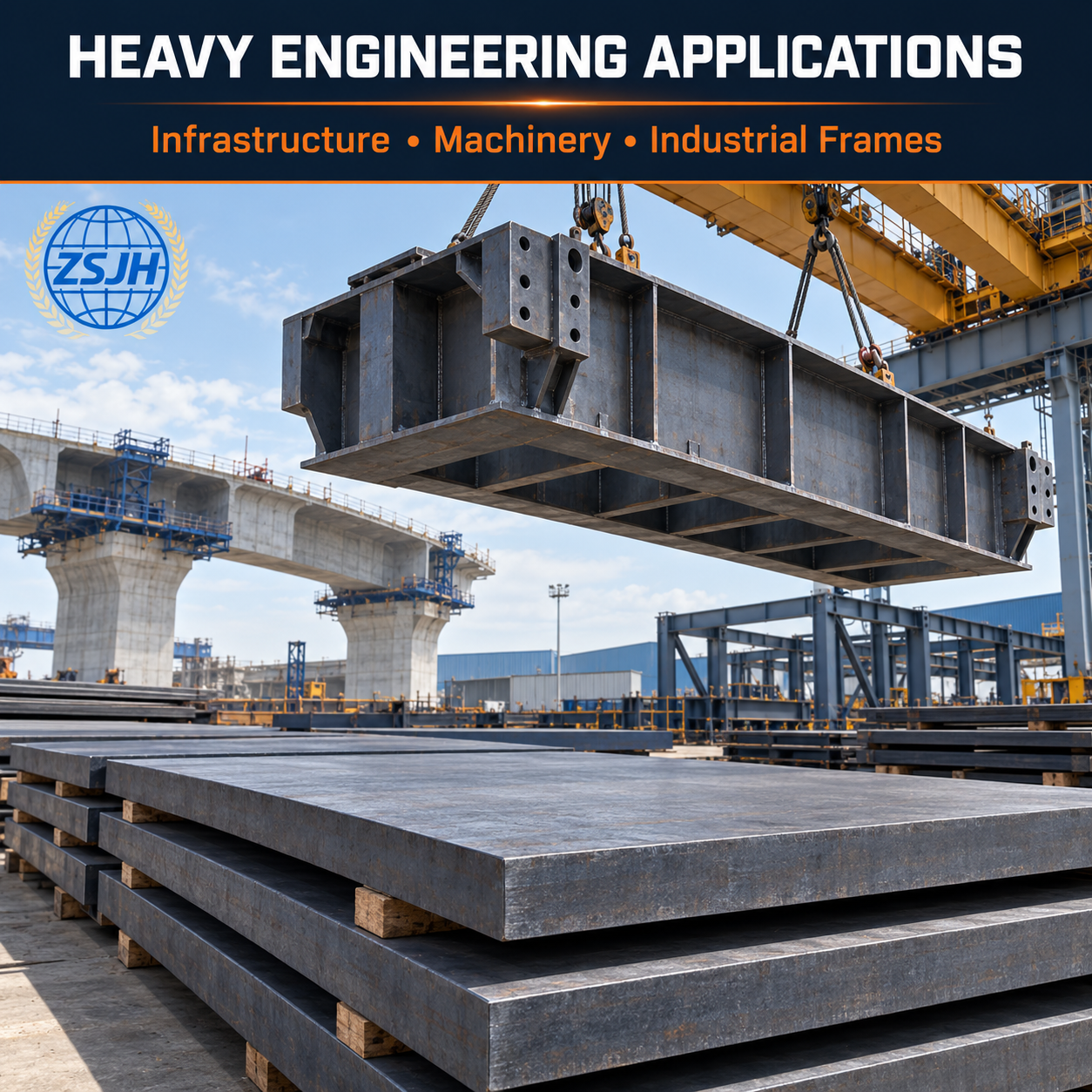
Heavy-gauge hot-rolled steel plate is commonly used for:
Welded plate girders
Box-beam and box-column structures
Industrial machinery bases
Equipment support frames
Large connection plates
Crane and lifting-equipment structures
Mining and material-handling machinery
Bridge components using an approved bridge grade
Industrial platforms
Power and processing-plant structures
Heavy vehicle frames
Storage and logistics equipment
Steel-building structural components
Infrastructure fabrication
Large customized welded assemblies
This product is suitable for heavy fabrication projects requiring plate-based structural components and customized processing.
The correct specification should be determined according to:
Design calculations
Component geometry
Required strength
Material thickness
Welding process
Service temperature
Impact-toughness requirement
Fatigue classification
Through-thickness loading
Surface-protection system
Applicable material and fabrication standards
Inspection-document requirements
General structural plate must not automatically be used for shipbuilding, pressure vessels, boilers, offshore structures, bridges or other regulated applications. These projects may require dedicated grades, approval documents and specific inspection procedures.
ZSJH can discuss the following services:
Customized plate width and length
CNC flame cutting
CNC plasma cutting
Saw cutting
Drilling and hole preparation
Edge machining
Weld bevel preparation
Plate bending and rolling
Shot blasting
Shop-primer application
Component assembly
Manual and automated welding
Weld inspection coordination
Identification and traceability marking
Customized export packaging
Final capability should be confirmed according to plate grade, thickness, dimensions, tolerances and drawings.
Flame and plasma cutting are widely used for heavy plate. Cutting method and parameters should be selected according to thickness, grade, heat-affected-zone requirements and required edge quality.
Weld bevels may be flame cut or machined. Bevel angle, root face and dimensional tolerances must follow the approved welding detail.
Welding procedure specifications should consider material grade, thickness, joint restraint, carbon equivalent, consumables, heat input and required toughness.
Heavy plates require adequate forming equipment. Bend radius, rolling direction, tooling and springback should be evaluated before processing.
Standard hot-rolled steel is not inherently corrosion-resistant. Blast cleaning, primer, paint, galvanizing or another engineered protection system may be required.
Heavy steel plates must be supported and lifted correctly to reduce deformation and handling damage.
Recommended precautions include:
Use lifting equipment rated for the actual load
Maintain balanced lifting points
Use suitable clamps, magnets or slings
Place plates on stable supports
Avoid excessive unsupported overhang
Separate plates where surface protection is required
Protect packages from standing water
Store indoors where practical
Keep identification marks traceable
Inspect edges and surfaces before fabrication
The terminology and thickness boundary vary among standards and markets. Product classification should follow the applicable standard and mill designation rather than a single universal thickness value.
Grade selection depends on required strength, thickness, welding, toughness, service temperature and design code. Project drawings and technical requirements should be reviewed before quotation.
Yes, when the selected grade is weldable and an appropriate procedure is used. Thick or highly restrained joints may require preheating, controlled heat input and hydrogen-control measures.
Yes. Flame, plasma, sawing, drilling and machining services may be available according to drawings, tolerances and material thickness.
Yes. Bevel preparation can be discussed according to the approved joint detail and fabrication requirements.
Not automatically. Ultrasonic examination level, acceptance criteria and reporting requirements must be specified before ordering.
Bridge projects may require dedicated bridge-steel grades, toughness requirements and inspection documentation. General structural grades should not be substituted without engineering approval.
No. Uncoated carbon steel can corrode. A suitable surface-preparation and protective-coating system should be selected for the service environment.
Documentation depends on the source mill, applicable standard and purchase agreement. All required certificates and test reports should be specified during quotation.
Please provide the material standard, complete grade, delivery condition, thickness, width, length, quantity, drawings, processing requirements, inspection requirements, documentation and destination port.
ZSJH assists customers in reviewing material grades, dimensions, delivery conditions and fabrication requirements according to project drawings.
We can coordinate plate cutting, drilling, beveling, bending, assembly, welding and surface treatment for customized components.
Material identification, dimensions, cutting, holes, bevels, welds, surface condition and packaging can be checked according to agreed requirements.
ZSJH supports steel-plate supply as well as fabricated girders, box sections, connection components and other structural assemblies.
Heavy plates and components are supported, protected and secured according to their size, weight and transportation method.
Our team supports technical clarification, drawing review, quotation preparation, production coordination, inspection arrangements, export documentation and shipping.
Send ZSJH your project drawings, applicable material standard, grade, delivery condition, plate dimensions, quantity, fabrication requirements, inspection requirements and destination port. Our team will review the information and provide a suitable heavy steel plate and fabrication solution.


