:sales@zsjhsteelgroup.com WhatsApp:+86-15122582058





| Quantity: | |
|---|---|


ZSJH
ASTM A572 Grade 50 provides a commonly specified minimum yield strength of 345 MPa or 50 ksi, making it suitable for many high-load structural applications.
The broad parallel flanges provide efficient resistance to major-axis bending, while the central web carries shear forces between the flanges.
The sections can be used in process plants, manufacturing facilities, pipe racks and equipment-support structures when confirmed by structural calculations.
The web and flanges provide suitable surfaces for shear tabs, end plates, bearing plates, stiffeners, brackets and moment connections.
Beams can be cut, drilled, coped, cambered and welded according to approved project drawings.
Products may be supplied as rolled, shot-blasted, primed, painted or galvanized, depending on the service environment and project requirements.
| Parameter | Available Specification |
|---|---|
| Product name | ASTM A572 Grade 50 Heavy-Duty W Beam |
| Product form | Hot-rolled wide-flange W-shape |
| Material specification | ASTM A572/A572M Grade 50 |
| Steel category | High-strength, low-alloy structural steel |
| Typical minimum yield strength | 345 MPa / 50 ksi |
| Typical minimum tensile strength | 450 MPa / 65 ksi |
| Section designation | According to the selected W-series size |
| Dimensions and section properties | According to applicable AISC shape data or agreed schedule |
| General dimensional tolerances | ASTM A6/A6M or agreed specification |
| Length | Standard mill length or customized fixed length |
| Surface condition | As rolled, blasted, primed, painted or galvanized |
| Cutting method | Straight saw cut, fixed-length cut or mitre cut |
| Processing | Drilling, slotting, coping, notching, welding and cambering |
| Connection method | Bolted, welded or combined |
| Inspection | Material, dimensions, straightness, surface and processing |
| Documentation | According to purchase-order requirements |
| Packaging | Bundled or individually supported for export |
Mechanical-property requirements may vary according to material thickness, product form and the applicable standard revision. The exact W-shape and ASTM A572 Grade 50 availability must be confirmed before ordering.
ASTM A572 Grade 50 and ASTM A992 may both provide a minimum yield strength of 50 ksi, but they should not be treated as automatically interchangeable.
ASTM A992 is widely used for structural W-shapes in building framing and contains requirements developed specifically for structural shapes. ASTM A572 Grade 50 covers a broader range of high-strength structural-steel products and may be specified for industrial, infrastructure and general structural applications.
Substitution between the two specifications requires approval from the responsible engineer and must consider:
Chemical composition
Tensile-property limits
Weldability
Toughness requirements
Shape availability
Member thickness
Connection design
Project specifications
Applicable construction codes
ASTM A572 Grade 50 W beams may be used for:
Process-plant structural frames
Industrial manufacturing facilities
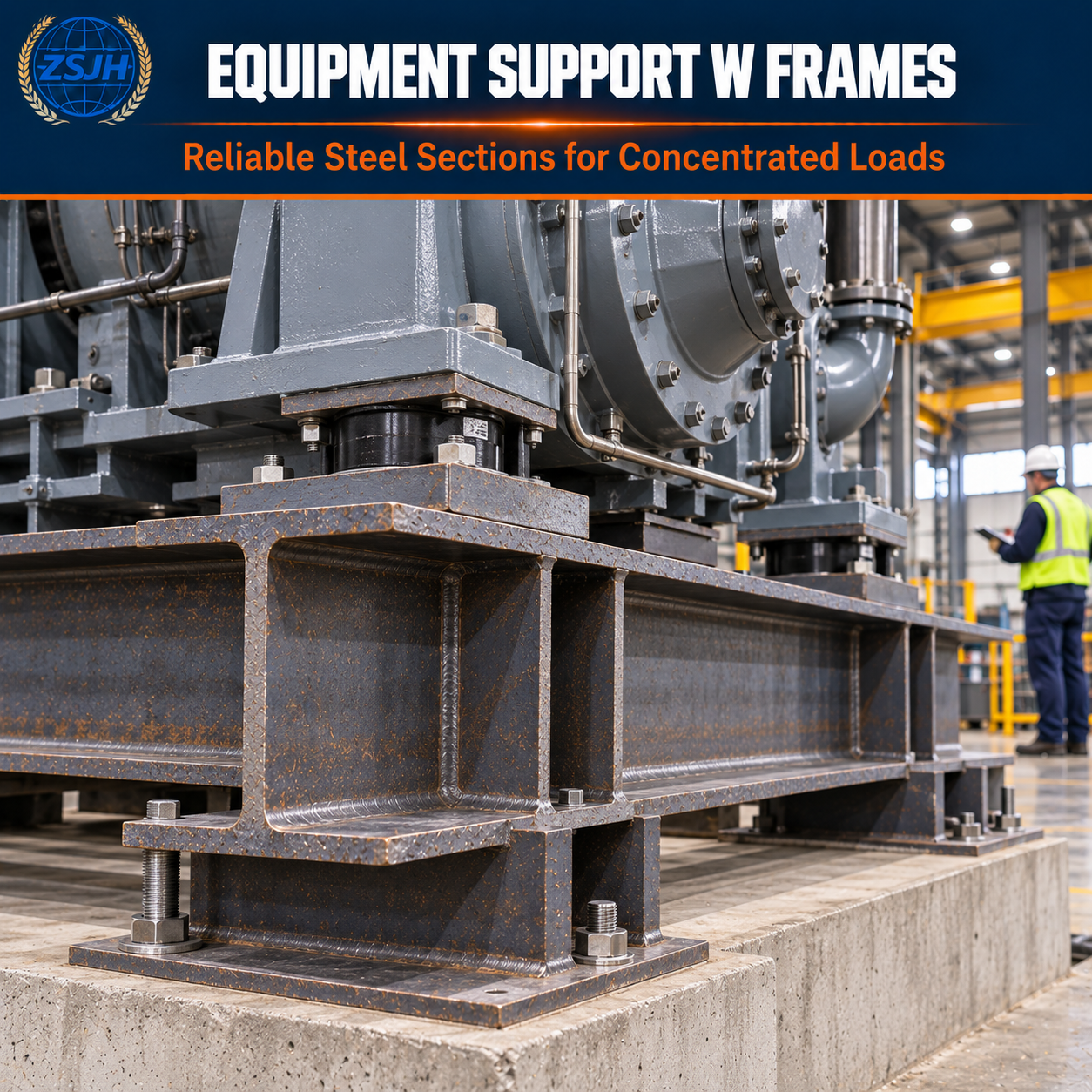
Heavy equipment-support structures
Compressor and pump supports
Turbine-support frames
Industrial pipe racks
Cable-tray support systems
Material-handling structures
Conveyor support frames
Transfer towers
Industrial mezzanines
Mill buildings
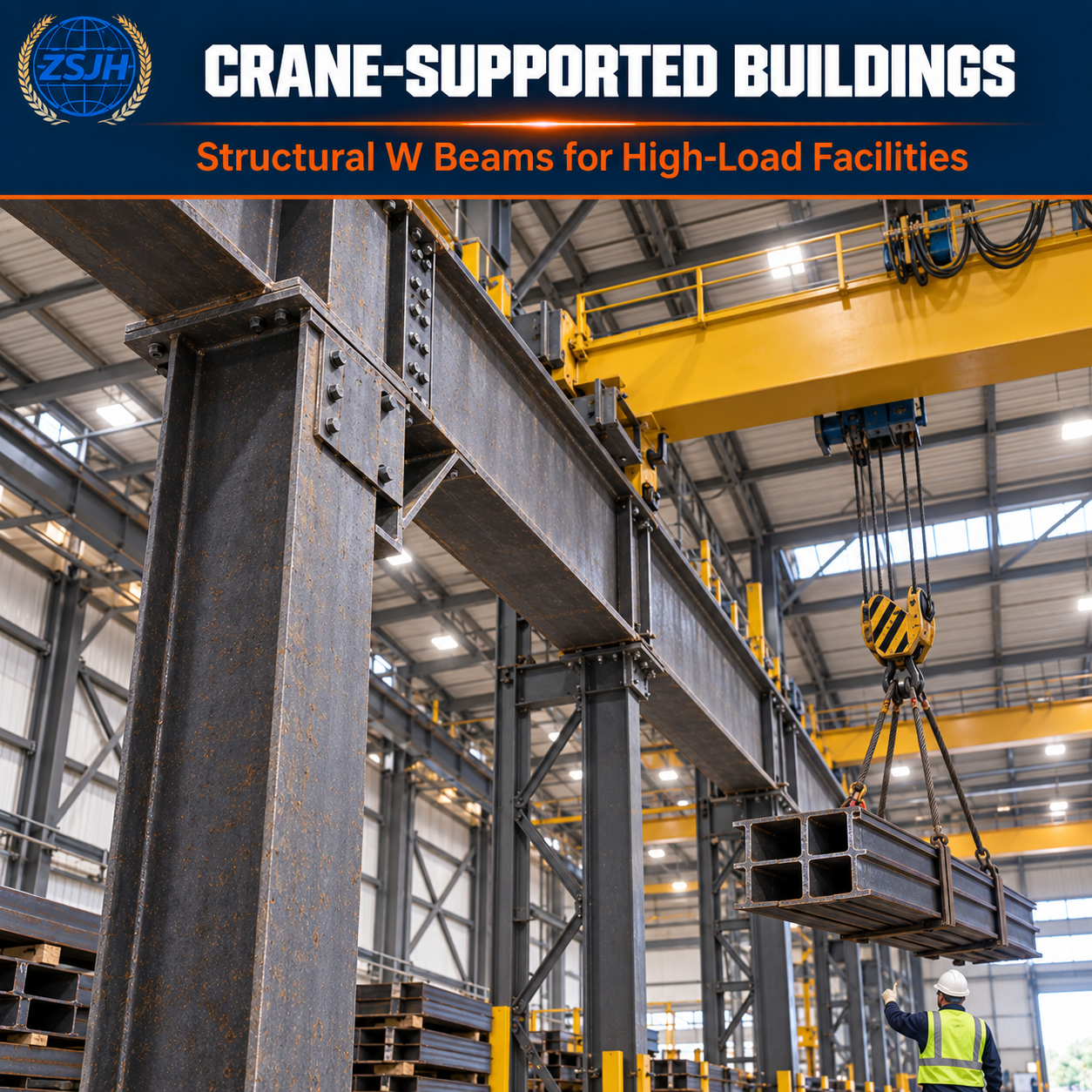
Crane-supported buildings
Heavy warehouse structures
Utility-support frames
Mining and bulk-material facilities
General high-load steel structures
These W beams are suitable for industrial projects requiring increased structural strength, standardized W-shape geometry and fabrication-ready steel components.
They may be considered for:
New industrial plant construction
Production-line expansion
Process-facility upgrades
Heavy-equipment installation
Utility and pipe-rack projects
Material-handling facilities
Industrial building extensions
Structural reinforcement
Fabricated steel modules
International projects using ASTM specifications
Final suitability must be verified through structural calculations and project-specific engineering.
Member selection must consider the permanent weight of the structure, equipment, piping, platforms and other supported components.
Machinery, conveyors and process equipment can introduce operating forces that are not represented by equipment weight alone.
Equipment feet, bearings, pipe supports and crane brackets can generate concentrated forces. Web stiffeners, bearing plates or local reinforcement may be required.
Rotating machinery, material-handling systems and cranes can produce dynamic amplification, vibration and impact loads.
Repeated loads from machinery, cranes or process equipment may create fatigue-sensitive conditions. Welded attachments and connection geometry require careful detailing.
A member may have sufficient strength but still experience unacceptable deflection or vibration. Equipment alignment and operating performance can require stricter serviceability limits.
A W beam with an insufficiently restrained compression flange may move laterally and twist under load. Unbraced length and restraint conditions must be considered.
W-shape columns require checks for axial strength, combined bending, effective length and buckling about both principal axes.
Chemical fumes, humidity, outdoor weather and industrial contaminants may require an enhanced coating system.
ASTM A572 Grade 50 is not fireproof. Fire-resistant protection or special engineering may be required for elevated-temperature environments.
In process plants, W beams can form structural bays that support:
Piping systems
Cable trays
Access platforms
Process vessels
Pumps
Compressors
Heat exchangers
Maintenance equipment
Modular process units
The design must consider piping reactions, thermal movement, equipment vibration, accidental loads and maintenance access.
W beams and columns are frequently used in industrial pipe-rack structures.
Pipe-rack design should consider:
Pipe dead load
Operating contents
Insulation
Thermal expansion
Friction forces
Anchor loads
Wind and seismic actions
Cable-tray loads
Maintenance loads
Future pipe additions
Pipe loads should be provided by the piping engineer and coordinated with the structural design.
Wide-flange beams can support heavy industrial equipment when appropriately reinforced and connected.
Important design factors include:
Equipment operating weight
Center of gravity
Mounting-point locations
Start-up and shutdown forces
Vibration frequency
Dynamic amplification
Anchor-bolt forces
Maintenance and replacement loads
Deflection and alignment limits
Bearing plates, stiffeners or additional bracing may be required under concentrated equipment loads.
W-shape columns and framing members may form part of crane-supported industrial buildings. However, the crane rail, runway girder, brackets and building frame have different structural functions.
The design should consider:
Crane capacity
Vertical wheel loads
Impact allowance
Horizontal surge
Longitudinal braking force
Fatigue cycles
Runway alignment
Local flange and web forces
Building-frame stability
Maintenance access
A standard W beam should not be used as a crane runway member without specialized engineering.
Steel is produced to meet the chemical-composition and mechanical-property requirements of ASTM A572 Grade 50.
The molten steel is cast into blooms or beam blanks suitable for structural-section rolling.
The feed material is reheated under controlled furnace conditions.
High-pressure water removes oxide scale before the main rolling stages.
The heated steel passes through roughing stands to create the preliminary section geometry.
Horizontal and vertical rolls progressively form the broad flanges, central web and root fillets of the W-shape.
The sections are cooled under controlled conditions to support stable dimensions and mechanical properties.
Mechanical straightening controls sweep, camber and longitudinal alignment.
Finished sections are cut into standard mill lengths or customized project lengths.
Material identification, dimensions, length, straightness and surface condition are checked.
Cutting, drilling, coping, welding, cambering and surface preparation can be performed according to approved drawings.
Finished beams are marked, supported and secured for transportation.
ZSJH can coordinate:
Fixed-length saw cutting
Mitre cutting
CNC beam drilling
Bolt-hole processing
Slotted-hole processing
Beam-end coping
Web and flange notching
Shear-tab welding
End-plate installation
Base-plate welding
Cap-plate welding
Bearing-plate installation
Transverse stiffeners
Longitudinal stiffeners
Bracket fabrication
Beam cambering
Shot blasting
Primer application
Finish painting
Hot-dip galvanizing, subject to design review
Component identification
Export packaging
All fabricated components should be produced according to approved shop drawings and specified tolerances.
Send us your required W-shape designation, ASTM A572 Grade 50 specification, length, quantity, fabrication drawings, surface-treatment requirements and destination port. ZSJH Steel will review your requirements and provide a tailored quotation for your industrial project.


